Weekly StatSheet For The ETF Tracker Newsletter – Updated Through 04/16/2020

Ulli ETF StatSheet Contact

ETF Data updated through Thursday, April 16, 2020

Methodology/Use of this StatSheet:

1. From the universe of over 1,800 ETFs, I have selected only those with a trading volume of over $5 million per day (HV ETFs), so that liquidity and a small bid/ask spread are assured.

2. Trend Tracking Indexes (TTIs)

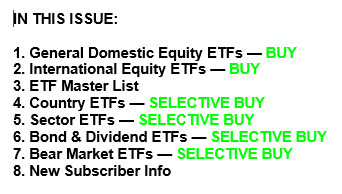
Buy or Sell decisions for Domestic and International ETFs (section 1 and 2), are made based on the respective TTI and its position either above or below its long-term M/A (Moving Average). A crossing of the trend line from below accompanied by some staying power above constitutes a “Buy” signal. Conversely, a clear break below the line constitutes a “Sell” signal. Additionally, I use a 7.5% trailing stop loss on all positions in these categories to control downside risk.

3. All other investment arenas do not have a TTI and should be traded based on  the position of the individual ETF relative to its own respective trend line (%M/A). That’s why those signals are referred to as a “Selective Buy.” In other words, if an ETF crosses its own trendline to the upside, a “Buy” signal is generated. Since these areas tend to be more volatile, I recommend a wider trailing sell stop of 7.5% -10% depending on your risk tolerance.

If you are unfamiliar with some of the terminology, please see Glossary of Terms and new subscriber information in section 9.     

1. DOMESTIC EQUITY ETFs: SELL — since 02/27/2020

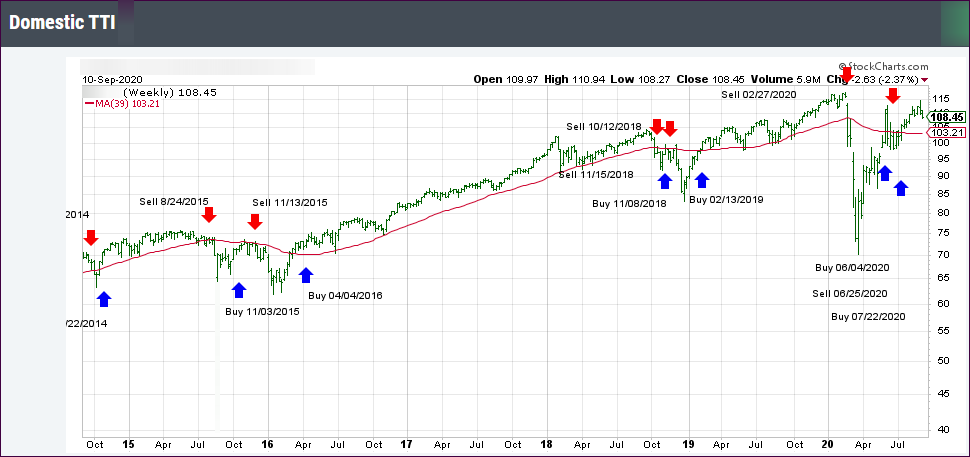
Click on chart to enlarge

Our main directional indicator, the Domestic Trend Tracking Index (TTI-green line in the above chart) is now positioned below its long-term trend line (red) by -15.42% after having generated a new Domestic “Sell” signal effective 2/27/20 as posted.

Read More

Jobless Claims Soar—Markets Dump And Pump

Ulli Market Commentary Contact

Jobless Claims Soar—Markets Dump And Pump

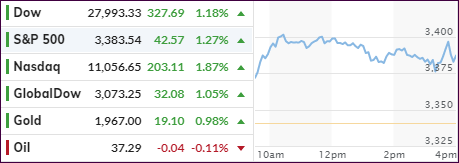
[Chart courtesy of MarketWatch.com]
  1. Moving the markets

The major indexes went on another roller coaster ride but managed to eke out a green close. Today’s jobless numbers were almost as bad as last week’s with 5.245 million new filings for unemployment benefits, but at least this was in line with expectations.

However, when looking at the big picture, this means that, as ZeroHedge explains, the four-week total is now up to 22.025 million, which is over 10 times the prior worst four-week period in the last 50-plus years. Subsequently, the last week’s “initial” and this week’s “continuing” claims are at the highest level as per Bloomberg’s chart.  

We will have to wait and see what this will do to the unemployment rate, but early forecasts point to a range of 17-20%.

What’s most concerting, however, is that in the last four weeks, more Americans have filed for unemployment than jobs gained during the last decade since the end of the Great Recession (22.13 million gained in a decade, 22.025 million lost in 4 weeks.)  

While the markets tumbled early on, hope prevailed that U.S. and European leaders will begin reopening their economies, although I think that will be slow process. Initially markets may jump at that fact, once it happens, but possibly head south again, as reality sets in that a V-shape type of recovery will not be in the cards and the actual upturn will be anything but speedy.

As Bloomberg points out, Macro Economic data took a steep dive and earnings expectations are collapsing, a serious issue, which so far has been conveniently overlooked by computer algos and traders alike. These things don’t seem to matter, until one day they do.

To confirm that fundamentals no longer matter, ZeroHedge noted:

Over the last four weeks, on days the initial jobless claims data has been released and Americans have lost over 22 million jobs, the S&P 500 has actually rallied (+6.2%, +2.3%, +1.4%, and +0.6%), and Nasdaq 100 (+5.72%, +1.99%, +0.11%, and +2.0%).

Does that make sense to you?

Read More

Reality Strikes Markets—Earnings And Econ Data Slammed

Ulli Market Commentary Contact

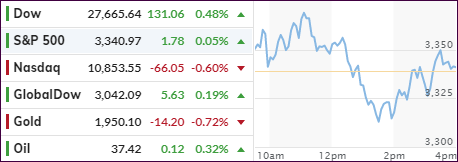
[Chart courtesy of MarketWatch.com]
  1. Moving the markets

Even the news scanning computer algos could not prevent an early market dump, as a variety of headlines confirmed what had been feared most, namely, an economic breakdown in a variety of sectors.

Here’s a random capture of titles that caught my attention:

  1. Homebuilder Sentiment Collapses As Mortgage Purchase Apps Plunge To Lowest In 5 Years
  2. US Industrial Production Crashes By Most Since End Of World War II
  3. Retail Icon JC Penney Prepares To File For Bankruptcy Protection
  4. Empire State Manufacturing Crashes Most Ever To -78, Lowest In History
  5. US Retail Sales Crash By Most Ever In March, Despite Hoarding
  6. BofA Profit Plunges 45% On $4.8 Billion In Expected Credit Losses
  7. JPM Sees Global Profits “Cratering” 70% In Q2
  8. Over 25% of Michigan Workforce Filed For Unemployment

Given that, you might have expected the Dow, as well as the markets in general, to plunge a multiple of what it did early on, but no, we saw a rebound late in the session recouping some of the early losses and closing this day only mildly in the red.

Economist Jason Thomas acknowledged some of the reality and summed it up like this:

“I think we’re in for a very rough time in the markets for the next couple of months, we are just now starting to get hard data, but it’s for March. What we are living through in April is much worse.”

Yes it is, but in regards to markets, the Fed has made it very clear that there are to be no losers—or at least that one does not have to bother trying to pick winners, an attitude that even the trillion dollar giant Blackrock has adopted:

“We will follow the Fed and other central banks by purchasing what they’re purchasing, and assets that rhyme with those.”

With so much market idiocy going on, I liked ZeroHege’s conclusion:

Of course, this state of affairs works… until it doesn’t, as the USSR demonstrated so vividly:

How much further can we take the dichotomy of bull markets as we head to 10%, 15%, or perhaps 25% unemployment? Let’s test the structure in a teleological manner. Can everyone lose their jobs or be paid to do nothing, and all activity stop except that of the government, but everything still remains happy in markets, because the Fed will just keep setting the price of assets? I believe we tried that from the 1930s up to 1991 (“We pretend to work, and they pretend to pay us”), and it didn’t work out so well for those on the receiving end of it.

Read More

Hope Of A Reopening Economy Powers Markets

Ulli Market Commentary Contact

[Chart courtesy of MarketWatch.com]
  1. Moving the markets

Hope of a reopening of the economy kept the bullish theme alive with the computer algos feasting on the latest news that the worst human toll of the coronavirus may have passed.

ZeroHedge summed it up like this:

In case stocks needed another reason to soar higher with 20% unemployment, 30% mortgage defaults, GDP about to print at -40%, cratering corporate profits, JPMorgan profit crashing 69% with Jamie Dimon warning of a “severe recession”, Boeing delivered moments ago when the company reported that customers cancelled a record number of orders for the 737 Max lead balloon last month, deepening the crisis the company faces between the coronavirus pandemic which has virtually frozen all commercial air flight and the continued grounding of its best-selling plane after two fatal crashes.

We’re staring the most likely worst ever earnings season in the face, and the markets rally, because fundamentals no longer matter, as I have repeatedly noted. Analyst Bill Blain sees it like this:

Massive monetary stimulus through QE Infinity, and unlimited fiscal support via the promise of sector and company bailouts and nationalizing payrolls, have fueled the market’s expectations rally. NOT BECAUSE OF A STRONGER ECONOMIC OUTLOOK OR RISING COMPANY RESULTS. Distortion and disconnect is not sustainable long-term (although it’s pretty much fueled markets since 2009).

The expectation is Central Banks can’t allow a market meltdown. Follow the Fed… you won’t lose.

Right now, the focus remains on the reopening of the economy with some erroneously expecting this to be like flipping a switch and voila… there is a V-shaped recovery, while the second half of the year already has some sort of normalcy priced in.

I think it will be a slow process, much slower than expected, of getting back to normal. I simply do not believe that people will rush out to restaurants or get involved in large gatherings the moment the shutdown is lifted.

Even Neel Kashkari, the head of the Federal Reserve Bank on Minneapolis, painted a gloomy, or let’s call it more realistic, picture via these comments:

“America should be ready for 18 months of shutdowns in ‘long, hard road’ ahead.”

“This could be a long, hard road that we have ahead of us until we get to either an effective therapy or a vaccine. It’s hard for me to see a V-shaped recovery under that scenario.”

Be that as it may, with the Fed being in full support mode of the markets, we could very well see the return to a bullish cycle, or, we could witness a total breakdown with the a visit of the March lows being a real possibility.

That’s why we must make sure that we don’t succumb to the desire of bottom fishing but be patient and wait, until the odds have improved and our Trend Tracking Indexes (section 3) are signaling the green light again.  

Read More

Slumping Into Earnings Season

Ulli Market Commentary Contact

[Chart courtesy of MarketWatch.com]
  1. Moving the markets

In case you missed it or got confused by last week’s efforts by the Fed to rescue the markets via an alphabet soup of emergency measures, analyst and author Graham Summers put together an easy to understand summary:

On Thursday the Fed announced a $2.3 trillion (with a “T”) monetary program.

In its simplest rendering, the Fed announced it would expand its current Quantitative Easing (QE) programs for municipal bonds, asset backed securities, and investment grade corporate debt. The Fed also announced it would begin buying junk bonds for the first time in history.

Thus, the Fed is now intervening directly in:

1)    The Treasury markets.

2)    The municipal bond markets.

3)    The corporate bond markets (both investment grade and junk).

4)    The commercial paper markets (short-term corporate debt market).

5)    The asset backed security market (everything from student loans to Certificates of Deposit and more).

At this point the only asset classes the Fed isn’t buying outright via a QE program are stocks and commodities. It is, however, worth noting that the Fed is buying bond Exchange Traded Funds or ETFs which trade on the stock market just like regular stocks.

Again, the Fed has effectively nationalized the U.S. debt markets. All in the span of just six weeks.

It is almost impossible to express the insanity of this. Perhaps the easiest way would be to say the Fed just printed the GDP of Brazil in last six weeks and is planning on printing the GDP of France in the next six weeks.

The multitrillion dollar question now is if this will stop the meltdown triggered by the economic shutdown in the U.S.

Of course, it is possible that these monetary efforts will stoke the market fire for a while, but the durations of it is questionable. As trend followers, we are less concerned with the “why’s” of a rally but more so that it penetrates our dividing line between bullish and bearish territory not only to the upside but also by a clear margin.

That would signal a new “Buy” for domestic equity ETFs, however, the duration of which is always an unknown. Right now, we have a way to go before such a signal will materialize, as you can see in section 3 below.

My point simply is that the newly created trillions of dollars could certainly drive equities against all fundamental valuations to a point of creating a new bullish theme for us. The recent stimulus has helped the markets bounce off their recent lows by an amazing 25%, despite some of the worst economic settings. This TV screenshot makes this abundantly clear.

Tumbling into another week best describes today’s action with the question in my mind being this one: Can the Fed and its continued stimulus efforts offset what is sure to be a miserable upcoming earnings season?

Read More

ETFs On The Cutline – Updated Through 04/09/2020

Ulli ETFs on the Cutline Contact

Below, please find the latest High-Volume ETF Cutline report, which shows how far above or below their respective long-term trend lines (39-week SMA) my currently tracked ETFs are positioned.

This report covers the HV ETF Master List from Thursday’s StatSheet and includes 322 High Volume ETFs, defined as those with an average daily volume of more than $5 million, of which currently 42 (last week 32) are hovering in bullish territory. The yellow line separates those ETFs that are positioned above their trend line (%M/A) from those that have dropped below it.

Take a look:                                                                   

The HV ETF Master Cutline Report

In case you are not familiar with some of the terminology used in the reports, please read the Glossary of Terms. If you missed the original post about the Cutline approach, you can read it here.