Iran Nuclear Pact Ends—Major Indexes Unchanged

Ulli Market Commentary Contact

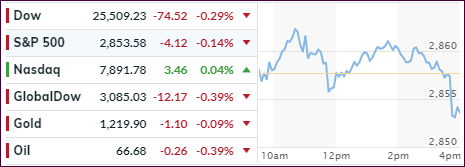
[Chart courtesy of MarketWatch.com]
  1. Moving the markets

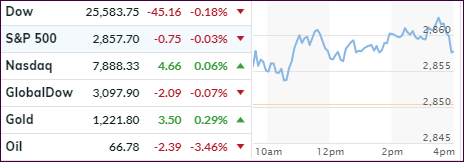
The much awaited and hyped up announcement by President Trump regarding the Iran nuclear pact had the major indexes, which hovered below their respective unchanged lines all morning, dipping down at first but managing to rebound to close essentially unchanged. Trump confirmed withdrawal from the pact and announced “the highest level of sanctions against Iran.”

While details were lacking, the markets pretty much took it in stride—so far—with most of the volatility occurring in the oil sector. The defense arena benefited as Israel bomb shelter headlines seem to play the drums of war. Domestically, Transportations lead with +0.76%, followed by Semiconductors and SmallCaps with +0.70% and +0.49% respectively.

Helping the markets gain some footing, after Trump’s announcement, was the VIX, which got pushed down to the 14 level thereby making sure that the Iran uncertainty supported the bulls and not the bears. Interest rates rose slightly with the 10-year bond yield creeping closer the 3% level, while the US Dollar (UUP) kept his recent strength alive by gaining +0.37%.

I don’t the market reaction to the Iran drama is over yet, and we’ll have to see how things play out over the next few days.

Read More

Trimming Early Gains

Ulli Market Commentary Contact

[Chart courtesy of MarketWatch.com]
  1. Moving the markets

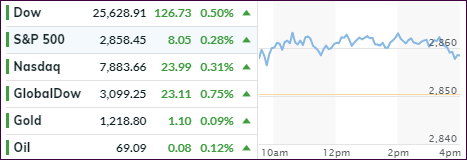
Last Friday’s winning ways continued this morning with the major indexes moving sideways but comfortably above the unchanged line. Then the Iran headlines appeared about Trump promising a decision tomorrow at 2 pm as to whether to de-certify the 2015 Iran nuclear pact and re-impose sanctions, which would hamper oil exports and interrupt the global supply chain.

That took the starch out of the rally and south we went, but the major indexes managed a green close. The S&P 500 dipped below its 200-day M/A on Friday but recovered and closed above it, while today, the index climbed above its 50-day M/A but closed below it. We’re still stuck in a wide sideways pattern, out of which we will eventually break out—either to the upside or to the downside.

Last week’s China trade headlines were in focus again, even though they resulted in no agreement after several days of talks other than Chinese news outlets reporting that “talks were positive” but more jawboning was needed to avoid a trade war. The markets were not affected, but this may change once the Trump/Iran deadline will have passed and other negative news reports become the main focus for the bears on Wall Street again.

Read More

ETFs On The Cutline – Updated Through 05/04/2018

Ulli ETFs on the Cutline Contact

Below please find the latest High Volume ETFs Cutline report, which shows how far above or below their respective long-term trend lines (39 week SMA) my currently tracked ETFs are positioned.

This report covers the HV ETF Master List from Thursday’s StatSheet and includes 366 High Volume ETFs ETFs, defined as those with an average daily volume of more than $5 million, of which currently 173 (last week 196) are hovering in bullish territory. The yellow line separates those ETFs that are positioned above their trend line (%M/A) from those that have dropped below it.

Take a look:

The HV ETF Master Cutline Report

In case you are not familiar with some of the terminology used in the reports, please read the Glossary of Terms.

If you missed the original post about the Cutline approach, you can read it here.

ETF Tracker Newsletter For May 4, 2018

Ulli ETF Tracker Contact

ETF Tracker StatSheet

https://theetfbully.com/2018/05/weekly-statsheet-for-the-etf-tracker-newsletter-updated-through-05-03-2018/

 FRIDAY SAVES THE WEEK

[Chart courtesy of MarketWatch.com]
  1. Moving the markets

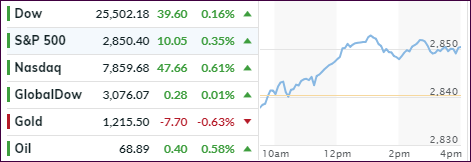
After slipping and sliding all week, the bulls finally regained some strength and pulled the major indexes out of the doldrums with the S&P 500 almost getting back to last Friday’s close.

The big mover was Apple, which was responsible for some 50 points of the Dow’s 332 point gain, for no reason other than reports that Warren Buffett bought 75 million shares. Apple not only surged to record highs but also helped the Dow to score its best day in 3 weeks after having fallen in 9 of the past 13 sessions.

This helped traders to shove reports of tense China trade talk negotiations on the back burner, but I am sure it will be moved to headline news again next week once concrete results emerge.

Of course, a rebound rally would not be complete without input from the Fed. Two of their mouthpieces appeared to cheer on the markets.

First, it was John Williams who declared that they are “comfortable overshooting 2% inflation for a while,” which was followed by Bill Dudley’s “I don’t think the Fed cares about financial markets per se.” That was enough to overshadow any weakness caused by the weaker-than-expected April non-farm payroll report, which some analysts graded with a “C-.”

On the week, the major indexes and bonds were saved by closing just about unchanged, helped in part today by the fact that shorts were squeezed and had to cover resulting in the Dow and S&P 500 now having successfully bounced off their 200-day M/As—again, thereby extending the bullish theme a little while longer.

Read More

Weekly StatSheet For The ETF Tracker Newsletter – Updated Through 05/03/2018

Ulli ETF StatSheet Contact

ETF Data updated through Thursday, May 3, 2018

Methodology/Use of this StatSheet:

  1. From the universe of over 1,800 ETFs, I have selected only those with a trading volume of over $5 million per day (HV ETFs), so that liquidity and a small bid/ask spread are assured.
  2. Trend Tracking Indexes (TTIs)

Buy or Sell decisions for Domestic and International ETFs (section 1 and 2), are made based on the respective TTI and its position either above or below its long-term M/A (Moving Average). A crossing of the trend line from below accompanied by some staying power above constitutes a “Buy” signal. Conversely, a clear break below the line constitutes a “Sell” signal. Additionally, I use a 7.5% trailing stop loss on all positions in these categories to control downside risk.

  1. All other investment arenas do not have a TTI and should be traded based on the position of the individual ETF relative to its own respective trend line (%M/A). That’s why those signals are referred to as a “Selective Buy.” In other words, if an ETF crosses its own trendline to the upside, a “Buy” signal is generated. Since these areas tend to be more volatile, I recommend a wider trailing sell stop of 7.5% -10% depending on your risk tolerance.

If you are unfamiliar with some of the terminology, please see Glossary of Terms and new subscriber information in section 9.


  1. DOMESTIC EQUITY ETFs: BUY — since 4/4/2016

Click on chart to enlarge

Our main directional indicator, the Domestic Trend Tracking Index (TTI-green line in the above chart) is positioned above its long-term trend line (red) by +0.75% after having generated a new Domestic Buy signal effective 4/4/2016 as posted.

Read More

Trade Worries Dump And Then Pump The Major Indexes

Ulli Market Commentary Contact

[Chart courtesy of MarketWatch.com]
  1. Moving the markets

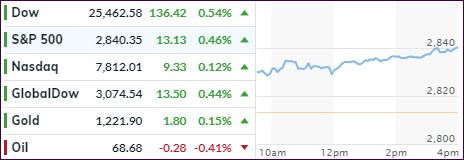
Another wild day in the markets pulled the major indexes way below the unchanged line with the Dow sinking some 400 points and the S&P 500 dropping below its 200-day M/A.

The cause of all this were the 2-day trade negotiations with China that had traders on edge when suddenly White House economist Calabria commented after day 1 that “he was ‘optimistic’ and that the US has ‘discreetly’ given China a list of asks and that the day ended “pretty positive.” That’s all Wall Street wanted to hear and off to the races we went.

What they did not want to hear and simply ignored, and may backfire later on, was Cambria’s conclusion that “the tough part in the talks is ensuring that China keeps its promises.” No joint statement was given at the end of the first day.

Be that as it may, only the Dow climbed back into the green, while the S&P and Nasdaq fell short. Nevertheless, despite the recovery, technical damage was done as the 200-day M/As were violated to the downside intra-day, the Dow and S&P managed to close back above it.

We’ll have to wait and see if this constant testing of the 200-day M/As will eventually cause a permanent break to the downside, which is sure to come with bearish consequences.

Read More