Below, please find the latest High-Volume ETF Cutline
report, which shows how far above or below their respective long-term trend
lines (39-week SMA) my currently tracked ETFs are positioned.
This report covers the HV ETF Master List from Thursday’s
StatSheet and includes 322 High Volume ETFs, defined as those with an average
daily volume of more than $5 million, of which currently 20 (last week 31) are
hovering in bullish territory. The yellow line separates those ETFs that are
positioned above their trend line (%M/A) from those that have dropped below it.
In case you are not familiar
with some of the terminology used in the reports, please read the Glossary of Terms.
If you missed the original
post about the Cutline approach, you can read it here.
Despite
an early bounce along the green side of the unchanged line, reality set in,
supported by the always unpredictable quad options expirations day, sending the
markets reeling—again.
The
major indexes were hammered, with the S&P 500 getting skunked by -15%—for
the week! Not helping matters late in the day was the fact that a death-cross in
the Dow had occurred, meaning its 50-day moving average had dropped below its
200-day M/A, which can be a sign of more weakness ahead.
Of
course, some clueless analysts were quick to point out that the last death
cross appeared three days before the Christmas Eve 2018 bottom. So, what difference
does that make? All the gains from that point forward have now been given back
and then some, which is a clear representation of the buy-and-hold idiocy.
ZH
points to the fact that today was a historic one. The Fed bought a record $107
billion in securities today alone, as its balance sheet exploded some 50% in
the last six months. It becomes clearer by the day that the Fed’s scramble to stabilize
the Treasury market is not working.
As
I said before, there is some big player (to be named later), like a bank or Hedge
fund, that got caught on the wrong side of a severely leveraged trade and needs
to be bailed out. Hence the monetization of various securities, including now
the Muni bond market. Something appears to be broken beyond repair, and I am
sure we will find out soon what it is.
ZH
added more color:
This
was the worst week since Lehman (and worst 4 weeks since Nov 1929) for The Dow
Jones Industrial Average…(Dow was down 18% during the Lehman week and 17.35%
this week), despite The Fed gushing a stunning $307 billion into the markets –
almost double its previous biggest liquidity injection (in March 2009)…
And
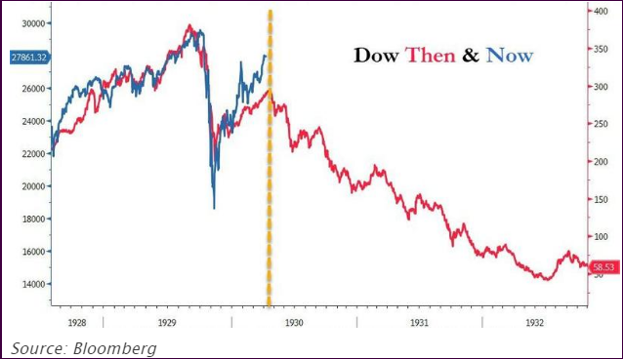
here’s Bloomberg’s updated chart
showing where we might be going, and that is towards the 1,700 level on the S&P
500. And longer term, we may even see history
repeat itself.
In
the meantime, enjoy the popcorn while watching this movie from the sidelines.
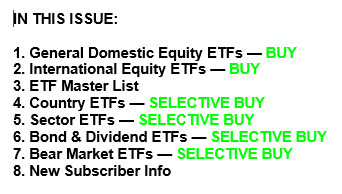
1. From the universe of over 1,800 ETFs, I have selected only those with a
trading volume of over $5 million per day (HV ETFs), so that liquidity and a
small bid/ask spread are assured.
2. Trend Tracking Indexes (TTIs)
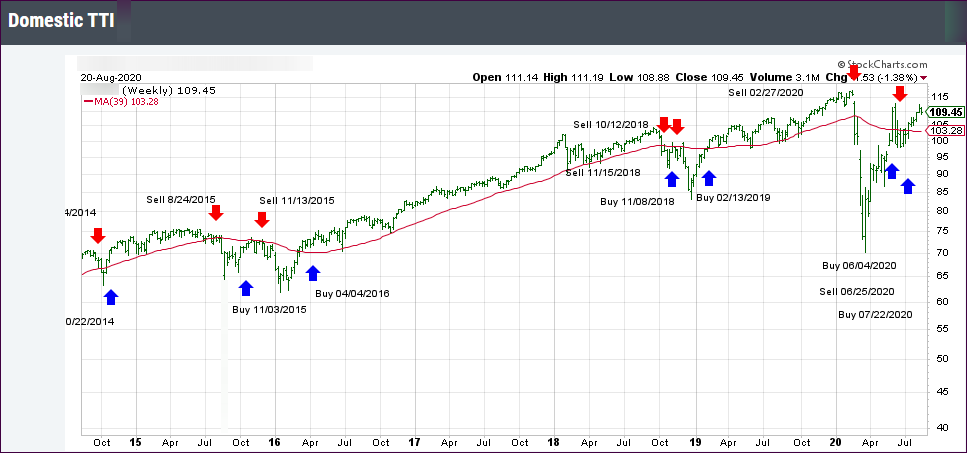
Buy or Sell decisions for Domestic and International ETFs (section 1 and
2), are made based on the respective TTI and its position either above or below
its long-term M/A (Moving Average). A crossing of the trend line from below
accompanied by some staying power above constitutes a “Buy” signal. Conversely,
a clear break below the line constitutes a “Sell” signal. Additionally, I use a
7.5% trailing stop loss on all positions in these categories to control
downside risk.
3. All other investment arenas do not have a TTI and should be traded
based on the position of the individual
ETF relative to its own respective trend line (%M/A). That’s why those signals
are referred to as a “Selective Buy.” In other words, if an ETF crosses its own
trendline to the upside, a “Buy” signal is generated. Since these areas tend to
be more volatile, I recommend a wider trailing sell stop of 7.5% -10% depending
on your risk tolerance.
If you are unfamiliar with some of the terminology, please see Glossary of Termsand new subscriber information in section 9.
1. DOMESTIC EQUITY ETFs: SELL
— since 02/27/2020
Click on chart to enlarge
Our main directional indicator, the Domestic Trend Tracking Index (TTI-green line in the above chart) is now positioned below its long-term trend line (red) by -27.99% after having generated a new Domestic “Sell” signal effective 2/27/20 as posted.
Last night, the futures fluctuated wildly with that theme
continuing throughout today’s trading day with the major indexes swinging around
their respective moving averages.
It appears that traders tried to figure out the possible consequences
of the all-out “kitchen sink” approach by the global central banks. It’s hard to
keep track of all their efforts to prop up the markets, but ZH managed to
compile this summary:
Fed announced a new emergency program
(MMLF) to aid money markets
ECB “no limits” bazooka (“Pandemic
Purchase Program w/ $820B of QE)
RBA 25bps cut to ELB, introduces QE and
targeted YCC
Japan discussing $276B packed including
“cash payouts” to households
S Korea new $40B package
Brazilian 50bps rate cut
US Senate passes 2nd stimulus bill and
negotiating the 3rd ($1.3T)
Fresh headlines from Bloomberg *GERMANY
MAY AUTHORIZE EMERGENCY DEBT AS SOON AS NEXT WEEK
BOE emergency rate cut to 0.1% and
GBP200BN QE expansion
The most recognized one was the ECB’s launch of Bazooka
#2, but we’ll have to wait and see if this thing will really produce the desired
result, or simply resemble a squirt from a water pistol.
The Fed, on the other hand, has now boosted its daily QE
by 66% overnight to a record $75 billion, and that is in ONE day. For comparison,
in the “good old days,” QE was less than that in ONE Month.
What this tells me is that the financial plumbing is
showing some serious leaks, which means some big players, be it hedge funds or
banks, are likely caught on the wrong side of a trade and are in dire straits
of a bailout. I am sure we will find out soon who these suspects are.
Still, we remain in a bear market for the foreseeable future.
While no one knows where the eventual bottom will be, a temporary stopping
point in this slide could be once the S&P’s price matches up with reality,
AKA US corporate profits, as Bloomberg presents in this
chart. For the S&P, that would mean a level of around 1,700, which would
be down another 30% from current prices. Ouch!
Looking at the big picture, not only have global markets
seen $25 trillion of monopoly money, AKA “paper” wealth, erased over the past 4
weeks, the bear has also annihilated all gains from the December 2018 crash;
that is for those in the buy-and-hold community.
In the meantime, the major indexes managed to eke out a
small gain with the Nasdaq faring the best with +2.30%, but for the week, the
Dow is the worst performer: Down by -13%.
So much for yesterday’s rebound of “hope,” which got annihilated,
as the major indexes took another step down. At one point, the Dow even lost
its 19k level, while the S&P dropped below 2.3k, but both were pushed back up
thanks to a bounce off their lows during the past 30 minutes.
Those buy-and-holders, which were hoping for the bond portion
of their portfolios to bail them out, were disappointed again, as yields rose, with
the 10-year being up almost 11 basis points to 1.19%, thereby exerting a double
whammy loss on portfolios still exposed to this insanity.
It’s no surprise that the cause of this upheaval is the fallout
from the coronavirus, as nations are shutting down, major corporations and businesses
struggling and looking for bailouts, while the banking sector is about to experience
some major pain, and possible failures, as above businesses may not be able to survive
a sharp drop in revenue, thereby increasing the possibility of defaults. Or,
better said, bank failures may be on the horizon.
Of course, the underlying problems are the same we saw in
2008, as nothing has been fixed, with ZH summing up the problem like this:
And it may come as a shock to some, but ever
since the financial crisis nothing has been actually fixed, and instead the Fed
stepped in at every market stress event to inject more liquidity, aiding the
issuance of even more debt, and kicking the can while helping mask the symptoms
of the crisis, only made the underlying financial instability even more acute.
Meanwhile, conventional wisdom that the US
banking system was rendered more stable now are dead wrong, with the public and
countless financial professionals fooled by the nearly two trillion in excess
reserves (we all saw what happened when this number dropped to a precarious
“low” of “only” $1.3 trillion in September of 2019)
injected by the Fed in recent years. All this liquidity upon liquidity has only
made the system that much more reliant on the Fed’s constant bailouts and
liquidity injections.
With market panic accelerating, and as I pointed out above,
ZH confirmed that today was the worst day ever for a combined equity/bond
portfolio, down -9.87%, as shown in Bloomberg’s chart.
The carnage may have a long way to go, so as trend trackers,
we feel privileged to enjoy a front row seat on the sidelines.
Equities managed a nice bounce today powered higher by news
that the Trump administration asked for a $1 trillion fiscal stimulus package
to mitigate the fallout effects from the coronavirus. News that the Fed moved
to support the commercial paper market via providing short-term funding needs,
also gave an assist and elevated sentiment.
After getting slaughtered yesterday, the major indexes
staged a nice rebound wiping out some of yesterday’s losses yet being far away
from establishing a new bullish trend.
Some of the measures the government is evaluating to help
combat the effects of the virus includes deferral of tax payments, sending checks
directly to the populace, also known as helicopter money, and keeping the financial
markets open and functioning.
Whether all these efforts will have the desired effect
remains to be seen, especially on the Fed’s part, where despite intervention, banking
liquidity worsened. At the same time, the 10-year yield spiked back above 1%, up
a substantial 30bps from the lows of the day. Something still does not make
sense in the overnight lending market.
All this has affected equities, where we have witnessed
3%+ moves in the S&P 500 during 13 of the past 22 trading days, approaching
the October 2008 experience, according to ZH. Systemic risk levels continue to
soar, as Bloomberg points out here.
Safety is number one in my book where, during these trying times, the return of our capital ranks higher than the return on our capital.