Below, please find the latest High-Volume ETF Cutline
report, which shows how far above or below their respective long-term trend
lines (39-week SMA) my currently tracked ETFs are positioned.
This report covers the HV ETF Master List from Thursday’s
StatSheet and includes 322 High Volume ETFs, defined as those with an average
daily volume of more than $5 million, of which currently 33 (last week 20) are
hovering in bullish territory. The yellow line separates those ETFs that are
positioned above their trend line (%M/A) from those that have dropped below it.
In case you are not familiar
with some of the terminology used in the reports, please read the Glossary of Terms.
If you missed the original
post about the Cutline approach, you can read it here.
After
trying to dig themselves out of an early hole, the major indexes dove into the close
and just about touched the lows of the day again, caused by the Fed’s announcement
that it will reduce Treasury QE from $75 billion to $60 billion per day,
thereby removing the much wanted “unlimited QE” from their vocabulary.
Despite
today’s set back, the S&P 500 managed a gain of some 10% for the week with some
pundits claiming this rebound to be the end of the bear market.
As
I posted before, markets don’t work that way, since it is a normal occurrence in
bearish periods to the see reversals of a magnitude, you’ll never experience in
bull markets.
What
we witnessed this week, also serves as a great answer to those who question why
I don’t immediately go short after a trend line break to the downside. It’s too
early for that kind of action due to the ever-present volatility. The idea of nibbling
at short positions comes more into play, once a slow, steady and continued downward
trend has been established.
Despite
Trump being scheduled to sign the government stimulus plan after the close, it
was not enough of an event to keep the bullish theme alive. I expected a pullback
into the weekend. After all, there could be a host of new and negative developments,
not just related to the virus but also to the crisis in the LIBOR
market, that nobody with a clear-thinking mind would want to be caught with
long positions.
So,
was this a sucker’s rally? While that is too early to tell, I must agree with JC
Parets at AllStarCharts, who summed it up like this:
“I
think you have to be a fool to actually think that the stock market moving an
arbitrary 20% in either direction means anything to anyone anywhere in the
world.”
Yes,
it will take a lot more than a 3-day 20% rebound of the temporary bottom,
after the massive fall we’ve seen, to establish a new bullish trend, like broad
participation and a host of moves of less than 1% per day.
So
far, the comparison to the events of 1929/30 are on target, as Bloomberg shows
in this updated
chart. It’s important to note that every drop was followed by a dead-cat-bounce,
until the final low occurred some 2.5 years later.
I
for one am curious to see if history repeats itself.
1. From the universe of over 1,800 ETFs, I have selected only those with a
trading volume of over $5 million per day (HV ETFs), so that liquidity and a
small bid/ask spread are assured.
2. Trend Tracking Indexes (TTIs)
Buy or Sell decisions for Domestic and International ETFs (section 1 and
2), are made based on the respective TTI and its position either above or below
its long-term M/A (Moving Average). A crossing of the trend line from below
accompanied by some staying power above constitutes a “Buy” signal. Conversely,
a clear break below the line constitutes a “Sell” signal. Additionally, I use a
7.5% trailing stop loss on all positions in these categories to control
downside risk.
3. All other investment arenas do not have a TTI and should be traded
based on the position of the individual
ETF relative to its own respective trend line (%M/A). That’s why those signals
are referred to as a “Selective Buy.” In other words, if an ETF crosses its own
trendline to the upside, a “Buy” signal is generated. Since these areas tend to
be more volatile, I recommend a wider trailing sell stop of 7.5% -10% depending
on your risk tolerance.
If you are unfamiliar with some of the terminology, please see Glossary of Termsand new subscriber information in section 9.
1. DOMESTIC EQUITY ETFs: SELL
— since 02/27/2020
Click on chart to enlarge
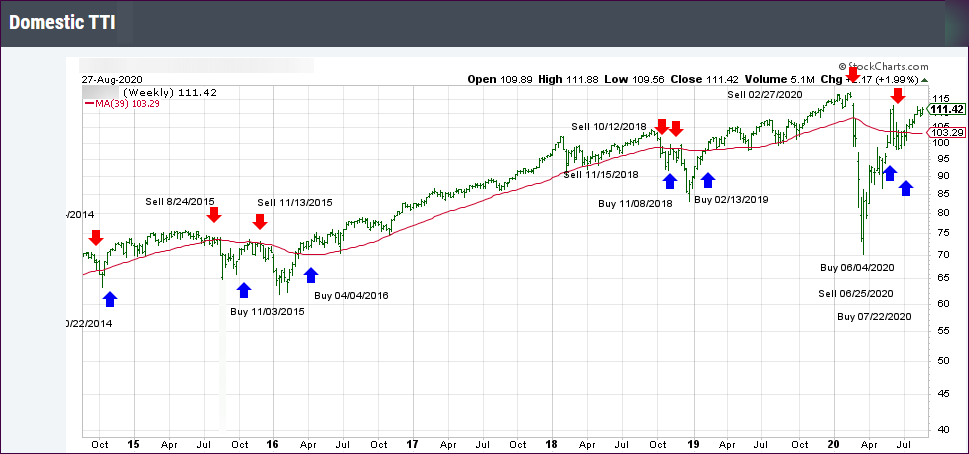
Our main directional indicator, the Domestic Trend Tracking Index (TTI-green line in the above chart) is now positioned below its long-term trend line (red) by -20.91% after having generated a new Domestic “Sell” signal effective 2/27/20 as posted.
Looking at today’s news headlines, you would think we’re back to last year’s theme of “bad news is good news” for the markets.
Here’s a sample of what we faced today:
More Than 500k Covid-19 Cases Diagnosed Worldwide:
“From 0 to 250,000 cases in 4 months. From 250,000 cases to 500,000 cases: 1
week.”
US Vehicle Sales Are Down 50%-75% in March
Oil Plunges
LIBOR Rate Increase Points to One Or
More Banks In Trouble.
Italy Reports Largest Jump In New Cases;
Deaths Decline
Morgan Staley: “We Are Underwhelmed By
This Low Participation Rally”
China Shuts All Border To Foreigners
A Record 3.3 million Americans Just Filed
For Unemployment
Benefits
Considering the above, the markets should have sold off sharply
but just the opposite occurred. A massive rally, right after the opening bell, slowed
down mid-day but was pumped into the close. If that does not make sense to you,
you’re not alone.
Sure, some euphoria over the anticipated stimulus bill, assumed
to be signed tomorrow, kept the bullish mood intact. However, traders’ optimism
was fueled by another powerful force, namely quarter-end rebalancing by the big
boys.
As ZH reports, according to estimates, balanced or 60/40
mutual funds, as well as sovereign wealth funds, representing a US and global
universe of $6 trillion dollars, needed to buy some $850 billion in mandated stocks
to revert to previous equity allocations.
In the end, ZH summarized the day as follows:
Of course, whether or not today’s action is
the result of a giant pension/sovereign wealth fund whale lifting all offers in
what has been the most illiquid market in history…and thus resulting in
overly pronounced moves, won’t be known until the end of the month.
While this rebound is in the books, we will find out soon
if it indeed has staying power once we cross into April.
Right now, given the surge of $3.3 million in unemployment
filings while markets exploding to the upside, makes only sense when
considering the rebalancing efforts by the whales.
That view is further supported by ZH’s commentary pointing
out that “…while the month-end pension rebalance suddenly appeared in the
last 10 minutes of trading, sending the ES up by 40 points in literally one
trade after it emerged that the Market on Close imbalance was $7 billion!
I wonder what will happen once these whales are done
buying.
Another strong rally lost half of its early gains late in
the session, as the upbeat mood waned with some chart watchers confirming what
I said yesterday, namely that big rebounds are not necessarily a sign that a
bottom has been formed.
More importantly, the indexes plunged into the close based
on news that a potential snag in the $2 trillion stimulus package may delay its
adoption and implementation, something that did not go over well on Wall
Street, as urgency to battle the corona virus economic fallout effects have taken
front and center.
Bernie Sanders turned out to be the culprit spoiling the
party by threatening to hold up the rescue package “until stronger conditions
are the imposed on the $500 billion corporate welfare fund.” Who knows how
long that battle will go on?
As a result, it’s a tug-of-war between the hopefully
positive effects of the stimulus plan, once passed, and the negative impact
from the corona virus. I am sure that the stimulus plan will give an assist, but
I doubt that the package is even close to being enough to reverse the damage done,
so I expect more proposals over the next month or so.
Again, as ZH reported, the giant short squeeze continued pushing
the most shorted stocks up by an amazing +21% in two days, which Bloomberg demonstrated
in this
chart.
Overnight, we saw extreme shifts again:
Dow futures show the insane scale of today’s
moves best – a 1000 point surge into yesterday’s close, a failed 1000 point
surge overnight (on the “deal”), another failed 1000 point surge into
and through the cash open, and then a 1500 points surge that almost held into
the close…
With all that uncertainty causing markets to behave in the
most unpredictable manor I have ever seen, the safest place to watch this debacle
unfold is from the sidelines.
The markets finally managed a solid comeback by using nothing
but hope for a $2.5 trillion stimulus package as a springboard with the Dow scoring
its best percentage gain (11%+) since 1933. However, history throws a shadow on
that event, if you look at this
chart and become aware of what happened afterwards.
Optimism grew that congress would come to an agreement on
a giant fiscal package focused on alleviating the devastating economic impact
from the coronavirus.
After the relentless selling of the past 3 weeks, it’s not
unexpected to see such a snap back, as bear markets historically can demonstrate
rebounds of a far greater magnitude than what we see during bull markets. Of course,
as we’ve observed all of last year, the biggest ever short
squeeze gave an assist today with the most shorted stocks soaring 11%,
according to ZH.
While the Fed has gone all out to unleash its stimulus efforts,
as I posted over the past few days, it’s now up to congress to grease the wheels
for fiscal and monetary stimulus to operate in sync.
Does that mean it will work, and the bear market is over?
I don’t believe so, although some MSM reports and a bunch
of traders expect a V-shape type of recovery. While that is possible, I don’t
think its likely, and we must wait and see how markets react, once congress
gives its nod. Let’s hope we don’t witness the old “buy the rumor, sell the
fact” reaction, which can easily put today’s rally back into reverse.
Looking at the analog chart
of 1929, we can clearly recognize that a sharp correction was followed by a
fake 2-month rebound, before bearish tendencies prevailed in a subsequent 2-year
brutal downturn.
Will history repeat itself? Who knows, but no matter how much
of a one-day rebound we experience, it’s most likely not the return to the good
old days.