Chart Patterns

Ulli Uncategorized Contact

Looking at chart patterns can sometimes help identify future market direction. While this obviously is not a perfect science, or a guarantee in any way that things should work out as a pattern indicates, I have seen remarkable consistency with some of them over the past 25 years.

In previous posts, I have referred to some forecasters who include chart patterns in their analysis to view the big picture. One of those patterns that the S&P; 500 is currently generating is a huge head-and-shoulders (H&S;) formation. If you’re not familiar with it, here’s what the picture looks like:


This is a weekly chart, and the head and both shoulders are clearly defined. The theory is that if prices decline from the right shoulder, and break through the neckline (indicated by the red slanting line), that would complete the pattern and lead to lower prices.

The neckline resides currently in the 1,030 area, which means a 10% drop from current prices would get us to that level. With the markets having run up since Labor Day on hopeful economic assumptions, a slide back down could happen in a hurry, should these assumptions be met with disappointment.

Conversely, if prices rally from the top of the right shoulder and end up rising above the high point the “Head” has made (April 2010), all bets are off, and the bullish trend is likely to continue.

While chart patterns such as this one are not an integral part of trend tracking, I use them occasionally to see if I can get a heads-up on future market direction.

No Load Fund/ETF Tracker updated through 9/30/2010

Ulli Uncategorized Contact

My latest No Load Fund/ETF Tracker has been posted at:

http://www.successful-investment.com/newsletter-archive.php

It was a non-directional week, and the major indexes lost slightly.

Our Trend Tracking Index (TTI) for domestic funds/ETFs held above its trend line (red) by +5.78% (last week +5.27%) and remains in bullish mode.


The international index broke back above its long-term trend line by +5.43% (last week +5.57%). A new Buy signal was triggered effective 9/7/10. If you decided to participate, be sure to use my recommended sell stop discipline.


[Click on charts to enlarge]

For more details, and the latest market commentary, as well as the updated No Load Fund/ETF Tracker StatSheet, please see the above link.

Pullback

Ulli Uncategorized Contact


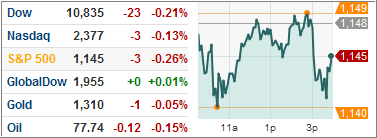
Several bullish attempts to break through last Friday’s close of 1,148 were rebuffed yesterday during a seesaw trading session. It may very well be an indication that upward momentum is either slowing or that this “Labor Day rally” is coming to an end.

Of course, these days you can never be sure as the markets seem to ignore bad news and see only positives in this economic wonderland. I am not sure if the fact that the Fed has announced that QE-2 (Quantitative Easing) is lurking in the background, and will be activated should the need arise, may be sufficient to keep any downside slide limited in scope.

As the above chart by MarketWatch.com shows, last hour buying kept the losses manageable, a phenomenon we have witnessed quite frequently lately. Continuing its relentless upward march was gold, which again hit a new closing high of $1,310. The dollar slipped and interest rates were lower.

Now that it appears that the markets have finally conquered the bad omen of the month of September, barring of course any unexpected events on the last trading day, we are now facing October, which has a similar evil historical record as a bull market killer.

I doubt that the bulls will be able to pull another rabbit out of the hat; however, only time will tell whether this month’s rebound off the lows still has legs. Watch for any trend reversals and be sure to track your trailing sell stops.

Economic Uncertainty Pushes Gold Above $1,300

Ulli Uncategorized Contact


Hardly a day goes by without some piece of data being released, which casts doubt on the economic recovery. Yesterday, the culprit turned out to be a large drop in consumer confidence, although better-than-expected earnings from Walgreen offset the bad news helping the market close higher.

The rally gathered some steam in the last hour of trading as the dollar declined against the yen and the euro.

Causing trouble early on was the Consumer Confidence Index, which slipped to a reading of 48.5 in September from a revised 53.2 in August. That turned out to be the lowest level since February.

It’s no surprise that confidence is waning in the face of no improvement in the labor markets and continued uncertainty whether a double-dip recession can be avoided. For that matter, it’s questionable whether the economy can even stand on its own legs and produce growth without being stimulated.

All that uncertainty helped gold break through the $1,300 level with silver reaching its highest price since 1980.

New data will be closely watched as we head into the final quarter of 2010. At the first sign of more economic weakening, the Fed has promised an assist via Quantitative Easing 2.0; an effort which will be closely scrutinized to see if it can produce any meaningful results.

In the absence of any positive effects, traders on Wall Street may very well reevaluate if these lofty market levels are indeed justified.

Chart courtesy of MarketWatch.com

Slowing Down

Ulli Uncategorized Contact


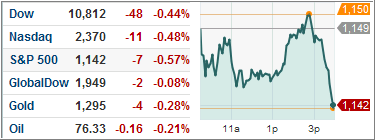
The bulls tried to keep upward momentum going yesterday, but other than a quick peek above the unchanged line, the major indexes meandered in negative territory and closed to the downside.

Profit taking contributed to the sagging of financial stocks in the last hour. Activity was confined within a small trading range, which is not surprising after Friday’s strong breakout above the S&P;’s resistance level.

Europe contributed to the weakness in financials as Moody’s downgraded the rating of Anglo Irish Bank to one level above junk. Also, concerns mounted that banks with sizable brokerage departments might see fewer earnings because of reduced trading volume over the past four months or so.

Bonds rallied, as interest rates were lower with the Treasury selling two-year notes at a record low yield of 0.441%.

If you think that’s a sign of deflation, you are correct, despite of what some of the inflationary worry birds would have you believe. Sure, eventually inflation will be an issue to be reckoned with; however, right nowhere it’s nowhere in sight, despite’s the continued Fed’s attempts to create it.

Chart courtesy of MarketWatch.com

A Lesson From Cuba

Ulli Uncategorized Contact

Bill Fleckenstein presented these interesting economic thoughts a few days ago in “Cuba understands what US doesn’t:”

As even the Cuban government lays off workers, we can’t seem to face the looming problems posed by our own bloated public payrolls.

It might seem obvious, but one of the fundamental rules of investing is “don’t lose money.” That rule is also one of the more important and unnoticed casualties of the Greenspan-to-Bernanke era at the Federal Reserve.

Why? Because once you stop worrying about loss of capital, lots of bad things can happen (in addition to losing money).

For those who need proof, just look at our two most recent asset bubbles. People and companies got up to a lot of mischief and were usually not worried that they might lose money. A lot of them behaved accordingly, which is to say, recklessly.

And why wouldn’t they? After all, they were encouraged to act that way. And nobody did more to convince people they shouldn’t worry about taking advantage of the bubble du jour, be it tech stocks or real estate, than Alan “What, Me Worry?” Greenspan.
…

As regular readers know, I think one of the best ways to protect yourself, against numerous threats on multiple fronts, is to own gold. Although I have not been too focused on it in the past, one of those threats — and therefore another reason we need protection — is the big problem this country faces with regard to the bloated structure of local, state and federal governments.

In my Aug. 13 column, I talked about the potential for class warfare between average citizens who are struggling and government workers who have the chance to retire on extremely generous pensions. In other words, there is going to be a clash between those struggling in the private sector and those living relatively fat off public money. What I had not realized until recently was just how out of control the numbers had become.

In a newsletter this month, Dennis Gartman shared some data on the subject, which I found very illuminating: In 1949, government spending was 14.3% of gross domestic product. As of 2009, it had risen to 24.7% of GDP (and is obviously higher now). In other words, since 1949, that percentage has grown 73%. Given the problems the country faces, this is something that will have to be addressed somewhere down the road.

More importantly, it isn’t just defense spending (as some would like to believe) that is the source of the increase. Gartman pointed out that in 1949, defense and international aid constituted 7.1% of GDP, while federal payments to individuals were just 3.7%. Today, only 4.9% goes to the former, while 14.7% is directed to the latter.

I suspect one thing the left and the right might be able to agree on is that it does not do anyone in the private sector any good to have a public sector that is bloated to such absurd levels.

Even communist Cuba has been forced to figure this out, as front-page articles in the Sept. 14 print edition of The New York Times (“Cuba’s public-sector layoffs signal major shift”) and the Sept. 15 print edition of The Wall Street Journal (“Cuba to cut state jobs in tilt toward free market”) made clear. Facing essentially the same problem that we do, the Cuban government plans to lay off 500,000 workers in hopes they will move over to the private sector. As the Cuban Workers Federation said in a statement quoted in The Journal: “Our state can’t keep maintaining . . . bloated payrolls.”

Neither can the United States. And if a communist government like Cuba can admit it and make changes, why can’t we?

Yes indeed, why can’t we? The goal of any government in my view should be to run a country with the greatest amount of effectiveness and efficiency and at a minimum cost to the public.

While very likely politicians on both sides of the aisle would agree with that assessment, it is far easier and politically safer to stay with the status quo and not rock the boat. In other words, it’s business as usual.