Index ETFs Maintain Upward Bias

Ulli Market Commentary Contact

Wed pic

[Chart courtesy of MarketWatch.com]

1. Moving The Markets

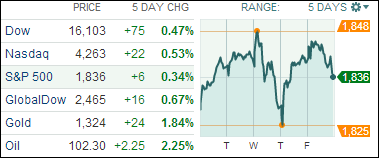
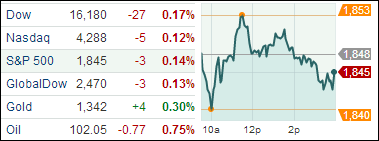
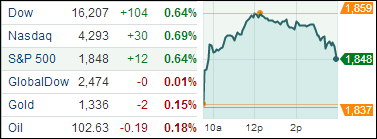
European equities headed higher supported by strong readings on factories and hopes that the ECB may take additional easing steps. That proved to be a springboard for the domestic indexes which, after an early rally, pulled back and then slowly inched their way higher with the DIA reaching a closing high.

Again, it seems the path of least resistance is up if there is no specific news to the contrary. Leading the ETF pack were utilities (XLU), which gained over 1.36% followed by consumer staples (XLP) with a strong 1.08%.

Analysts in general consider the current environment bullish for equities due to a positive third quarter earnings season, along with positive investor sentiment caused by the assumption of the Fed holding off on tapering until March. Nevertheless, it pays to be cautious, especially in view of the widespread complacency in the market place.

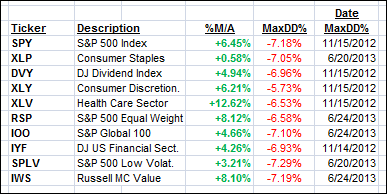
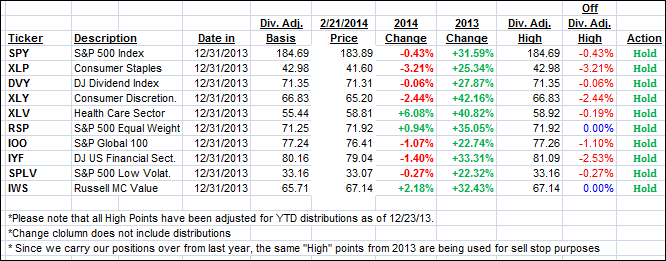
Let’s review the new ETF section below:

Read More

7 ETF Model Portfolios You Can Use – Updated through 11/5/2013

Ulli Model ETF Portfolios Contact

The month of October closed on a slight down note as the markets had to digest the highs the major indexes were making. We have been bouncing against a glass ceiling, as far as the S&P 500 is concerned, as the index slipped by some 0.5% since last week’s ETF model portfolio report.

Bond ETFs have been making a comeback, but the rebound has not been strong enough to push them out of bear market territory and above their long term trend lines. With the ever present Fed “taper” looming on the horizon, the direction of interest rates is at best questionable.

Domestic equities remain the place to be as the major indexes have been holding up very well during the fear months (September/October) against all predictions to the contrary. If you think this relentless equity march higher is ridiculous, you are not alone. However, a trend is a trend, and it needs to be followed until it ends.

In the meantime, here’s the latest ETF Model Portfolio update:

Read More

Bonds Drop As Index Leaders Play Musical Chairs

Ulli Market Commentary Contact

Tue pic

[Chart courtesy of MarketWatch.com]

1. Moving The Markets

Emerging-market stocks dropped to a one-month low, led by Turkish equities, on concern that a slower expansion in the euro area will crimp global growth. While Bond ETFs have risen from the dead, they still are hovering below their long-term trend lines and are not in a buy mode at this time. However, the consensus seems to be that the Fed’s taper decision has been put off until 2014, whih may have opened the door for potential asset flows back into fixed income.

The SPDR S&P 500 ETF (SPY) and PowerShares QQQ have continued to push to new highs and remain in healthy uptrends.

Right now we are seeing small rotations in index leadership, which may be a sign of institutional investors starting to jockey for position before the end of the year. What I think we will see through the remaining two months of 2013 is a push/pull between the latecomers who are chasing performance and the early adopters who are looking to lock in gains on their positions.

Let’s review the new ETF section below:

Read More

11-05-2013

Ulli Newsletter Archives Contact

The ETF/No Load Fund Tracker

Monthly Review—October 31, 2013

Euphoria Drives US Stocks Near All-Time Highs In October

US stocks finished higher in October amid speculation the Federal Reserve would withdraw its stimulus by as early as January and despite a prolonged government shutdown at the beginning of the month that threatened to derail the nation’s economic recovery.

The blue-chip Dow Jones Industrial Average ended up 2.8 percent for the month.

The S&P 500 index finished at 1,757, adding 4.5 percent for the month while the tech-heavy NASDAQ Composite Index closed out at 3,920, up 3.9 percent for the month.

These gains made it the best October for equities in three years across the board. Equity analysts, however, speculate the market is ready for a pause after a strong showing.

The ongoing earnings season continued to paint a mixed picture of the economy with about 68.5 percent of S&P 500 companies topping Wall Street expectations, well above the long-term average of 63 percent. However, only 53.5 percent topped revenue forecasts, missing the 61 percent average recorded since 2002.

Among major economic developments in October, the US Fed released the year’s policy statement, keeping its interest rates and assets-purchase program unchanged as expected. The world’s largest central bank acknowledged fiscal policies are causing headwinds to the economy and noted the recent slowdown in the housing sector. What caught the market’s attention, though, was the omission of the term “tightening fiscal conditions” that appeared in the September policy directive. Markets perceived this omission as somewhat hawkish as the FOMC didn’t change its forecast to account for the impact from the government shutdown, and were caught slightly off guard.

Factory activity in the US remained strong for the month with the Chicago Purchasing Managers’ Index coming in at 65.9, marking its best performance since March 2011 and handily beating expectations for a reading of 55. The constituents of the benchmark were equally strong with order backlog, new orders and production indexes posting double-digit growth.

The September nonfarm payroll report, delayed due to the partial govt. shutdown earlier in the month, was a cause for concern. It showed the economy just created 148,000 jobs compared to the 193,000 in August. Nonfarm private payrolls increased by a dismal 126,000 in September compared to a 161,000 gain in the previous month.

The political morass in Washington took its toll on consumer sentiment. The final reading of the University of Michigan/Thomson Reuters Consumer Sentiment Index fell to 73.2 from an earlier estimate of 75.2 and was nearly 10 points lower than the September reading.

Across the Atlantic, European stocks surged in October with the pan-European Stoxx Europe 600 index rising 3.8 percent for the month.

The real economy however, painted a different picture. European labor markets continued to suffer with unemployment rate in the euro area hitting a record 12.2 percent in September. Brussels-based Eurostat revised August’ unemployment rate upwards to 12.2 percent from the previously estimated 12 percent.

Inflation in the single-currency region fell to the lowest level in nearly four years in October. The European Central Bank will be under pressure to cut interest rates and ease money supply to support the region’s struggling economy when it meets this week for policy decisions.

Prominent European equity indexed posted robust gains for the month. UK’s FTSE 100 added 4.2 percent in October while Germany’s DAX 30 index picked up 5.1 percent.

Our major holdings picked up some steam during the month of October, especially Consumer staples (XLP), which gained some 6.5%; yes that is in one month. Take a look at the chart:

OctETFs

XLP was the top performer during the first few months of this year; it then underperformed during the summer months before picking up the slack and shifting into overdrive. I believe that our current combination of ETFs will serve us well in the intermediate future.

Our main directional indicator, the Domestic Trend Tracking Index (TTI) kept pace with the major indexes and remains solidly on the bullish side of the trend line, as the chart shows:

TTI

We have successfully made it through the historic bull market killer months (September/October), and are now entering the seasonally strong period for equities. I do like to point out that, due to the Fed’s policies, the markets are manipulated and pushed to current record highs artificially and not due to underlying fundamental strength.

However, as trend followers we really don’t care what causes the markets to go up as long as they do go up. But, it also means, the possibility of a sudden market reversal will always be with us, so we have to continuously be on guard in case the euphoria comes to an end all of a sudden.

Keeping The Bull Alive

Ulli Market Commentary Contact

Mon pic

[Chart courtesy of MarketWatch.com]

1. Moving The Markets

U.S. stocks rose, after the S&P 500 Index climbed for four straight weeks, as Exxon Mobil Corp. and U.S. Steel Corp. led a commodity rally while investors awaited data on employment and economic growth. All major indexes gained as the chart above shows. About 5.7 billion shares changed hands, the slowest trading in two weeks.

Look for a healthy market in the two months to close out 2013. The S&P 500’s return has been positive over November and December every year since the bull market began in 2009. While earnings growth is slowing and the Federal Reserve is planning to curtail stimulus, it usually doesn’t pay to fight the trend in stocks. Let us also not forget that the Fed policy makers decided last week to maintain the $85 billion in monthly bond purchases.

Let’s review the new ETF section below:

Read More

ETFs/Mutual Funds On The Cutline – Updated Through 11/1/2013

Ulli ETFs on the Cutline Contact

Below are the latest ETF Cutline reports, which show how far above or below their respective long-term trend lines (39 week SMA) my currently tracked ETFs/MFs are positioned.

The first report covers the ETF Master List from Thursday’s StatSheet and includes 398 ETFs, of which currently 332 (last week 348) are hovering in bullish territory.

The second report includes only High Volume ETFs. To clarify, High Volume (HV) ETFs are defined as those with an average daily volume of $10 million or higher.

These ETFs are generated from my selected list of some 93 that I use in my advisor practice. It cuts out the “noise,” which simply means it eliminates those ETFs that I would never buy because of their volume limitations. 71 ETFs (last week 73) have managed to remain in bullish territory after the recent market volatility.

The third report covers Mutual Funds on the Cutline. There are currently 811 (last week 826) above the line and 48 below it out of the 859 that I follow.

Take a look:

1. ETF Master Cutline Report     

2. ETF High Volume Cutline Report

3. MF Cutline Report

In case you are not familiar with some of the terminology used in the reports, please read the Glossary of Terms.

If you missed the original post about the Cutline approach, you can read it here.