Weekly StatSheet For The ETF/No Load Fund Tracker Newsletter – Updated Through 03/01/2016

Ulli ETF StatSheet Contact

ETF/Mutual Fund Data updated through Tuesday, March 1, 2016

Special Note: Due to issues with our data provider, all prices are updated only through 3/1/16.

TOC010716

If you are not familiar with some of the terminology used, please see the Glossary of Terms.


1. DOMESTIC EQUITY MUTUAL FUNDS/ETFs: SELL — since 11/13/2015

TTI

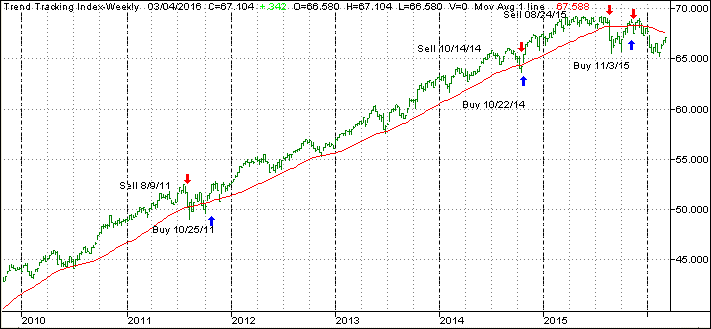
Our main directional indicator, the Domestic Trend Tracking Index (TTI-green line in above chart) has recently crawled above its long term trend line (red) and finally generated a new “Buy” signal effective 11/3/15. The market subsequently dropped, and we exited again on 11/13/15. As of today, the TTI remains below its trend line by -0.58%, which means we are in cash on the sidelines.

Read More

And The Short Squeeze Continues…

Ulli Market Commentary Contact

Thur pic

[Chart courtesy of MarketWatch.com]

1. Moving the Markets

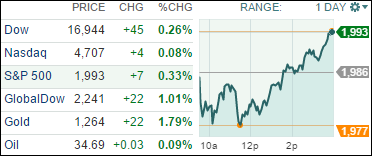
Sure, why not? Manufacturing is in a clear recession and the services economy is about to follow, but the short squeeze continued late in the day with the computer trading algos pushing the indexes another notch higher towards the 2,000 level on the S&P 500.

To my way of thinking, the markets are now so overbought during this 2 week straight up run based on absolutely no economic improvements since the S&P closed at the 1,829 level on February 11th. Reality has to set in sooner or later as this pace simply can’t be sustained given domestic and global data points. As I said before, bear market rallies can be downright stunning in their voraciousness as we just witnessed.

Investors also digested a spate of economic data today. The number of Americans filing for first-time jobless claims rose 6,000 to 278,000 in the past week, which is more than expected.

Wall Street will be closely eyeing the February jobs report set for release by the government tomorrow morning. Analysts forecast 200,000 new jobs created last month. The employment report is a key report, as it is closely watched by the Federal Reserve and how it comes in could impact the path of interest rates.

Read More

Second Day Of March Modest At Most

Ulli Market Commentary Contact

Wed pic

[Chart courtesy of MarketWatch.com]

1. Moving the Markets

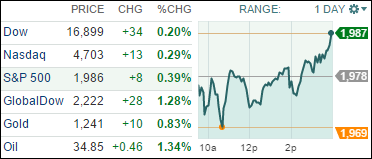
After posting its best start to March ever on signs the U.S. economy is perking up, U.S. stocks managed modest gains and the Nasdaq exited correction territory as investors digested the latest upward move and Super Tuesday results.

Tuesday’s rally, which was powered in part by incoming economic data that allegedly suggests that recession fears are overblown, was viewed through a positive lens by Wall Street.

Wall Street also woke up to a presidential campaign in which Democrat Hillary Clinton and Republican Donald Trump increased their leads against rivals after Super Tuesday voting in 11 states. Investors are closely watching the campaign as government-driven policies impact the performance of the economy and stock market.

We received an update on the economy today and the results were modest at best. The news was that the economy expanded in most regions over the past six weeks but activity slowed in some areas as the manufacturing industry continued to struggle, offsetting the recovering housing market and growth in consumer spending, the Federal Reserve said in their beige book report. In other words, it’s still questionable whether the next rate hike to be decided at the next Fed March meeting is still on.

Read More

When Bad News Is Good News And Good News Is Great News

Ulli Market Commentary Contact

Tue pic

[Chart courtesy of MarketWatch.com]

1. Moving the Markets

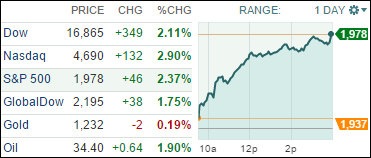
As I was scanning the early news on MarketWatch, I cam across the headline “Wall Street gains as weak data spurs stimulus,” which was later removed and replaced with “Wall Street surges as data points to economic recovery” confirming that according to MSM bad news is good news and good news can be great news—all at the same time.

However, nothing mattered, despite the worst global macro data in some 4 years as timely verbal assists about possible interventions from ECBs Draghi and NY Fed President Dudley lit some fire under the major indexes.

That was enough and March came in like a bull in a China shop for with U.S. stocks up sharply adding fuel to an early rally on China’s latest stimulus move. All major indexes gained more than 2.1%.

The initial boost came after China freed more money for lending by lowering the amount commercial lenders must hold in reserve in a move to shore up slowing economic growth. I can’t see how this would be a good thing given the massive amounts of non-performing loans in the system other than to lift the stock markets temporarily.

Domestically, bank and tech stocks led the charge. Bank of America (BAC) rose 5% to $13.15 and JPMorgan Chase (JPM) gained 4.3% percent, to $58.72, pacing the gains among financial stocks.

Shares of Valeant (VRX) took a hit today. The company is under investigation from the SEC, but they are denying suggestions from a short-seller that they used Philidor and other specialty pharmacies to commit accounting fraud.

Read More

Dow Is Only Index To Stay Above Water In February

Ulli Market Commentary Contact

Mon pic

[Chart courtesy of MarketWatch.com]

1. Moving the Markets

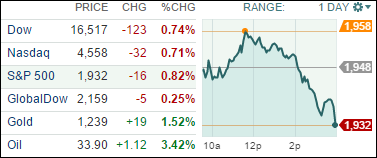
U.S. stocks ended February on a sour note as oil prices rose and “the” meeting of G20 finance officials ended without pledges for joint action to stimulate sagging global economic growth. As I mentioned on Friday, chances are great that useless jawboning without concrete results or resolutions is as good as it gets.

The weak end to February resulted in a mixed bag in terms of the performance of the three big U.S. stock indexes. The Dow did the best for the month, rising 0.3%. The S&P was next, down 0.4%. The Nasdaq brought up the rear, falling 1.2% for February.

Finance ministers and central bankers from the Group of 20 of the world’s biggest economies said they would use “all tools” at their disposal to bolster weak global growth at a meeting in Shanghai on Saturday. They also vowed not devalue their currencies to boost exports. Sure, I won’t hold my breath for that one.

Again, most of February’s rally was short covering, which turned out to be longest uninterrupted cover streak in some 2 years. We’ll now have to wait and see if this rebound off the February lows actually has legs or if we’re close to heading back south. The latter would be my best guess for the day.

Read More

ETFs/Mutual Funds On The Cutline – Updated Through 02/26/2016

Ulli ETFs on the Cutline Contact

Below are the latest ETF Cutline reports, which show how far above or below their respective long-term trend lines (39 week SMA) my currently tracked ETFs/MFs are positioned.

The first report covers the ETF Master List from Thursday’s StatSheet and includes 381 ETFs, of which currently 55 (last week 48) are hovering in bullish territory.

The second report includes only High Volume ETFs. To clarify, High Volume (HV) ETFs are defined as those with an average daily volume of $10 million or higher. Volume figures can change in a hurry, so be sure to check first before investing.

These ETFs are generated from my selected list of 98 that I use in my advisor practice. It cuts out the “noise,” which simply means it eliminates those ETFs that I would never buy because of their volume limitations. 13 ETFs (last week 12) have managed to remain in bullish territory after the recent market volatility.

The third report covers Mutual Funds on the Cutline. There are currently 32 (last week 29) above the line and 748 below it out of the 780 that I follow.

Take a look:

  1. ETF Master Cutline Report
  2. ETF High Volume Cutline Report
  3. MF Cutline Report

In case you are not familiar with some of the terminology used in the reports, please read the Glossary of Terms.

If you missed the original post about the Cutline approach, you can read it here.