Smashing Exuberance

Ulli Market Commentary Contact

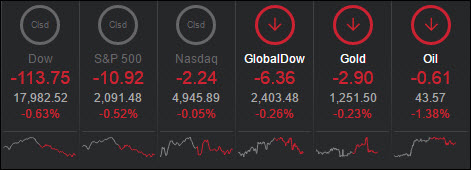
Wed pic

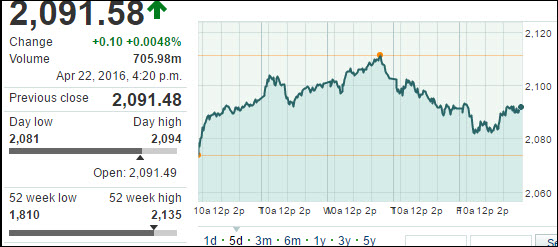
[Chart courtesy of MarketWatch.com]

1. Moving the Markets

There was much hope of the Fed showing signs of not only relenting from their planned interest rate hikes in 2016 but possibly shifting in reverse and lowering rates in the very near future.

Such was the anticipation as Fed chief Yellen delivered testimony in front of a congressional committee, which also had the opportunity to participate in a Q&A session. While equities displayed some exuberance early on, the major indexes slid in the afternoon as it became clear that no assist to push stocks out of their doldrums was forthcoming.

Yellen said that financial conditions “have become less supportive to growth” and “downside risks” are largely stemming from uncertainty over the state of the Chinese economy. In the end, Yellen left the door wide open as to further rate increases in 2016. To me, that means that equities have to find another driver to push prices higher as the Fed, at least for the time being, is not showing an accommodative stance.

With the markets ending basically unchanged, only 3 of our 10 ETFs in the Spotlight made a dash above the unchanged line led by Healthcare (XLV) with +0.87%. On the downside, the Select Dividend ETF (DVY) lost -0.38%.

Read More

Oil Dumps; Major Indexes Seesaw

Ulli Market Commentary Contact

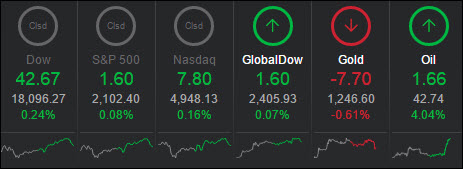
Tue pic

[Chart courtesy of MarketWatch.com]

1. Moving the Markets

Today was repeat of yesterday’s session in that markets sold off most of the day but managed a better recovery during the last hour by closing only slightly below the unchanged line. Apparently the bulls are still alive and putting up a fight during these tug-of-war sessions.

The energy sector ended up being the worst performer, followed by telecommunications and financials. The tech sector rallied early on but lost its momentum as the FANG stocks (Facebook, Amazon, Netflix and Google) got spanked again for the second day in a row with Netflix being the only gainer for the day.

At the open, the domestic markets had to live with the fact that the Nikkei Average had lost 5.4%, its biggest decline since 2013 while the 10-year Japanese bond yield fell below zero for the first time. Much of the focus is on Asia this week (with China being closed), however, let’s not forget the banking debacle in Europe where some of the Italian banks are suffering from a constantly increasing amount of NPLs (Non Performing Loans).

Not to be outdone, Deutsche Bank (DB), the German behemoth with over $60 trillion in derivatives, is in dire straits and has been in the cross-hairs for all kinds of trouble while its stock price has dropped to records lows. Some have compared DB to having a “Lehman moment,” a reference to the firm that brought about the 2008 financial crisis.

4 of our 10 ETFs in the Spotlight ended up on the plus side, while 6 of them dropped below the unchanged line. Leading the charge was Healthcare (XLV) with +0.74% while the Global 100 (IOO) was the loser of the day with -0.71%.

Read More

Dead Cat Bounce Saves Indexes From Crashing

Ulli Market Commentary Contact

Mon pic

[Chart courtesy of MarketWatch.com]

1. Moving the Markets

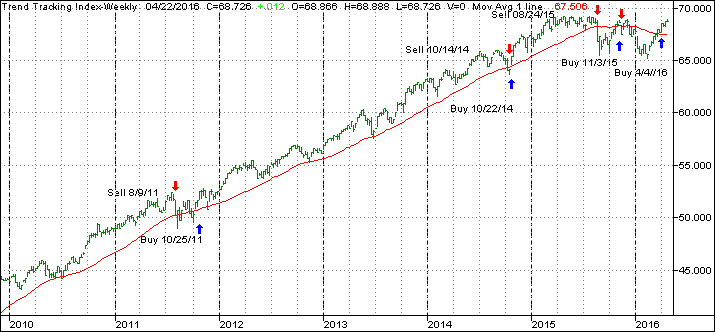
It it hadn’t been for a last hour turn-around, possibly a dead cat bounce, the major indexes may have headed for a steep dive. As it turned out, the worst was avoided for the time being, but this type of market action underscores what I have been saying since the middle of November—when our Domestic TTI broke below its long-term trend line—that a bear market has started and the only unknown is its magnitude and duration.

On the heels of Friday’s sell-off, the culprits remain the same in that crude oil continued its southerly path, European banks, especially Deutsche Bank, are in “fear” mode and, of course, the global economic slowdown has become all too real now.

Besides the Material Sector (-2.7%), Financials took a beating at the tune of -2.6%, however, energy was fairly resilient and closed up +0.1%. While the S&P 500 closed below its January closing low (1,859), it still remains above its January intra-day low of 1,812 which, once taken out will not bode well for equities in general. We’ll have to wait and see if and when we get there; in the meantime, I expect some rebound efforts followed by more downside moves.

9 of our 10 ETFs in the Spotlight headed south led by the Financials (IYF) with -2.63%. Only one survived the onslaught and that was the Dividend ETF (DVY), which actually managed to squeeze out a gain of +0.08%.

Read More

ETFs/Mutual Funds On The Cutline – Updated Through 02/05/2016

Ulli ETFs on the Cutline Contact

Below are the latest ETF Cutline reports, which show how far above or below their respective long-term trend lines (39 week SMA) my currently tracked ETFs/MFs are positioned.

The first report covers the ETF Master List from Thursday’s StatSheet and includes 381 ETFs, of which currently 40 (last week 38) are hovering in bullish territory.

The second report includes only High Volume ETFs. To clarify, High Volume (HV) ETFs are defined as those with an average daily volume of $10 million or higher. Volume figures can change in a hurry, so be sure to check first before investing.

These ETFs are generated from my selected list of 98 that I use in my advisor practice. It cuts out the “noise,” which simply means it eliminates those ETFs that I would never buy because of their volume limitations. 10 ETFs (last week 8) have managed to remain in bullish territory after the recent market volatility.

The third report covers Mutual Funds on the Cutline. There are currently 27 (last week 15) above the line and 754 below it out of the 781 that I follow.

Take a look:

  1. ETF Master Cutline Report
  2. ETF High Volume Cutline Report
  3. MF Cutline Report

In case you are not familiar with some of the terminology used in the reports, please read the Glossary of Terms.

If you missed the original post about the Cutline approach, you can read it here.

One Man’s Opinion: Are US Banks Well Capitalized?

Ulli Market Review Contact

ManThe US economy has been growing at 2 percent real and perhaps 2.9 percent nominal for the past several years, said Bill Gross, portfolio manager at Janus Capital Group.

Japan is above the (recession) line and euro-land seems to have come out of their recession; so easy monetary policy is working a little bit, but central banks’ philosophy remains questionable. Their age old economic models that suggest the lower the interest rates are driven, the better it gets because asset prices go up and the wealth effect gets disseminated down the real economy, but the economy getting normal does not seem to be working for a number of reasons.

The rush for more and more negative interest rates could have negative consequences as it affects business models of insurance companies and pension funds. Ultimately it affects savers; if savers don’t earn a return of their money, then saving diminishes and investment languishes, he noted.

Read More

New ETFs On The Block: Guggenheim Dow Jones Industrial Average Dividend ETF (DJD)

Ulli Dividend ETFs Contact

InvestingAmid heightened market volatility and slumping Treasury yields, many investors have started to believe lower rates will linger for a bit longer, meaning dividend plays could make hay for an extended period while the Fed falters. Such a scenario may look ideal for a strategically timed new smart-beta product from Guggenheim Investments.   

The newly launched Guggenheim Dow Jones Industrial Average Dividend ETF (DJD) is weighted based on the dividend yields of the 30 stocks in the index. While the Dow Jones Industrial Average index remains one of the most popular indices in the world, it’s also one of the most maligned.

Created in 1896 by Charles Dow, the blue-chip benchmark follows a price weighting mechanism, which means the priciest stock in the index also gets the maximum weight. Not fundamentals. Not market capitalization. That also means price volatility of Goldman Sachs weighs more on the index despite the fact that Apple Inc, also a Dow component, has more than seven times the market capitalization of Goldman.

Read More