Hope Of Trade Talk Resumptions Powers Markets

Ulli Market Commentary Contact

[Chart courtesy of MarketWatch.com]
  1. Moving the markets

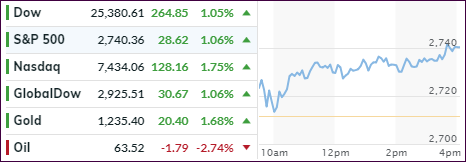
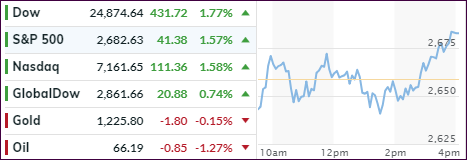
It didn’t take much to get the markets going after yesterday’s drubbing and the see-saw action we’ve seen over the past week. Strong earnings from Walmart and Cisco set the tone early on, and reports of a resumption of US/China trade talks next week provided the ammo to push the major indexes up with the Dow having its best day in some 4 months.

Please note the absurdity in that the trade wars with China have not been resolved in any way, shape or form. It was merely the mention of these talks being reopened again that helped boost overall sentiment and motivated the bulls to come out full force.

The Turkish currency turmoil subsided somewhat as the lira rallied for a 3rd straight session against the dollar. Throwing an assist was Qatar, which provided a lifeline by investing $15 billion in Turkey, after Turkey’s FinMin soothed raw nerves by announcing that “capital controls would be ruled out as a policy option.” That’s a good thing as these would likely promote broad capital flight from an Emerging Market space.

Not all stocks participated in today’s rebound as the FANGs resumed their downtrend thanks to a 3% stumble in Facebook. The FANGs are now within shouting distance of touching their 10% correction level, as you can see here.

Looking at the big picture, there is only one thing that has been responsible for the recent weakness in the markets as well as for the strength over the past 3 years. Take a guess and then see the answer presented in this chart.

Read More

Turkey Turmoil Returns; A-Dead-Cat Bounce Dies

Ulli Market Commentary Contact

[Chart courtesy of MarketWatch.com]
  1. Moving the markets

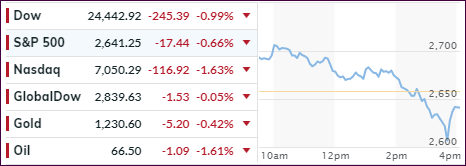
I felt that yesterday’s rebound had the smell of a dead-cat-bounce and, based on today’s carnage, that seems to have been accurate—at least for the time being. Despite assurances to the opposite, the “C” word, as in contagion, was suddenly on investors’ minds, as concerns about Turkey’s currency crisis and US/China trade tensions made their presence felt.

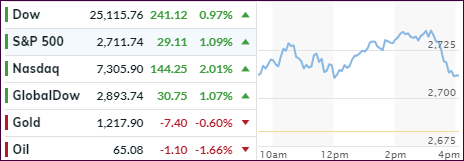
The damage was not limited to equities but also to energy, which was the worst performing sector in the S&P with crude oil getting pounded at the rate of over 3%. The major indexes, while off to a poor start after the opening, managed to limit some losses by crawling back but not reaching the unchanged line.

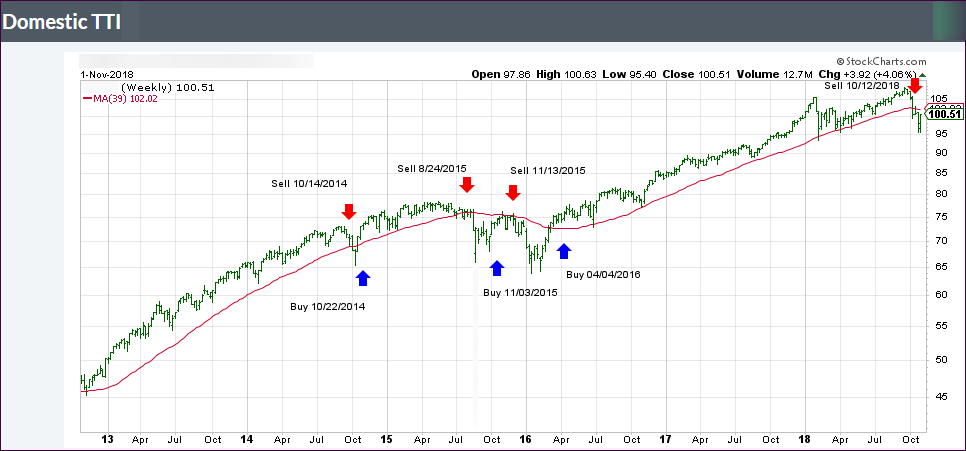
Globally, the outcome was similar with stocks not just falling to 6-week lows but also breaking below major averages, which affected our Domestic TTI by confirming that a new “Sell” signal indeed has been triggered. More in section 3 below.

Contagion is a distinct possibility as a result of the fallout from Turkey’s currency destruction, which already has affected the European banks and, which are now in bear market territory meaning they have come off their highs by more than 20%.

Taking this a step further, stocks of GSIBs, also known as Globally Systemic Important Banks, have dropped 23% off their highs with no end in sight. Remember, these are banks that must be supported by governments at all costs, or things may turn real ugly very fast—economically speaking that is.

Even the VIX appeared to have woken up from a summer snooze by spiking to 17 but settling back down to the 15 area. Benefiting from this wild trading day were interest rates, which dropped as the 10-year bond yield settled down 3 basis points to 2.86%.

As I pointed out yesterday, only a few US banks have direct involvement in Turkey, so this is currently viewed only as one more addition to global uncertainties, of which there are plenty. I don’t think this will simply go away or be resolved quickly, so we must be alert to this being only one domino that can have serious effects on the European banking system and by extension, US banks as well.

Read More

Shaking Off The Turkish Crisis; Equities Rebound

Ulli Uncategorized Contact

[Chart courtesy of MarketWatch.com]
  1. Moving the markets

For sure, the Turkish crisis has not been resolved, but it merely paused, as the emerging markets’ exchange rates rallied and had their best day in 3 weeks as this chart shows. ZH commented:

Of course, all eyes were on the Lira as it rallied back up to unchanged from Friday’s close… After its biggest single-day loss ever, the lira rebounded most since 2001…

So, the theme of the day that “the lira is fixed” was enough to bring back the bulls to push the major indexes out of yesterday’s doldrums and past last Friday’s closing prices. Sure, with nothing having been resolved in the emerging market arena, this rebound could very well turn out to be a dead cat bounce.

Of course, we won’t know for sure until more time passes, but with the US dollar’s relentless push to new cycle highs (made today), it’s questionable in my mind that emerging nations with dollar denominated debt can dig themselves out of the current hole when their currencies are heading south almost daily.

Read More

Turmoil in Turkey Troubles Markets

Ulli Market Commentary Contact

[Chart courtesy of MarketWatch.com]
  1. Moving the markets

Despite the US not having much direct financial exposure in Turley, its ongoing troubles did stop investors in their tracks. That simply means risk assets, such as equities, fell out of favor today, and the major indexes headed south wiping out some early gains and ending in the red.

After all, no direct exposure does not mean, the US is isolated—far from it. In the simplest terms, these days most countries are connected at the hip. For example, European banks are heavily exposed to Turkish debt and in turn, US banks are holders of European debt. If any domino falls, the subsequent effect will surely travel across the Atlantic in a hurry.

The Turkish Central Bank went all out and declared to provide “all the liquidity the banks need,” but fell short of announcing a hike in interest rates. So, the lira continued to tumble, and raised concerns that this could ripple through the emerging markets economies first, and then who knows who’s next.

Emerging market currencies got pummeled again as the US Dollar climbed relentlessly for the 3rd day in a row to spike to its highest since June 2017. This also affected commodities with DBC losing -0.53%.

With the US/China trade wars having been shoved in the background for the moment, but still very much alive, and the emerging markets pandemonium in full swing, we seem to be going through a crisis phase, which could keep equities in check until a more positive theme develops. On the other hand, it is entirely possible that these current events, along with subsequent developments, can spell the end of the this very extended market cycle.

Since no one has the answer, we’ll go along for the ride until our Trend Tracking Indexes (TTIs) give the signal to step aside.

Read More

ETFs On The Cutline – Updated Through 08/10/2018

Ulli ETFs on the Cutline Contact

Below, please find the latest High-Volume ETF Cutline report, which shows how far above or below their respective long-term trend lines (39-week SMA) my currently tracked ETFs are positioned.

This report covers the HV ETF Master List from Thursday’s StatSheet and includes 366 High Volume ETFs ETFs, defined as those with an average daily volume of more than $5 million, of which currently 165 (last week 175) are hovering in bullish territory. The yellow line separates those ETFs that are positioned above their trend line (%M/A) from those that have dropped below it.

Take a look:

The HV ETF Master Cutline Report

In case you are not familiar with some of the terminology used in the reports, please read the Glossary of Terms.

If you missed the original post about the Cutline approach, you can read it here.

ETF Tracker Newsletter For August 10, 2018

Ulli ETF Tracker Contact

ETF Tracker StatSheet

https://theetfbully.com/2018/08/weekly-statsheet-for-the-etf-tracker-newsletter-updated-through-08-09-2018/

 TURKEY RATTLES THE EQUITY CAGE

[Chart courtesy of MarketWatch.com]
  1. Moving the markets

As I mentioned yesterday, “domestic equity markets have note priced in any long-term consequences of a prolonged trade war with China, reeling emerging markets and European banking problems.” This came true today at least regarding one emerging market, namely Turkey, which has been dealing with a mounting currency crisis for quite some time.

The Turkish Lira plunged to a record low of 6.3005 per dollar making it the worst performing emerging market currency in 2018, while their 10-year bond yield catapulted to a new record high of 20.67%. The Lira is down 20% for the week and 40% YTD. Fears of contagion spread in a hurry, as mostly European banks have some 40% exposure of the Turkish banking sector assets.

Even though US banks have only limited involvement, this kind of international turmoil is bound to send shivers around the world and waking up investors to the fact that all may not be well. After all, no country is isolated enough to disregard and not be affected by events in global economies and/or foreign currencies, especially if the latter just had their worst week since 2011.

That’s all it took to put the bears in charge and south we went. Domestically, the major indexes lost about 0.75% and managed to stage a comeback late in the session, which was not enough to produce green numbers.

Not helping matters was volatility in Russian markets with the Ruble dropping some 5% to 27-month lows against the US dollar, after their stock indexes dove as much as 9% on Thursday. This was the result of newly announced US sanctions.

With all the currency destruction around the world, the US dollar benefited and surged for the week, while the 10-year Treasury yield dropped 6 basis points today to end at 2.87%, as the flight to safety was on.

I just don’t believe that this is the end of the emerging markets currency destruction. I am sure there will be more fallout to come. The questions are: “How far will it spread and to what degree will equity markets be affected?”Is this just an outlier, and will we be back to ‘normal’ next week?

Unfortunately, we will have to wait for the answers to not only develop but also be reflected in our Trend Tracking Indexes (TTIs) before taking evasive action.

Read More