ETFs On The Cutline – Updated Through 04/06/2018

Ulli ETFs on the Cutline Contact

Below please find the latest High Volume ETFs Cutline report, which shows how far above or below their respective long-term trend lines (39 week SMA) my currently tracked ETFs are positioned.

This report covers the HV ETF Master List from Thursday’s StatSheet and includes 366 High Volume ETFs ETFs, defined as those with an average daily volume of more than $5 million, of which currently 125 (last week 173) are hovering in bullish territory. The yellow line separates those ETFs that are positioned above their trend line (%M/A) from those that have dropped below it.

Take a look:

The HV ETF Master Cutline Report

In case you are not familiar with some of the terminology used in the reports, please read the Glossary of Terms.

If you missed the original post about the Cutline approach, you can read it here.

ETF Tracker Newsletter For April 6, 2018

Ulli ETF Tracker Contact

ETF Tracker StatSheet

https://theetfbully.com/2018/04/weekly-statsheet-for-the-etf-tracker-newsletter-updated-through-04-05-2018/

 ANOTHER TARIFF TANTRUM

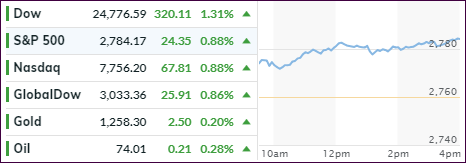
[Chart courtesy of MarketWatch.com]
  1. Moving the markets

A variety of factors combined to deliver another market knockout punch. Things looked dicey from the opening bell when the jobs report disappointed by delivering on 103k new jobs in March vs. an expected 170k. That was the good news.

The bad news continued in the China-U.S. trade fight as Trump proposed fresh tariffs. Relentless selling continued in the afternoon after Fed chairman Powell’s well intended speech discussing his support for a “patient” approach to raising interest rates fell on deaf ears and did nothing but accelerate downward momentum.

Then Trump confirmed that in regards to the effect on markets as a result of the trade standoff “I’m not saying there won’t be a little pain so we might lose a little of it but we’re going to have a much stronger country when we’re finished, and that’s what I’m all about.”

These were not exactly words designed to calm shattered nerves, and the VIX jumped to a 7 year high. Now barely 3 months into 2018, already we’ve seen no fewer than 22 sessions with intra-day moves in the Dow of 400+ points. Compare that to 2017 where we had 1 (hat tip to ZH for this stat)!

The S&P 500 did a repeat and for a brief moment broke through its 200-day M/A to the downside, for the 4th time this month, but it managed to close above it by a small margin. To me, it now looks to be just a matter of time until this level is broken, which may mean a return to bear market territory.

Our Trend Tracking Indexes (TTI) confirm that we are near an inflection point, which means that the current bullish cycles are coming to an end should downside momentum  continue.

How close are we? While our TTIs survived this day and remain on the bullish side of their respective trend lines (see section 3), we are within striking distance (around +0.5%) of breaking below them. Once that occurs, the odds are increased that a new bear market will be upon us. That is when the rubber meets the road, and we will step aside to the safety of the sidelines.

Read More

Weekly StatSheet For The ETF Tracker Newsletter – Updated Through 04/05/2018

Ulli ETF StatSheet Contact

ETF Data updated through Thursday, April 5, 2018

Methodology/Use of this StatSheet:

  1. From the universe of over 1,800 ETFs, I have selected only those with a trading volume of over $5 million per day (HV ETFs), so that liquidity and a small bid/ask spread are assured.
  2. Trend Tracking Indexes (TTIs)

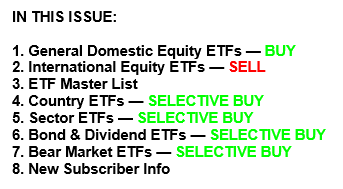
Buy or Sell decisions for Domestic and International ETFs (section 1 and 2), are made based on the respective TTI and its position either above or below its long-term M/A (Moving Average). A crossing of the trend line from below accompanied by some staying power above constitutes a “Buy” signal. Conversely, a clear break below the line constitutes a “Sell” signal. Additionally, I use a 7.5% trailing stop loss on all positions in these categories to control downside risk.

  1. All other investment arenas do not have a TTI and should be traded based on the position of the individual ETF relative to its own respective trend line (%M/A). That’s why those signals are referred to as a “Selective Buy.” In other words, if an ETF crosses its own trendline to the upside, a “Buy” signal is generated. Since these areas tend to be more volatile, I recommend a wider trailing sell stop of 7.5% -10% depending on your risk tolerance.

If you are unfamiliar with some of the terminology, please see Glossary of Terms and new subscriber information in section 9.


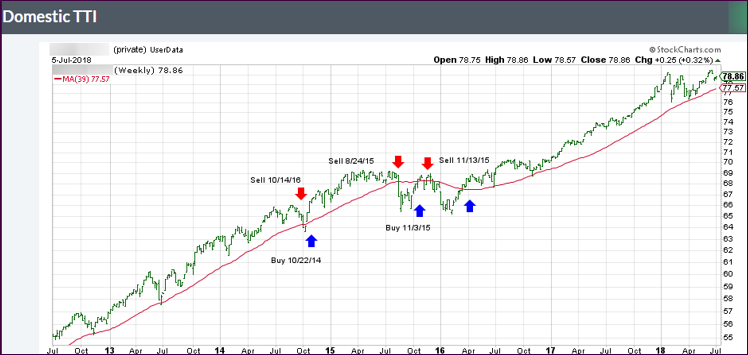
  1. DOMESTIC EQUITY ETFs: BUY — since 4/4/2016

Click on chart to enlarge

Our main directional indicator, the Domestic Trend Tracking Index (TTI-green line in the above chart) is positioned above its long-term trend line (red) by +1.53% after having generated a new Domestic Buy signal effective 4/4/2016 as posted.

Read More

Easing Trade Tensions Equal Higher Markets

Ulli Market Commentary Contact

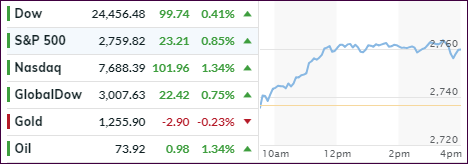
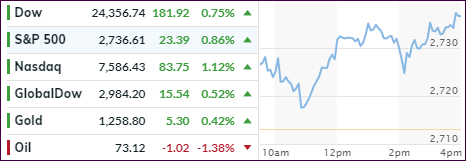
[Chart courtesy of MarketWatch.com]
  1. Moving the markets

What a difference a day makes! As much as yesterday’s trade-war fears were the culprit contributing to the early market dump, today’s easing of those fears helped spark an early rally that continued the rebound and led to the Dow’s first 3-day win streak in a month.

While the early rally ran out of steam mid-day, and a sideways pattern pushed the major indexes around and off their highs, we ended up with solid gains.

The supporting actors, in the form of Trump’s trade chief Peter Navarro and Economic Council director Larry Kudlow appeared to offer more soothing words about the trade tensions. “There is still time to hash out a deal” and “the latest measures are just proposals right now” were exactly the things traders wanted to hear in order to sustain the positive market momentum.

While the gains were broad, the exception were Semiconductors (SMH), which were dragged down by one stock, namely Micron, which has been a recent darling in the hedge fund industry, but its 4% loss pulled down the entire sector.

Interest rates bounded off their recent lows with the 10-year bond yield gaining 4 basis points to end at +2.83%. That helped the US Dollar (UUP) gain +0.38% adding to recent advances and now having conquered its 50-day M/A again.

Read More

Massive Sell-Off Turns Into Solid Gains

Ulli Market Commentary Contact

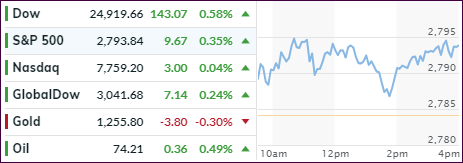
[Chart courtesy of MarketWatch.com]
  1. Moving the markets

The chart above showing today’s rebound simply does not do justice to what actually happened. Right after the opening bell, the Dow plunged some 600 points only to begin a slow comeback and, along with the other major indexes, managed not only to recoup all early losses but turn the session into solid gains. In the end, the Dow traded in a range of some 840 points.

Causing this early turmoil was China’s announcement that it would slap tariffs on $50 billion of 106 billion of US imports. This was not really earthshaking news, as such possibility had been telegraphed a couple of weeks ago, but Wall Street’s short term memory would have none of that and down we went.

Igniting the rebound was the new kid on the block, namely Trump’s new National Economic Council director Larry Kudlow who said that “stock markets shouldn’t overreact to trade tensions between US and China because proposals by both countries are a first step and haven’t been implemented,” and offered even more soothing words by opining that “it is possible the tariffs will never come to pass.”

That was all it took, and the early dump turned into a successful pump. Needless to say, all red numbers vanished, and we closed solidly in the green with the S&P 500 regaining its 200-day M/A and the VIX dropping below 20. The 10-year bond yield remained unchanged, while the US Dollar went nowhere fast and gave back -0.04%.

While it’s been a wild ride this week, nothing has been gained or lost, because we’re just about back to the point (S&P) where we started. Let’s see if the next headlines have some more volatility surprises for us in store.

Read More

Tech Wreck Reverses

Ulli Market Commentary Contact

[Chart courtesy of MarketWatch.com]
  1. Moving the markets

We started the session on a positive note, after yesterday’s drubbing, with the major indexes hovering above and slightly below their respective unchanged lines, as the beaten down tech sector showed signs of life. That caused me to hold off with my planned liquidation of one of our holdings, as we moved away from the trailing sell stop.

I also was watching the international ETFs very closely as my International TTI had slipped below its long term trend line, but only by a small margin (as I posted yesterday), which I considered inconclusive as far as the magnitude of the trend line break was concerned. That sector rallied as well, so no action was required on my part.

Early afternoon, as the S&P retreated off its highs and touched its unchanged line, out of nowhere, buyers appeared resulting in a buying panic to drive the indexes to session highs. What happened? Zerohedge describes it best:

It was generally a quiet day, with no macro news and equities range-bound, seemingly spooked by the ongoing verbal war between Trump and Jeff Bezos, where first in a tweet then a White House press conference, the president warned that US taxpayers will no longer subsidize Amazon “by the billions.” And, as has been the case recently, every time Trump spoke or tweeted, Amazon turned negative.

And then, just around 2:45pm, a Bloomberg headline hit, according to which  President Trump is not formally looking at options to address his concerns with Amazon, which immediately unleashed a buying panic first in Amazon and then across the broader market.

In my mind, the questions is whether Trump’s feud with Amazon will eventually run its course and subside, so Wall Street has one less thing to worry about and can push equities back towards all-time highs. Or, will Trump be the tough guy and risk a market meltdown? I guess we will find out soon.

Read More