Weekly StatSheet For The ETF Tracker Newsletter – Updated Through 04/19/2018

Ulli ETF StatSheet Contact

ETF Data updated through Thursday, April 19, 2018

Methodology/Use of this StatSheet:

  1. From the universe of over 1,800 ETFs, I have selected only those with a trading volume of over $5 million per day (HV ETFs), so that liquidity and a small bid/ask spread are assured.
  2. Trend Tracking Indexes (TTIs)

Buy or Sell decisions for Domestic and International ETFs (section 1 and 2), are made based on the respective TTI and its position either above or below its long-term M/A (Moving Average). A crossing of the trend line from below accompanied by some staying power above constitutes a “Buy” signal. Conversely, a clear break below the line constitutes a “Sell” signal. Additionally, I use a 7.5% trailing stop loss on all positions in these categories to control downside risk.

  1. All other investment arenas do not have a TTI and should be traded based on the position of the individual ETF relative to its own respective trend line (%M/A). That’s why those signals are referred to as a “Selective Buy.” In other words, if an ETF crosses its own trendline to the upside, a “Buy” signal is generated. Since these areas tend to be more volatile, I recommend a wider trailing sell stop of 7.5% -10% depending on your risk tolerance.

If you are unfamiliar with some of the terminology, please see Glossary of Terms and new subscriber information in section 9.


  1. DOMESTIC EQUITY ETFs: BUY — since 4/4/2016

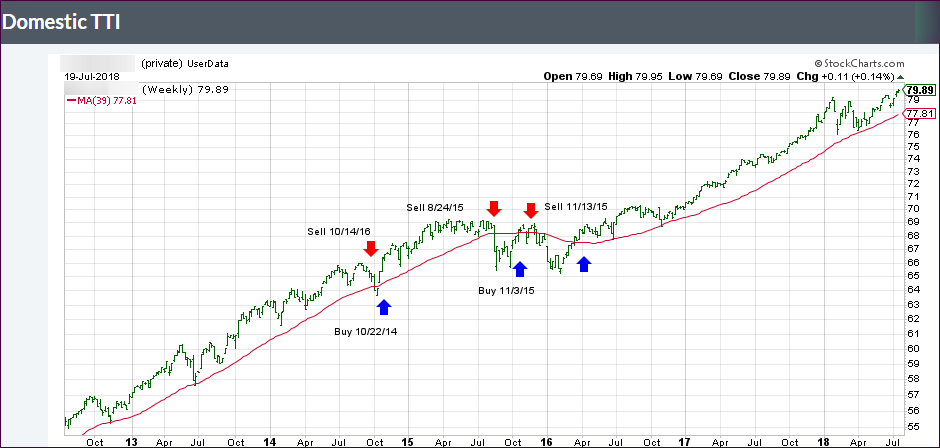
Click on chart to enlarge

Our main directional indicator, the Domestic Trend Tracking Index (TTI-green line in the above chart) is positioned above its long-term trend line (red) by +1.80% after having generated a new Domestic Buy signal effective 4/4/2016 as posted.

Read More

Tech Sector Pulls Down Stocks

Ulli Market Commentary Contact


[Chart courtesy of MarketWatch.com]
  1. Moving the markets

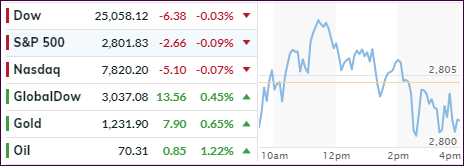
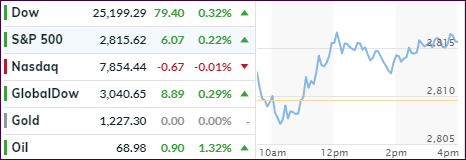
The 3-day really came to an end today with the major indexes pulling back but rallying off their session lows to limit damage. The late day rebound was the result of an announcement that Trump was told by Rosenstein that he was not the target of the Mueller investigation. That lifted the bullish spirits and sent stocks higher.

The technology sector stumbled with especially Semiconductors taking a hard hit with SMH dropping -4.46%, which brings it to within shouting distance of triggering its trailing sell stop. We’ve seen this scenario now several times over the past couple of months and each time SMH managed to recover. We’ll find out soon if this time will be different.

Earnings in general disappointed in other areas as well. Tobacco stocks got spanked, thanks to Philip Morris, and lost over 12%. Apple dropped almost 3%, not due to any announcements, but it was simply the casualty of a weak tech sector.

Financials (XLF +1.53%) outperformed most likely due to higher interest rates. The 10-year bond yield continued its recent snap-back and gained 5 basis points to end the session at 2.92%, a level last seen in mid-March. That caused the US Dollar to jump +0.30% back above its 50-day M/A.

Today’s reversal, after the smooth ride higher over the past 3 days, serves as a reminder that market conditions can change quickly, and that it is imperative not to become complacent but to remain alert and be prepared to deal with any directional changes that might come our way.

Read More

Hanging On To The Unchanged Line

Ulli Market Commentary Contact

[Chart courtesy of MarketWatch.com]
  1. Moving the markets

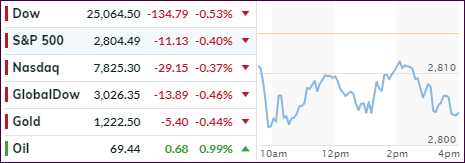
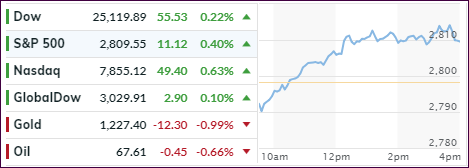
The Dow was the weakling of the day as IBM got spanked at the tune of -7.53%, which equaled a loss of 84 points on the Dow. We had a positive opening, followed by a dump and pump and a soft slide into the close with 2 out the three major indexes managing to end in the green by a tiny margin.

Energy (XLE) made up for some of the weak sectors by gaining +1.56% joined by Transportations (IYT +1.77%), whose performance is widely recognized as a bullish indicator. So far, banks are suffering despite good results with the Banking index (KRX) losing another -0.58% and honing in on early April lows. Financials (XLF) joined the club and gave back -0.44% despite solid earnings.

IBM was the center of attention with its sharp drop in stock price, which was its worst one-day decline since April 2013. Its earnings beat was the result of fancy accounting driven by a one-time tax gain.

In other news, the Fed’s Beige Book release did not affect markets, as its economic activity was shown to remain at a modest to moderate pace. Interest rates reversed and jumped with the 10-year bond yield gaining 5 basis points to end at 2.87%. So did the US Dollar (UUP) which, despite a volatile session, rose +0.21%.

Read More

Markets Pop On Earnings Cheers

Ulli Market Commentary Contact

[Chart courtesy of MarketWatch.com]
  1. Moving the markets

After yesterday’s solid gains, equities followed through with another session marked by bullish sentiment, as the major indexes piled on gains for the second straight day. The S&P 500 conquered its 50-day M/A to the upside and closed at a level last seen on March 19. The rally was broad with all 11 S&P sectors ending higher.

One supporting actor was the VIX, which dropped below 15, its lowest level since March 9. The VIX is a reflection of bullish and bearish option contracts. It moves opposite to stocks, meaning when it rallies, it creates a bearish environment for equities and vice versa.

Helping the markets was a positive view of first-quarter-earnings with growth expected to be some 17.3%, a number which we have not seen since 2011, although it’s uncertain how much of this is attributable to Trump’s recently passed tax bill. Everything was interpreted as a positive that even the underperformance of bank stocks, despite “blockbuster” Goldman Sachs earnings, could not put a dent in the session’s bullish trend.

Interest rates were lower with the 10-year bond yield giving back another basis point to close at 2.82%. The US Dollar (UUP) had a roller coaster day but ended unchanged.

In the end, assisting the markets as well was the fact that trade tensions with China did not worsen recently, which encouraged investors to maintain and add to equity exposure.

Read More

Markets Gain Broadly As Geopolitical Tensions Wane

Ulli Market Commentary Contact

[Chart courtesy of MarketWatch.com]
  1. Moving the markets

By the time the opening bell rang this morning, the lobbing of a bunch of missiles into useless Syrian targets on Friday had been long forgotten with the focus now having shifted to the upcoming earnings season.

Everything appeared to be positive for the market with the S&P 500 honing in on its 50-day M/A, below which it has been stuck since March 9th. All of the 11 S&P sectors closed in the green. While BofAs earnings results exceeded expectations, the stock rose only +0.44%.

Interest rates showed a mixed picture with the 10-year bond yield coming down by 1 basis point to end the day at 2.83%. The US Dollar (UUP) gave back -0.34% and dipped below its 50-day M/A confirming bearish momentum.

With the Syrian debacle having died down, hopefully for good, and earnings season on deck, with great expectations, we should be able to break out of the current congestive sideways pattern and resume a more consistent upward trend. Only time will tell.

Read More

ETFs On The Cutline – Updated Through 04/13/2018

Ulli ETFs on the Cutline Contact

Below please find the latest High Volume ETFs Cutline report, which shows how far above or below their respective long-term trend lines (39 week SMA) my currently tracked ETFs are positioned.

This report covers the HV ETF Master List from Thursday’s StatSheet and includes 366 High Volume ETFs ETFs, defined as those with an average daily volume of more than $5 million, of which currently 193 (last week 125) are hovering in bullish territory. The yellow line separates those ETFs that are positioned above their trend line (%M/A) from those that have dropped below it.

Take a look:

The HV ETF Master Cutline Report

In case you are not familiar with some of the terminology used in the reports, please read the Glossary of Terms.

If you missed the original post about the Cutline approach, you can read it here.