ETFs On The Cutline – Updated Through 05/18/2018

Ulli ETFs on the Cutline Contact

Below please find the latest High Volume ETFs Cutline report, which shows how far above or below their respective long-term trend lines (39 week SMA) my currently tracked ETFs are positioned.

This report covers the HV ETF Master List from Thursday’s StatSheet and includes 366 High Volume ETFs ETFs, defined as those with an average daily volume of more than $5 million, of which currently 185 (last week 199) are hovering in bullish territory. The yellow line separates those ETFs that are positioned above their trend line (%M/A) from those that have dropped below it.

Take a look:

The HV ETF Master Cutline Report

In case you are not familiar with some of the terminology used in the reports, please read the Glossary of Terms.

If you missed the original post about the Cutline approach, you can read it here.

ETF Tracker Newsletter For May 18, 2018

Ulli ETF Tracker Contact

ETF Tracker StatSheet

https://theetfbully.com/2018/05/weekly-statsheet-for-the-etf-tracker-newsletter-updated-through-05-17-2018/

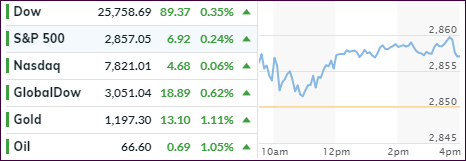
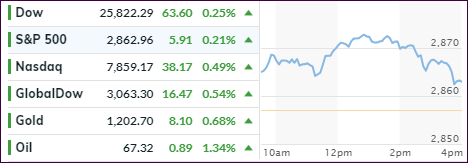
 MAJOR INDEXES RETREAT FOR THE WEEK

[Chart courtesy of MarketWatch.com]
  1. Moving the markets

The primary direction for the major indexes this week was sideways to down. The Dow and S&P gave back -0.5%, their third weekly declines of the past four, while the Nasdaq sank -0.7%.

The more dramatic action happened in Italy and the Emerging Markets (EMs) with Italian stocks, bonds, banks and credit all dumping this week. While EM’s foreign exchange and debt collapsed, their stocks declined more modestly putting our EEM holding within striking distance of triggering its trailing sell stop.

Bucking the trend again were SmallCaps by rising +0.1% today to a third straight record close and third positive week, which was its longest streak since January.

Trade talks with China took a spin for the worse creating more anxiety and nervousness among traders as “progress” was a word nowhere to be uttered neither by the U.S. nor China. Alleged offers made by China on Thursday were promptly denied on Friday.

Even a small assist from sliding 10-year bond yields, which early on made an intra-day of 3.11%, but in the end gave back 5 basis points to close at 3.06%, did nothing to prop up equities.

So, we end this week still stuck in a sideways pattern and wondering if climbing bond yields will bring an end to this bullish run, or if a new driver emerges to push this market out of the doldrums.

Read More

Weekly StatSheet For The ETF Tracker Newsletter – Updated Through 05/17/2018

Ulli ETF StatSheet Contact

ETF Data updated through Thursday, May 17, 2018

Methodology/Use of this StatSheet:

From the universe of over 1,800 ETFs, I have selected only those with a trading volume of over $5 million per day (HV ETFs), so that liquidity and a small bid/ask spread are assured.

1. Trend Tracking Indexes (TTIs)

Buy or Sell decisions for Domestic and International ETFs (section 1 and 2), are made based on the respective TTI and its position either above or below its long-term M/A (Moving Average). A crossing of the trend line from below accompanied by some staying power above constitutes a “Buy” signal. Conversely, a clear break below the line constitutes a “Sell” signal. Additionally, I use a 7.5% trailing stop loss on all positions in these categories to control downside risk.

2.  All other investment arenas do not have a TTI and should be traded based on the position of the individual ETF relative to its own respective trend line (%M/A). That’s why those signals are referred to as a “Selective Buy.” In other words, if an ETF crosses its own trendline to the upside, a “Buy” signal is generated. Since these areas tend to be more volatile, I recommend a wider trailing sell stop of 7.5% -10% depending on your risk tolerance.

If you are unfamiliar with some of the terminology, please see Glossary of Terms and new subscriber information in section 9.


  1. DOMESTIC EQUITY ETFs: BUY — since 4/4/2016

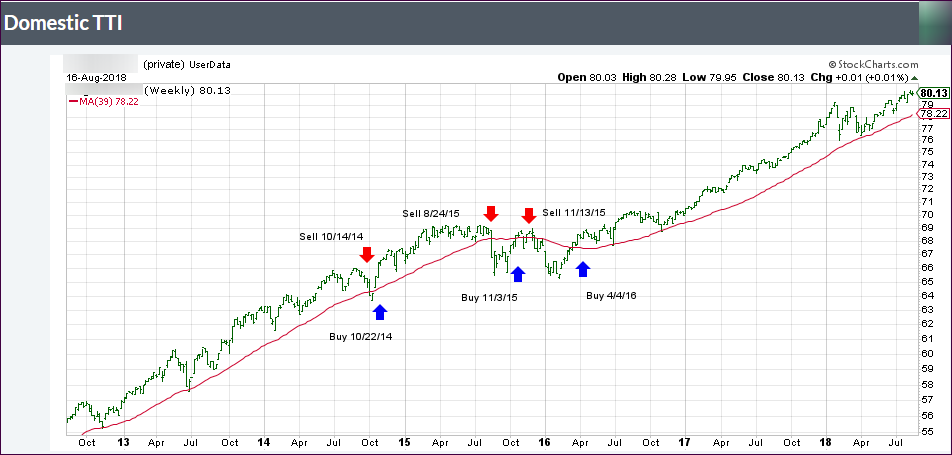
Click on chart to enlarge

Our main directional indicator, the Domestic Trend Tracking Index (TTI-green line in the above chart) is positioned above its long-term trend line (red) by +1.99% after having generated a new Domestic Buy signal effective 4/4/2016 as posted.

Read More

Rising Bond Yields Keep Markets In Check

Ulli Market Commentary Contact

[Chart courtesy of MarketWatch.com]
  1. Moving the markets

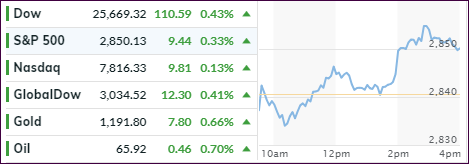
An early rally lost steam with the major indexes heading south and closing slightly in the red. It was mixed picture as weakness in the tech arena could not be offset by advancing energy shares and continued strength in SmallCaps (+0.48%).

Rising bond yields affected the defensive sectors like utilities (-0.9%) and real estate (-0.5%), which were heading south on a slippery slope. Today was no exception, as the 10-year bond yield kept crawling higher and added 2 basis points to close at 3.11%—nearly a 7-year high.

As I mentioned yesterday, climbing yields can only be ignored for so long before they take a bite out of equity gains. Not helping matters were President Trump’s comments about the ongoing U.S./China trade talks, currently held in Washington, when he said that expectations for the negotiations were low.

In the end, none of the events of the day were conducive to produce the bullish case for equities. Higher bond yields will simply remain the elephant in the room for equities, which means they present a glass ceiling that will be hard to crack.

Read More

Poor Economic Data—Markets Rally

Ulli Market Commentary Contact

[Chart courtesy of MarketWatch.com]
  1. Moving the markets

When weak data points appear, one way to deal with them is to simply ignore them. That’s what traders did today, as Housing Starts and Permits tumbled in April (-3.7% MoM and -1.78% MoM respectively), although March permits were revised upwards from +1.9% Mom to 3.6% MoM).

This was followed by a plunge of ReFi applications to 10 year lows, thanks to the Fed’s recent rate hikes and the subsequent spike in mortgage rates.

However, these economic data dumps did nothing other than to push the broad markets higher and to also send SmallCaps (Russell 2000) to a record high. The US Macro Surprise Index confirmed that US economic data are the weakest and most disappointing in 7 months (hat tip to ZH for these numbers).

While Treasury bond yields traded in a narrow range, the trend was up with the 10-year yield rising 1 basis point to close at 3.09%. Overcoming these headwinds was a challenge that traders managed to handle well, at least for today, by keeping the bullish theme alive. However, should the bond yield spike continue unabated, we will run into a scenario that will simply be no longer sustainable for the bullish cause.

Read More

Spiking Bond Yields Equals Sinking Equities

Ulli Market Commentary Contact

[Chart courtesy of MarketWatch.com]
  1. Moving the markets

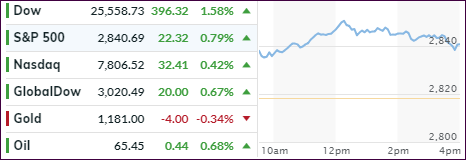
It all started with an April slowdown in retail sales from a revised higher (+0.8%) March number to a lame +0.3% in April indicating a lack of follow through growth. That sent equities lower right after the opening to a level at which the indexes vacillated till closing with the Dow and Transports dipping into the red YTD.

The VIX had its own wild ride by dropping early to the 12 handle only to rebound sharply to touch the 15 number, a rally that kept the indexes pinned below their respective unchanged lines. Remember, a rising VIX causes lower stock prices and vice versa.

But the bloodbath occurred in Treasury Bonds with the yield on the 10-year spiking 8 basis points to an intra-day high of 3.09% but settling at 3.08%, it’s highest since 2011 and its largest single-day jump since March. That punished bond prices with the 20-year (TLT) gapping down and losing -1.14%.

This jump in yield came among continued worries about the uncertainty caused by the deadlock of trade negotiations between the U.S. and China. The fear remains that a clash, or no resolution, may push prices and inflation higher affecting bonds negatively.

It now remains to be seen if the recent channel breakout of the S&P was head fake, which I believe could be true, especially if interest rates continue their path higher. If they retreat, we might see a resumption of the recent trend line bounce.

Read More