ETF Tracker Newsletter For May 25, 2018

Ulli ETF Tracker Contact

ETF Tracker StatSheet

https://theetfbully.com/2018/05/weekly-statsheet-for-the-etf-tracker-newsletter-updated-through-05-24-2018/

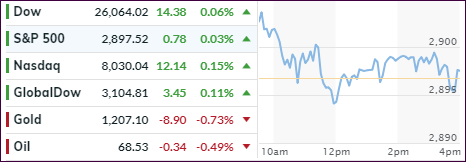
CRUDE OIL TUMBLES AND MAJOR INDEXES SLIP

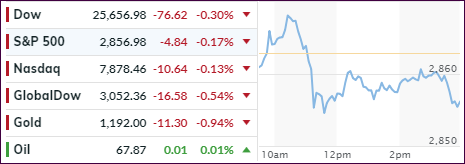
[Chart courtesy of MarketWatch.com]
  1. Moving the markets

Crude oil took a dive today (-4.5%) as reports that OPEC, along with other major players in this arena, may increase production by as much as $1 million barrels a day. The energy sector followed suit with XLE dropping -2.6% for the session and -4.5% for the week.

The major indexes fared better despite having a see-saw week and, while slipping today, managed to eke out some small gains for the past 5 trading days by adding +0.2% (Dow), +0.3% (S&P) and 1.1% (Nasdaq).

Geopolitical headlines dominated, and it appears that the U.S./N. Korea summit may be back on after Trump’s cancellation yesterday. There was no impact on market behavior during today’s session as this on/off cycle now appears meaningless and may be repeated several more times.

Turmoil in other markets continues, especially in bonds where the bears, betting on higher rates, have been slaughtered recently as 10-year yields, which made a high of 3.11%, suddenly turned around and headed south closing today at 2.93%.

And the trouble in Europe took center stage with ZeroHedge reporting Italy as the biggest headline maker:

  1. Italian stocks worst week since Nov 2016 (US election)
  2. Italian stocks worst two-week drop Jun 2016 (Brexit)
  3. Italian banks worst week since Jun 2016 (Brexit)
  4. Italian 2Y Spread to Bunds biggest spike since July 2012
  5. Italian redenomination risk biggest spike ever to record high…

As I said before, events from Europe, as well as negative developments from Deutsche Bank (DB), have the ability to affect markets and interest rates in the U.S. For example, European banks had a downright ugly week, which caused their U.S. counterparts to suffer as well although to a lesser degree.

What caused this sudden reversal in bond yields? No one has the answer yet, but it could be, just maybe, that the widely proclaimed strength in the U.S. economy is not what it’s cracked up to be. It certainly is a possibility motivating the Fed to ease up a bit on its intention of higher rates, and letting inflation shoot past its intended 2% target in order to not negatively impact the economy.

We’ll have to be patient and wait for the outcome. In the meantime, I hope you’re having a great and relaxing Memorial weekend.

Read More

Weekly StatSheet For The ETF Tracker Newsletter – Updated Through 05/24/2018

Ulli ETF StatSheet, Uncategorized Contact

ETF Data updated through Thursday, May 24, 2018

Methodology/Use of this StatSheet:

  1. From the universe of over 1,800 ETFs, I have selected only those with a trading volume of over $5 million per day (HV ETFs), so that liquidity and a small bid/ask spread are assured.
  2. Trend Tracking Indexes (TTIs)

Buy or Sell decisions for Domestic and International ETFs (section 1 and 2), are made based on the respective TTI and its position either above or below its long-term M/A (Moving Average). A crossing of the trend line from below accompanied by some staying power above constitutes a “Buy” signal. Conversely, a clear break below the line constitutes a “Sell” signal. Additionally, I use a 7.5% trailing stop loss on all positions in these categories to control downside risk.

  1. All other investment arenas do not have a TTI and should be traded based on the position of the individual ETF relative to its own respective trend line (%M/A). That’s why those signals are referred to as a “Selective Buy.” In other words, if an ETF crosses its own trendline to the upside, a “Buy” signal is generated. Since these areas tend to be more volatile, I recommend a wider trailing sell stop of 7.5% -10% depending on your risk tolerance.

If you are unfamiliar with some of the terminology, please see Glossary of Terms and new subscriber information in section 9.


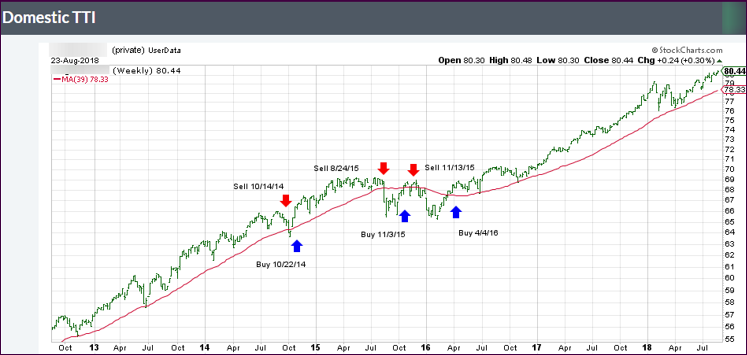
  1. DOMESTIC EQUITY ETFs: BUY — since 4/4/2016

Click on chart to enlarge

Our main directional indicator, the Domestic Trend Tracking Index (TTI-green line in the above chart) is positioned above its long-term trend line (red) by +2.04% after having generated a new Domestic Buy signal effective 4/4/2016 as posted.

Read More

Equities Dive And Thrive

Ulli Market Commentary Contact

[Chart courtesy of MarketWatch.com]
  1. Moving the markets

The Major Indexes took a steep dive right after the opening bell caused by geopolitical concerns, as President Trump canceled the widely anticipated summit with N. Korea’s Kim Jong Un. The reason given was alleged “open hostility” from the country.

Not helping matters was weakness in the energy sector (-1.7%) and in financials (-0.7%). However, the markets found a bottom at mid-morning thanks to dip-buyers, which was followed by a slow climb back towards the unchanged line. Even though we fell short, the early morning losses were sharply reduced.

Far more concerning to me is the state of affairs of Deutsche Bank (DB), the largest derivatives holder in the world with over $50 trillion, while the market capitalization of the bank has dwindled down to some $22 billion. Why is that important?

The bank appears to be crumbling with its stock price now approaching the critical $10 level and that in the face of an upcoming possible S&P downgrade within the next couple of weeks. A downgrade could put the bank in danger of collapsing, which would have a ripple effect around the world as this bank has huge systemic risk. Take a look at this chart and be amazed as to which institutions might be affected…

Interest rates continued to do an about face with the 10-year bond yield slipping not just 3 basis points to 2.98% but closing below the psychologically important line in the sand, namely the 3% level. Whether this current down trend will continue or not is anybody’s guess, but if it does, it certainly could give a boost to equities.

Read More

Early Slide Followed By A Late Ramp

Ulli Market Commentary Contact

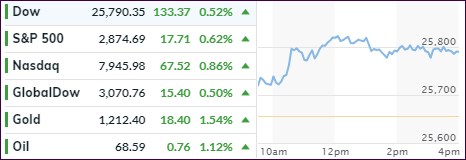
[Chart courtesy of MarketWatch.com]
  1. Moving the markets

For most of the session, the major indexes were aimlessly meandering below their respective unchanged lines waiting for the release of the Fed minutes in anticipation of possible changes to interest rate policy.

In a sense, that wait was rewarded as markets interpreted the FOMC minutes as “dovish” meaning that rate hikes may not arrive in such an aggressive manner as anticipated. Although the Fed pretty much confirmed a June hike, the 2% inflation target, which was hit back in March, was adjusted. It was noted that if inflation moves slightly above that target, it might do so only temporarily.

In other words, the 2% level is no longer a hard number to be strictly adhered to. Or, you could interpret this as “we’ll move the goal posts whenever it suits our purpose.”

Market reaction was instant with bond yields tumbling as the 10-year slipped back to its 3% level scoring its biggest drop in just about 2 months and settling at one-week lows. Bond prices, which move opposite to yields, were the beneficiary with the 20-year bond (TLT) gaining +0.73%.

The major indexes scrambled back above their respective unchanged lines and scored modest gains with the Nasdaq leading the pack with +0.64%, while the US Dollar (UUP) reduced early gains but still ended up +0.41%.

Read More

Trade Wars: Optimism Gives Way To Pessimism; Major Indexes Sink

Ulli Market Commentary Contact

[Chart courtesy of MarketWatch.com]
  1. Moving the markets

Yesterday’s rally, which was entirely powered by hope for a U.S./China trade resolution, came under pressure today, after an early follow through ramp petered out in the afternoon with the major indexes heading straight south into the red scoring modest losses.

Pessimism replaced optimism as uncertainties over trade policy and geopolitical issues took center stage. Responding to reporters if he was happy with the current state of the trade talks, President Trump responded with “not really” and that negotiations “have a long way to go.” Not exactly the kind of ‘progress’ report markets had expected, and down we went.

Adding fuel to the fire were reports that in regards to the upcoming historical meeting between Trump and N. Korea’s Kim Jong Un, Trump said that such a meeting may happen later than currently scheduled. That was followed White House headlines that any new nuclear deal with Iran would be subject to a list of demands.

None of these developments were soothing to Wall Street traders, who adopted a wait-and-see attitude. All of the above mentioned events really don’t have any major direct economic impact, but are more of a psychological nature causing uncertainty and keeping markets stuck in a broad range.

Read More

Easing Trade War Fears Power Markets

Ulli Market Commentary Contact

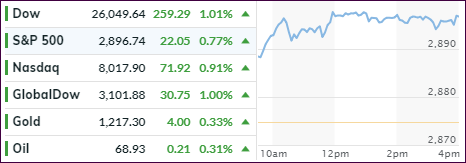
[Chart courtesy of MarketWatch.com]
  1. Moving the markets

Right after the opening bell, the major indexes jumped and remained firmly entrenched above the unchanged line for the entire session gaining solidly across the board.

Causing this euphoria was hope that the U.S./China trade animosities and rhetoric finally softened after weekend news that the Trump administration would delay implementation of tariffs on Chinese goods. In other words, they agreed to put the current hostilities on hold until a new deal can be worked out.

That’s all it took and off to the races we went without looking back. Actually, there were a lot of uncertainties to be concerned with. If you followed the weekend news, you noticed that Emerging Markets are still in stumble mode, which started back in February with lower lows being interrupted by periodic bounces.

Then there were the Italian financial markets, which are imploding due to sharply spiking rates while domestic bond yields and the U.S dollar were stuck and going nowhere. Italy took the headlines in Europe with one analyst proclaiming that “the Italian 2-year yield has given back 3 years of monetary suppression in 6 trading days.” How bad was it? This chart makes it abundantly clear while I am pondering the question if this could be the canary in the coalmine.

But none of this mattered today, as the main objective was to push the Dow back above 25k, which was accomplished with the help of not letting an early VIX rally (translates into lower stock prices) get out of hand.

Read More