Weekly StatSheet For The ETF Tracker Newsletter – Updated Through 02/28/2019

Ulli ETF StatSheet Contact

ETF Data updated through Thursday, February 28, 2019
Methodology/Use of this StatSheet:

  1. From the universe of over 1,800 ETFs, I have selected only those with a trading volume of over $5 million per day (HV ETFs), so that liquidity and a small bid/ask spread are assured.
  2. Trend Tracking Indexes (TTIs)

Buy or Sell decisions for Domestic and International ETFs (section 1 and 2), are made based on the respective TTI and its position either above or below its long-term M/A (Moving Average). A crossing of the trend line from below accompanied by some staying power above constitutes a “Buy” signal. Conversely, a clear break below the line constitutes a “Sell” signal. Additionally, I use a 7.5% trailing stop loss on all positions in these categories to control downside risk.

  1. All other investment arenas do not have a TTI and should be traded based on the position of the individual ETF relative to its own respective trend line (%M/A). That’s why those signals are referred to as a “Selective Buy.” In other words, if an ETF crosses its own trendline to the upside, a “Buy” signal is generated. Since these areas tend to be more volatile, I recommend a wider trailing sell stop of 7.5% -10% depending on your risk tolerance.

If you are unfamiliar with some of the terminology, please see Glossary of Terms and new subscriber information in section 9.


  1. DOMESTIC EQUITY ETFs: BUY — since 02/13/2019
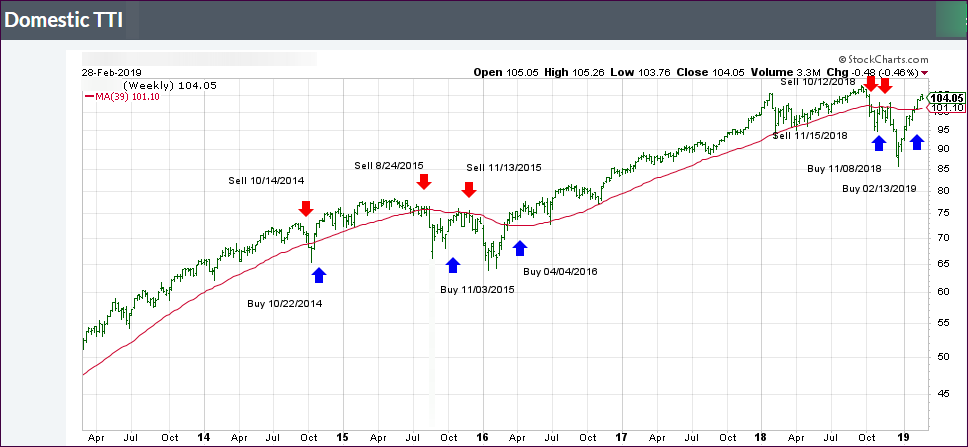
Click on chart to enlarge

Our main directional indicator, the Domestic Trend Tracking Index (TTI-green line in the above chart) is now positioned above its long-term trend line (red) by +2.98% after having generated a new Domestic “Buy” signal effective 2/13/19 as posted.
Read More

Clawing Back

Ulli Market Commentary Contact

[Chart courtesy of MarketWatch.com]
  1. Moving the markets

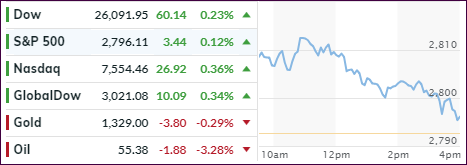
We started the day out in the red with some economic data contributing to the slide as US factory orders fell for the second month in a row. January pending home sales managed to rebound more than expected (+4.6% vs. 1% MoM) but continued to tumble year-over-year for the 13th straight month.

Then it was US trade rep Lighthizer’s turn to put out some negative vibes by stating that it’s “too early to tell” if a trade deal will happen, despite Trump and Xi planning to meet next month to iron out some details.

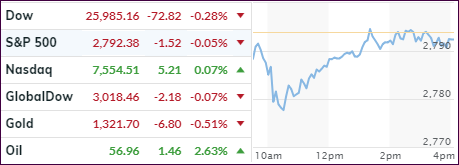
Equities tumbled but managed a mid-day come-back, which faded into the close. The Nasdaq reclaimed the unchanged line by the tiniest of margins, while the Dow and S&P 500 stayed slightly in the red.

It seems like we are witnessing a consolidation phase with the S&P 500 (SPY) knocking at the 2,800 level for the 4th time in 5 months, after the 3 prior attempts were rebuffed. If a break-through materializes, we’ll have a clear shot of taking out the old highs made last September. If it fails, we’ll be heading back south again.

Read More

Struggling For Dominance

Ulli Market Commentary Contact

[Chart courtesy of MarketWatch.com]
  1. Moving the markets

The markets were on standby this morning hanging on every word that Fed chair Powell was uttering at a congressional testimony. He confirmed that the central bank has adopted a wait-and-see approach due to some economic data having pointed to slower U.S. growth, despite a report showing an increase in consumer confidence.

He added that “the job market remains strong” and “we are seeing signs of stronger wage growth,” a remark that may have some members of his interest rate committee consider voting for a hike in rates in order to front-run any resulting inflation.

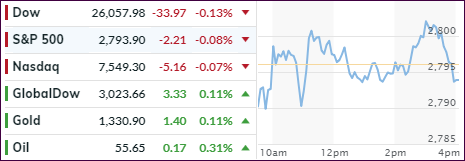
With no new earth-shaking news coming our way from the U.S.-China trade talks, the markets focused on the above, with bulls and bears slugging it out around the unchanged line with no clear winner at the end.

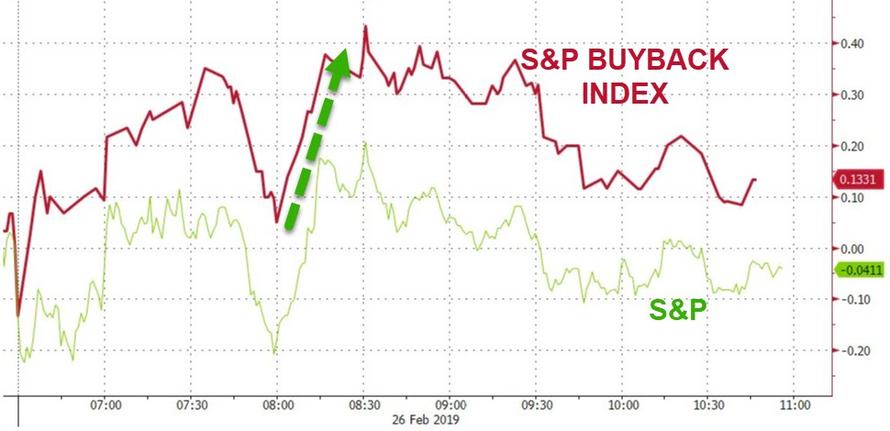
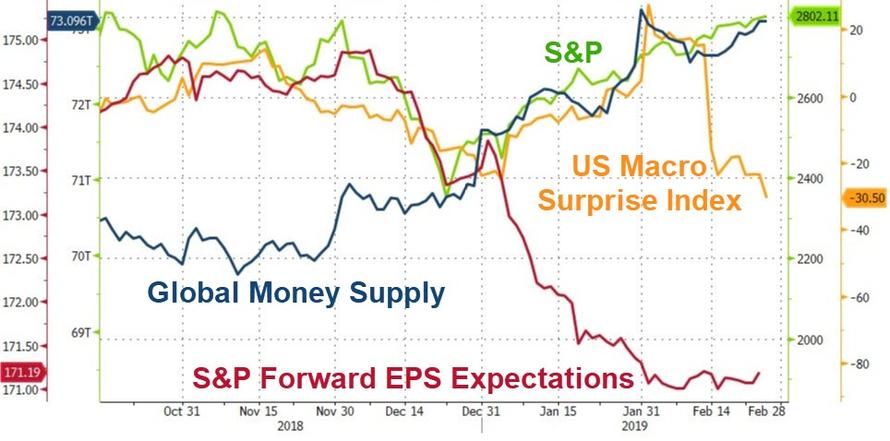
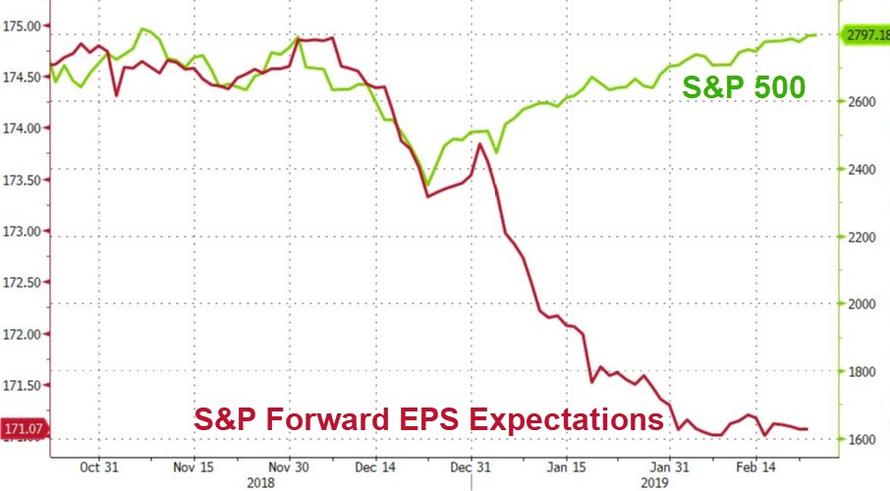
The S&P 500 ran into tough overhead resistance at the 2,800 level again and seemed to take directional cues from the S&P Buyback index. Looking at big picture, we see an interesting trend. Namely, that the S&P 500 follows Global Money Supply, while being out of sync with the US Macro Surprise Index and forward EPS expectations.

Eventually, something will have to give to bring these indicators back into alignment. Will the S&P 500 move down or will the other 2 indicators move up?

Read More

Bouncing And Fading

Ulli Market Commentary Contact

[Chart courtesy of MarketWatch.com]
  1. Moving the markets

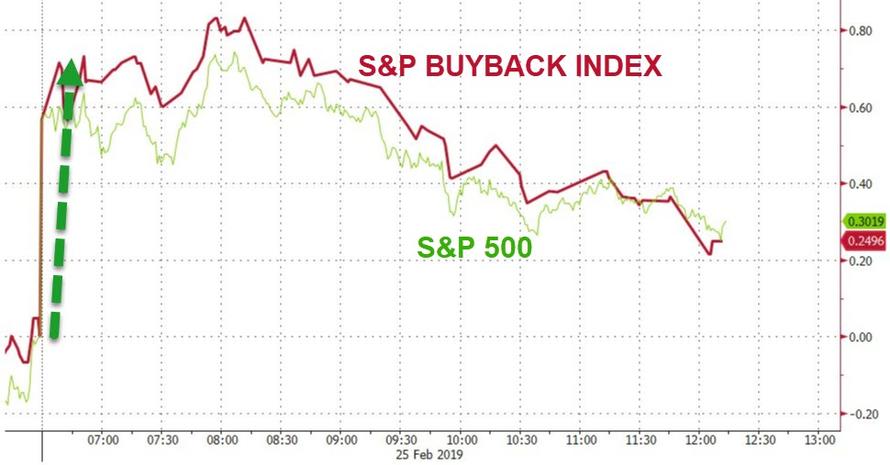
An early bounce had the S&P 500 piercing its overhead resistance zone, namely the 2,800 point. However, the index was not able to hold on, as a slow and steady decline pulled equities off their lofty levels. Good thing we ran out of time, or we might have seen a red close.

As it turned out, the major indexes ended up only fractionally in the green, as early euphoria, that Trump may be inclined to delay China tariffs, waned. But he said that “substantial progress” in trade talks have been made over the weekend.

So, the trade deal headlines appear to be a wonderful tool to keep the markets in check now that the earnings season has ended. Any economic news, no matter how poor they are, register as “good news” for the computer algos, as we’ve seen last week when retail sales collapsed.

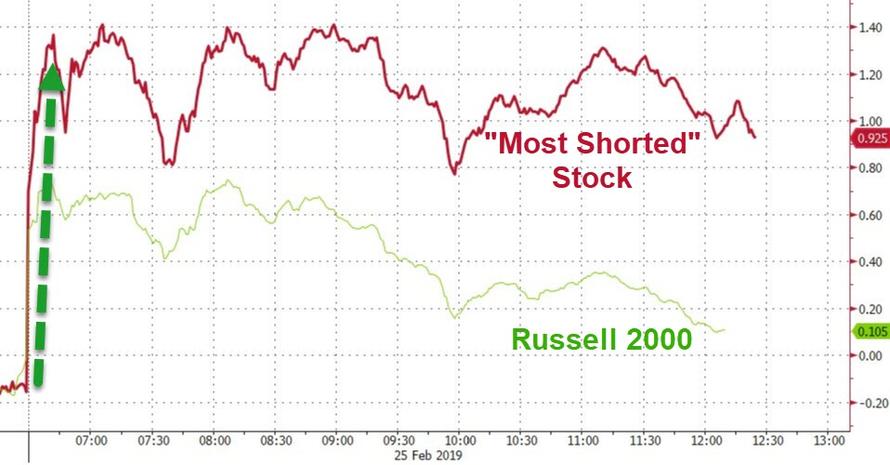
Additional assists supporting the early rally came from corporate buybacks and a huge short squeeze, both of which were the spark that got things going. And then there is this diversion, which, no matter how many times I post it, leaves me pondering: Who will be right in the end?

Read More

ETFs On The Cutline – Updated Through 02/22/2019

Ulli ETFs on the Cutline Contact

Below, please find the latest High-Volume ETF Cutline report, which shows how far above or below their respective long-term trend lines (39-week SMA) my currently tracked ETFs are positioned.

This report covers the HV ETF Master List from Thursday’s StatSheet and includes 322 High Volume ETFs, defined as those with an average daily volume of more than $5 million, of which currently 222 (last week 189) are hovering in bullish territory. The yellow line separates those ETFs that are positioned above their trend line (%M/A) from those that have dropped below it.

Take a look:

The HV ETF Master Cutline Report

In case you are not familiar with some of the terminology used in the reports, please read the Glossary of Terms.

If you missed the original post about the Cutline approach, you can read it here.