No Market Commentary

Ulli Uncategorized Contact

As I posted yesterday, I will not be able to write today’s commentary nor tomorrow’s “ETFs on the Cutline” report.

Regular posting will resume on Monday.

Ulli…

Weekly StatSheet For The ETF Tracker Newsletter – Updated Through 05/02/2019

Ulli ETF StatSheet Contact

ETF Data updated through Thursday, May 2, 2019

Methodology/Use of this StatSheet:

  1. From the universe of over 1,800 ETFs, I have selected only those with a trading volume of over $5 million per day (HV ETFs), so that liquidity and a small bid/ask spread are assured.
  2. Trend Tracking Indexes (TTIs)

Buy or Sell decisions for Domestic and International ETFs (section 1 and 2), are made based on the respective TTI and its position either above or below its long-term M/A (Moving Average). A crossing of the trend line from below accompanied by some staying power above constitutes a “Buy” signal. Conversely, a clear break below the line constitutes a “Sell” signal. Additionally, I use a 7.5% trailing stop loss on all positions in these categories to control downside risk.

  1. All other investment arenas do not have a TTI and should be traded based on the position of the individual ETF relative to its own respective trend line (%M/A). That’s why those signals are referred to as a “Selective Buy.” In other words, if an ETF crosses its own trendline to the upside, a “Buy” signal is generated. Since these areas tend to be more volatile, I recommend a wider trailing sell stop of 7.5% -10% depending on your risk tolerance.

If you are unfamiliar with some of the terminology, please see Glossary of Terms and new subscriber information in section 9.


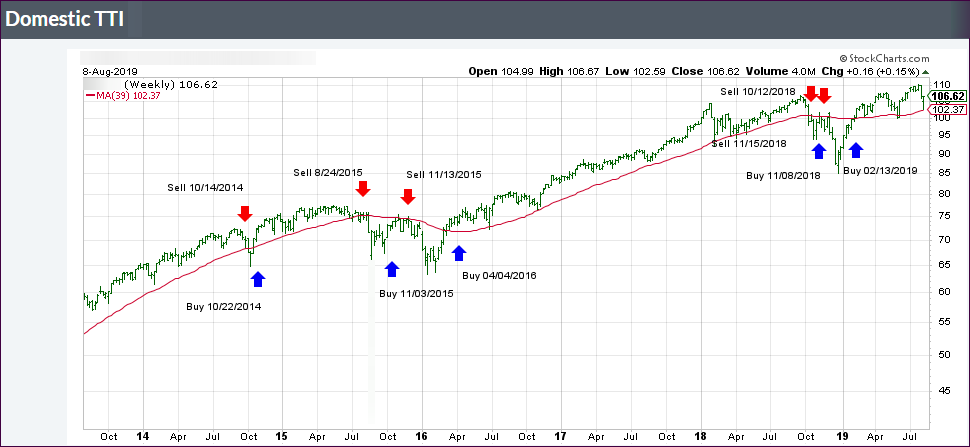
  1. DOMESTIC EQUITY ETFs: BUY — since 02/13/2019

Click on chart to enlarge

Our main directional indicator, the Domestic Trend Tracking Index (TTI-green line in the above chart) is now positioned above its long-term trend line (red) by +5.73% after having generated a new Domestic “Buy” signal effective 2/13/19 as posted.

Read More

Markets In Retreat Mode

Ulli Market Commentary Contact

[Chart courtesy of MarketWatch.com]
  1. Moving the markets

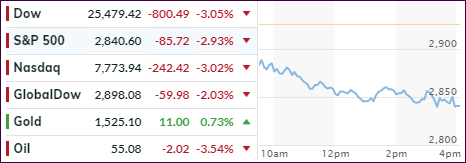
After an early meandering around their respective unchanged lines, the major indexes took a sudden steep dive and quickly red numbers spread across traders’ computer screens.

The scramble to find the culprit was on. Turns out that news by the India press that US-China trade negotiations had hit a brick wall, and thereby an impasse, caused the already nervous Wall Streeters, which were still reeling from the Fed’s “transitory hawkishness,” to push the sell buttons. The Dow dropped some 220 points before finding a bottom.

ZeroHedge, as always tongue-in-cheek, was quick to tweet a suggestion to the White House to resolve this sudden and unexpected market drop:

White House to do list:

1) Unleash the Kudlow

2) call the PPT

3) demand QE

Despite no White House response, the major indexes managed to climb back and cut the early losses in half with the Dow now heading towards its second down week in a row since December 21st.

When well-known indexes, such as the S&P 500, make a new all-time high, and there is no confirmation from another well-known index covering the same markets, such as the NYSE, you must wonder if history will repeat itself regarding the subsequent -20% sell-off. ZH posted this chart, leaving open the question as to whether the lack of the NYSE making its new all-time high again could be a bad omen for the S&P 500.

On a personal note, I am out tomorrow and will not be able to write the market commentary nor Saturday’s ‘ETFs on the Cutline’ report. My wife and I will be traveling out of town celebrating my son’s college graduation.

Regular posting will resume on Monday.

Read More

Fed Does Not Cave To White House Demands — Holds Rates Steady, Disappoints Markets

Ulli Market Commentary Contact

[Chart courtesy of MarketWatch.com]
  1. Moving the markets

The session started with the major indexes edging higher, that is until the Fed came out stating that current “policy is appropriate with no bias to hike or cut.” Powell further elaborated that U.S. inflation is “possibly being dragged down by ‘transitory’ forces” and that their current stance is “appropriate right now” and “we don’t see a strong case for moving in either direction.

That put an end to the rumor that the White House is dictating Fed policy and most likely also served as a face-saving action by the Fed, which it had been in dire need of, ever since the sudden policy U-turn last December.

The markets were hoping for a more “dovish” stance from the Fed, so traders decided to hit the sell buttons during the last hour to share their disappointment with the investing public. Apparently, the Fed’s use of the word “transitory” did not only have a negative effect on stocks but also bonds and gold, while the US dollar benefited and spiked.

Economic news continued to present more negatives. The manufacturing index plunged to October 2016 lows, while the gauge for export orders dropped below 50 for the first time in three years, as imports missed the threshold for the first time in two years, according to ZH.

This ended up being a poor start to the month of May, and we’ll have to wait and see if the adage “sell in May and go away,” proves to be correct again.

Read More

An Early Struggle Followed By A Late Rebound

Ulli Market Commentary Contact

[Chart courtesy of MarketWatch.com]
  1. Moving the markets

A sudden mid-morning drop pulled the major indexes further south, after an already weak opening caused by Google’s poor report card, which showed that revenue growth cooled off in Q1 and all major sales categories performed worse than projected. The punishment was immediate with the stock price being down some 8%.

Not helping the markets was White House Chief of Staff Mulvaney’s comment that the U.S. won’t do a deal with China, unless it’s “great.” The major indexes took it as a negative and south we went.

Not to be outdone, President Trump then reaffirmed his position towards interest rates by demanding the Fed slashes rates by 1%. And that after he called for QE4 and rate cuts earlier this month. Let’s see what happens with the outcome of the FOMC (Federal Open Market Committee), which just started its two-day meeting. We should have an answer by noon tomorrow.

The economy offered a mixed set of numbers. Consumer Confidence spiked and beat expectations. This was offset by a continued slump in home prices nationwide and a crash of the PMI data (manufacturing and services), which was its biggest 2-monthly drop in some five years.

In the end, 2 of the 3 major indexes staged a magic V-shape type of recovery back above the unchanged line, while the Nasdaq lagged and gave back -0.66%, thanks to Google’s disappointing numbers.

Tomorrow’s outcome of the Fed meeting could set market direction for the near future despite seasonal headwinds.

Read More

A Green Monday

Ulli Market Commentary Contact

[Chart courtesy of MarketWatch.com]
  1. Moving the markets

While the major indexes closed in the green to start the week, the gains were minor despite the Nasdaq scoring back to back record closes. The S&P 500 managed to notch a new intra-day high but slipped into the close barely finding support above the unchanged line.

The index has now reached an extremely overbought level, the most since January 2018, which was a moment in time that signaled an upcoming sudden and sharp correction. Complacency is high with VIX showing record short positions, which means traders are betting on a continued stream of low volatility. That is absolute insane and will not end well, as markets can turn suddenly and violently when extreme levels are reached.

Rising rates pulled interest rate sensitive sectors, such as low volatility equity and Real Estate ETFs a little lower, with the US Dollar joining the party and losing some of its luster as well, although the slide was modest.

On the economic front, we saw that consumer spending jumped 0.9% in March, its largest monthly gain in almost 10 years. Allegedly, core inflation weakened, leading traders to conclude that the Fed will not yet be motivated to change its interest rate policy.

Yet, at the same time, the US savings rate plunged, while YoY spending has accelerated beyond income growth. Yes, that is only possible because of the never-ending use of credit.

Go figure…

Read More