Weekly StatSheet For The ETF Tracker Newsletter – Updated Through 07/16/2020

Ulli ETF StatSheet Contact

ETF Data updated through Thursday, July 16, 2020
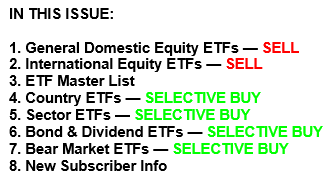
Methodology/Use of this StatSheet:

1. From the universe of over 1,800 ETFs, I have selected only those with a trading volume of over $5 million per day (HV ETFs), so that liquidity and a small bid/ask spread are assured.

2. Trend Tracking Indexes (TTIs)

Buy or Sell decisions for Domestic and International ETFs (section 1 and 2), are made based on the respective TTI and its position either above or below its long-term M/A (Moving Average). A crossing of the trend line from below accompanied by some staying power above constitutes a “Buy” signal. Conversely, a clear break below the line constitutes a “Sell” signal. Additionally, I use a 7.5% trailing stop loss on all positions in these categories to control downside risk.

3. All other investment arenas do not have a TTI and should be traded based on  the position of the individual ETF relative to its own respective trend line (%M/A). That’s why those signals are referred to as a “Selective Buy.” In other words, if an ETF crosses its own trendline to the upside, a “Buy” signal is generated. Since these areas tend to be more volatile, I recommend a wider trailing sell stop of 7.5% -10% depending on your risk tolerance.

If you are unfamiliar with some of the terminology, please see Glossary of Terms and new subscriber information in section 9.     

1. DOMESTIC EQUITY ETFs: SELL — since 06/25/2020
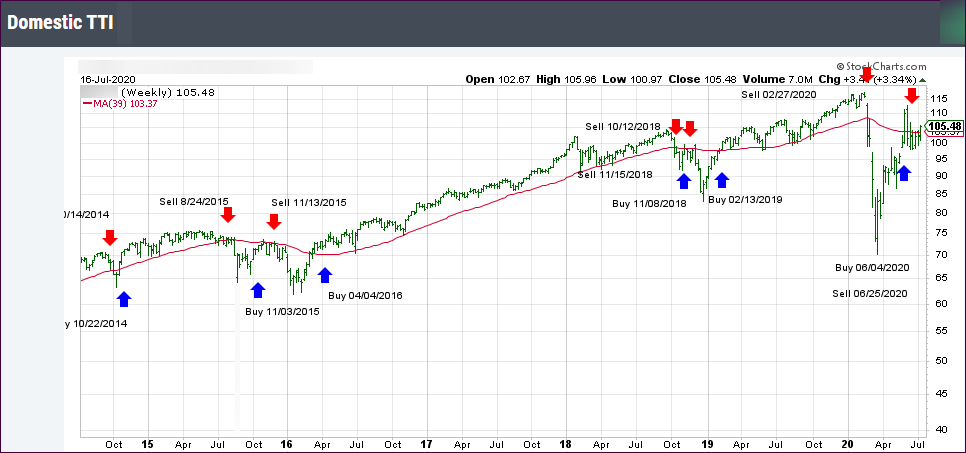
 

Click on chart to enlarge

Our main directional indicator, the Domestic Trend Tracking Index (TTI-green line in the above chart) has now rallied above its long-term trend line (red) by +2.03% but is still in “Sell” mode until we see more upside verification.

Read More
Chopping And Flopping

Ulli Market Commentary Contact

[Chart courtesy of MarketWatch.com]

  1. Moving the markets

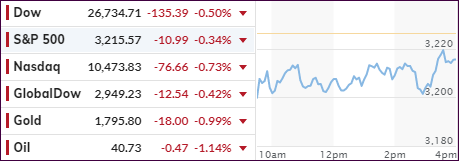
Yesterday’s hard-fought gains vanished in a hurry with bearish sentiment taking over by pulling the major indexes off their lofty levels right after the opening bell. We ended up off the lows but still in the red.

Contributing to the drop were mixed corporate earnings and questionable econ data, as well as an early drop in the Asian markets. Chinese stocks suffered their biggest one-day loss since the beginning of the pandemic.

Domestically, tech stocks/ETFs have been on a tear YTD but are starting to look a little wobbly, yet they are not even close to triggering their respective trailing sell stops.

Big banks so far have delivered earnings in line with expectations mainly by showing outsized gains in their trading divisions, but BofA stumbled somewhat due to concerns about the boost in its loan loss provisions. However, with the bar set extremely low for second quarter earnings, it comes as no surprise that any “beat” will be cheered as a bullish event by the headline scanning computer algos.

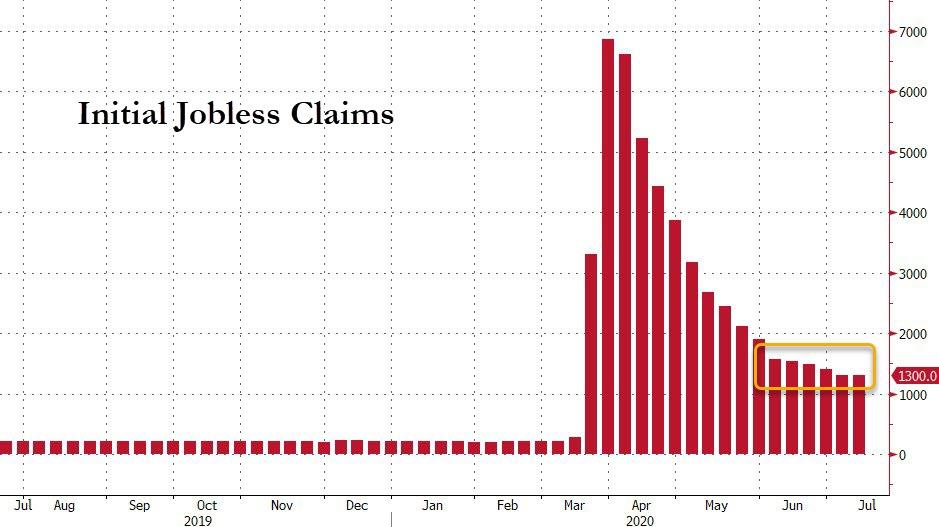
Despite hopes for a recovery, non-farm payroll data continued to paint a not so good picture, as over 50 million Americans have now filed for first-time jobless benefits since the lockdown began. Today’s data showed another 1.3 million first time filings vs. an expected 1.25 million, according to ZH, with Bloomberg adding the visual picture.

It’s no secret that the Fed is controlling the markets, and we are ever so close to face a managed economy. I grew up in one, but you probably did not, so Michael Every from Rabobank explained about an economy that could never keep supply matching consumer demand, such as the old Soviet system was famous for:

A man goes into the Soviet car showroom and asks to buy a car. The disinterested salesman doesn’t even put out his cigarette and says, “We only take 100% cash payments.” The man puts down a bag full of rubles on the table. The salesman sits up and counts them greedily.

“The only color is grey,” he informs the customer as he counts.

“No problem,” the man replies. “When will it arrive?”

The salesman slowly looks through a dog-eared book and says “Mmm…….five years from today.”

The customer nods sagely; and then asks: “Morning or afternoon?”

“What do you care morning or afternoon?” asks the salesman “It’s five years from now!”

“Well,” says the customer, “I am getting my fridge in the morning.”

It struck my funny bone and hopefully this moment of lightheartedness can bring smile on your face in this all too uncertain world.

Read More

Bouncing Higher In Choppy Trading

Ulli Market Commentary Contact

[Chart courtesy of MarketWatch.com]

  1. Moving the markets

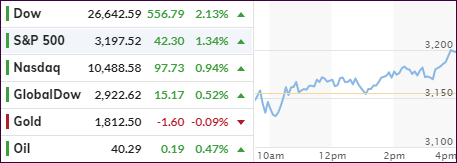
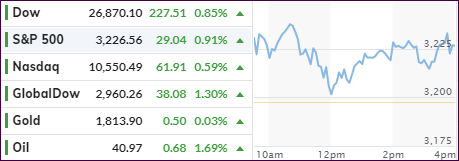
An early ramp ran into resistance with the major indexes pulling back sharply, and the Nasdaq dipping into the red, but a mid-session bounce pulled stocks out of the doldrums and into a green close. Today’s session was a lot choppier than yesterday’s rebound.

Supporting the continued bullishness was the Fed’s account of business activities in its 12 districts, which showed activity picking up, but sluggishness from the fallout of Covid-19 still being a factor. In other words, uncertainty reigns and a wave of layoff lurk on the horizon.

Given that, traders focused on some bright spots in second quarter earnings and the never-ending race for a vaccine. Moderna Inc. put itself back in the limelight and got the bulls roaring early on as its coronavirus candidate produced a “robust” immune system response in a larger group of people, according to MarketWatch.

But:

“Solicited adverse events that occurred in more than half the participants included fatigue, chills, headache, myalgia, and pain at the injection site,” the report states. Fever, joint pain, and nausea were also reported.

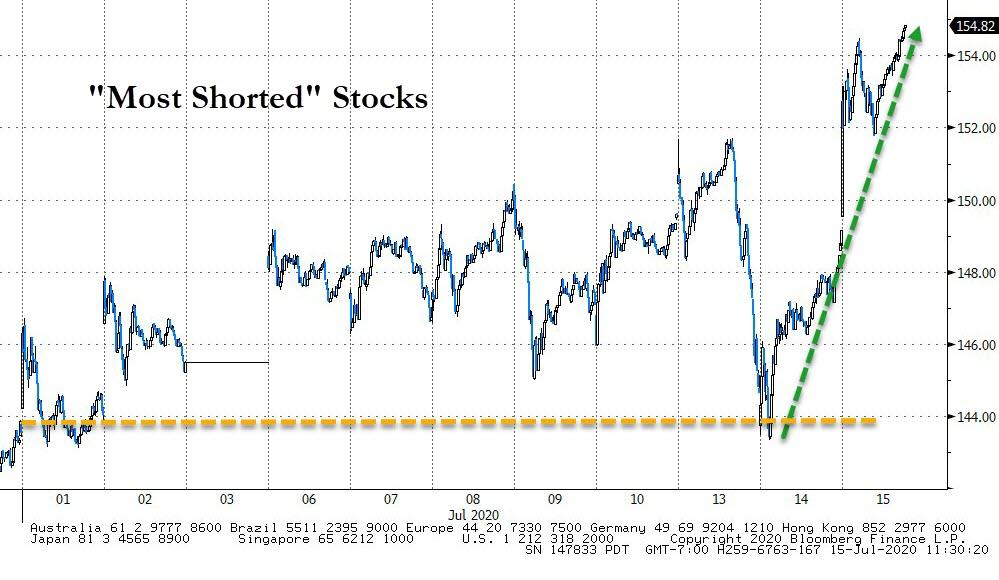
Helping the bullish Moderna story was a massive short squeeze, the biggest in 3 months, reported ZH, but it did not help the S&P 500 conquer critical resistance after testing it four times today.  

The Nasdaq lagged in performance, but broad-based advances assisted our Trend Tracking Indexes (TTIs) to conquer their respective long-term trend lines to the upside.

See section 3 for more details.

Read More

Climbing Out Of A Deep Hole

Ulli Market Commentary Contact

[Chart courtesy of MarketWatch.com]

  1. Moving the markets

While all three major indexes raced ahead and closed with solid gains, it was the Nasdaq, and to a lesser degree the S&P 500, which had to dig themselves out of a deep hole early in the session, as red numbers dominated.

The late day pump came from none other than Fed Governor Brainard, who called for a sustained large-scale asset purchase by the US Central Bank to help the economy rebound amid a “thick fog of uncertainty” brought on by Covid-19.

There you have it; how much more of a wink with a fencepost can you get? Especially, ahead of a devastating earnings season, confirming once again that fundamentals no longer matter, and we are clearly witnessing a centrally planned market environment.

Brainard also warned that the U.S. economic recovery likely “will face headwinds for some time,” and require further accommodation, while speaking during a virtual event hosted by the National Association for Business Economics.

Regarding the latest on Covid-19, ZH summed it up like this:

  • Spain places 160,000 under lockdown
  • EU drops Serbia, Montenegro from safe travel list
  • Arizona sees big jump with 4,273 new cases
  • North Carolina sees record hospitalized
  • Alabama reports record rise in deaths
  • Moderna releases latest clinical trial update
  • TMC releases latest Houston numbers
  • Philly bars all public events until Feb 2021
  • Florida positivity rate jumps to 15%+
  • Florida reports biggest jump in deaths
  • India places Bangalore back on lockdown
  • US daily cases below 60k
  • Global daily cases below 200k
  • Hong Kong imposes new restrictions
  • France makes mask wearing mandatory in public
  • Australia cases top 10k.
  • Iran closes mosques, schools
  • WHO warns: “there will be no return to normal”

For a change, we saw the Nasdaq lag again with the Dow outpacing it for the third straight day, but still trailing severely on a YTD basis.

Earnings season is on deck with JPM beating expectations despite soaring credit losses, while Wells Fargo’s CEO was “extremely disappointed” with its first quarterly loss since 2008.

More earnings reports, up and down, will be forthcoming, but to me it will be interesting to see, how much interference the Fed will run, should the markets start to get wobbly.

Read More

Markets Roll Over—Nasdaq Leads The Tumble

Ulli Market Commentary Contact

[Chart courtesy of MarketWatch.com]

  1. Moving the markets

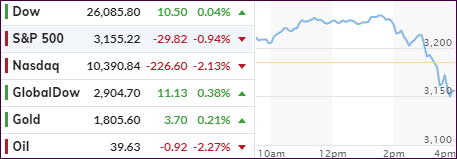
The bullish train kept on moving throughout the early part of the session, when suddenly the wheels came off, and the major indexes engaged in a swan dive, which was led in magnitude by none other than the Nasdaq.

Of course, the tech sector has been on a relentless ramp since the March lows by outperforming all other indexes. Hence, it is not surprising that it would lead on the way down as well.

The Dow held up the best by closing at its unchanged line, with the S&P surrendering -0.94% and Nasdaq being hit the hardest with -2.13%.

The initial sharp rally was fed by news from the FDA agreeing to grant “fast track” status to a couple of vaccines produced by Pfizer and a German biotech firm, which caused to the Nasdaq scoring another intraday high before hitting the skids.

Contributing to the sudden demise in sentiment was CA gov Newsom’s announcement to roll back the re-opening status to phase 1, which means closure of bars, gyms, indoor dining, movies, wineries, zoos, museums, etc.

In other words, we are going backwards, and those business barely in recovery and survival mode will have to deal with these consequences again. I am afraid, many will not survive this time.

On the other hand, the higher the number of Covid cases, and the more layoffs, the more bullish it is for stocks, commented Rabobank’s Michael Every:

… for the stock market to move substantially from this point on – since the market is now fully disconnected from fundamentals and is simply a derivative of endogenous liquidity and fund flow – Powell will need to find another justification to expand the Fed’s QE aggressively, as discussed in “JPMorgan Spots A Big Problem For Stocks.” Something like – for example – a second wave of the coronavirus pandemic.

Added ZH:

Michael is right, of course, however now that central banks basically have full control over capital markets, his job “to understand what the market is doing” basically boils down to just one thing – as Goldman explained, all investors care about first thing in the morning is whether to fight or follow the Fed. The rest no longer matters.

Such is the world we are living in and trying to guess what the markets will be doing is an exercise in futility. That is why we let long-term market direction determine our decision-making process, which includes heading for the sidelines, once our indicators flash the signal.

Read More

ETFs On The Cutline – Updated Through 07/10/2020

Ulli ETFs on the Cutline Contact

Below, please find the latest High-Volume ETF Cutline report, which shows how far above or below their respective long-term trend lines (39-week SMA) my currently tracked ETFs are positioned.

This report covers the HV ETF Master List from Thursday’s StatSheet and includes 312 High Volume ETFs, defined as those with an average daily volume of more than $5 million, of which currently 148 (last week 138) are hovering in bullish territory. The yellow line separates those ETFs that are positioned above their trend line (%M/A) from those that have dropped below it.

Take a look:                                                                   

The HV ETF Master Cutline Report

In case you are not familiar with some of the terminology used in the reports, please read the Glossary of Terms. If you missed the original post about the Cutline approach, you can read it here..