Boosted By Earnings

Ulli Market Commentary Contact

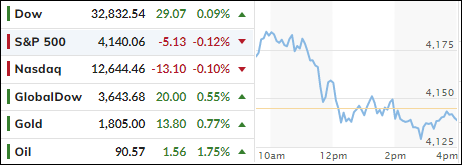
[Chart courtesy of MarketWatch.com]
  1. Moving the markets

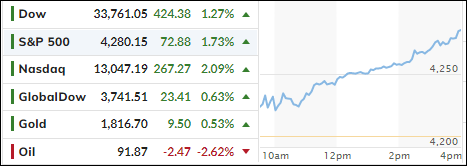
Today was comeback day with the S&P 500, after having fallen for two straight weeks, finally receiving a boost, along with the other major indexes, to end the session in the green. The Nasdaq led the charge with a gain of over 2%.

Some analysts contributed this bounce to sentiment and positioning as having been too bearish, hence a bullish response resulted, also because of better-than-expected bank earnings with Citizen’s Financial jumping more than 7%, while powerhouse JP Morgan added a more modest 2%.

A few tech and media companies like Disney (+3.8%) and Netflix (+3.7%) joined the party, while Microsoft and Alphabet each gained over 1%. “Despite recession concerns, the underlying economic data have been holding up fairly well,” added a strategist at Edward Jones.

Still, this solid rebound was astounding for two reasons:

  1. It happened in the face of a continued surge in bond yields. The 10-year added almost 8 basis points (bps), to close the session at 2.94%, with the 3% level now in striking distance. It remains to be seen whether a break above it will bring bearish sentiment back in play.
  2. The world as a whole and the IMF have slashed global growth outlooks, slamming crude oil lower, while Fed mouthpiece Bullard threated with 75 bps hikes instead of the previously announced 50 bps.

Traders and algos did not care, and the rally was on thereby erasing some of the recent losses. And, as you might have expected, the ever-lurking short squeeze gave an assist and helped sustain the bounce into the close.  

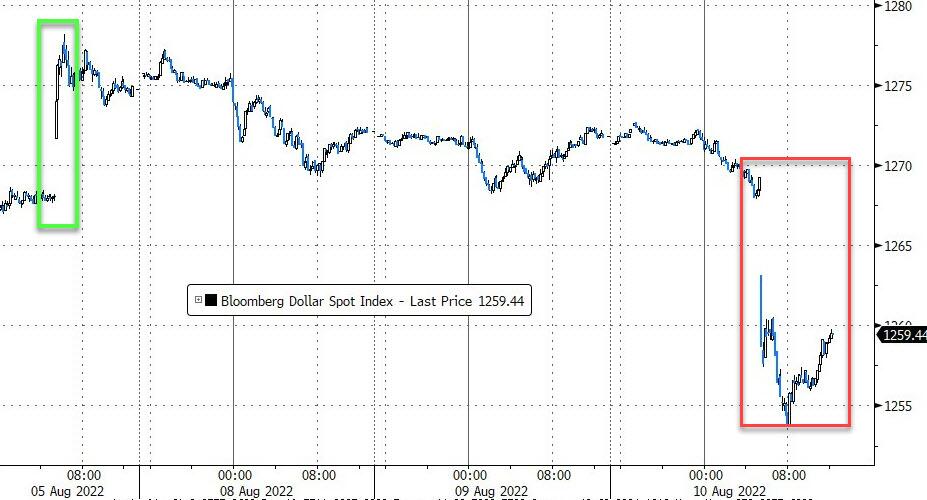
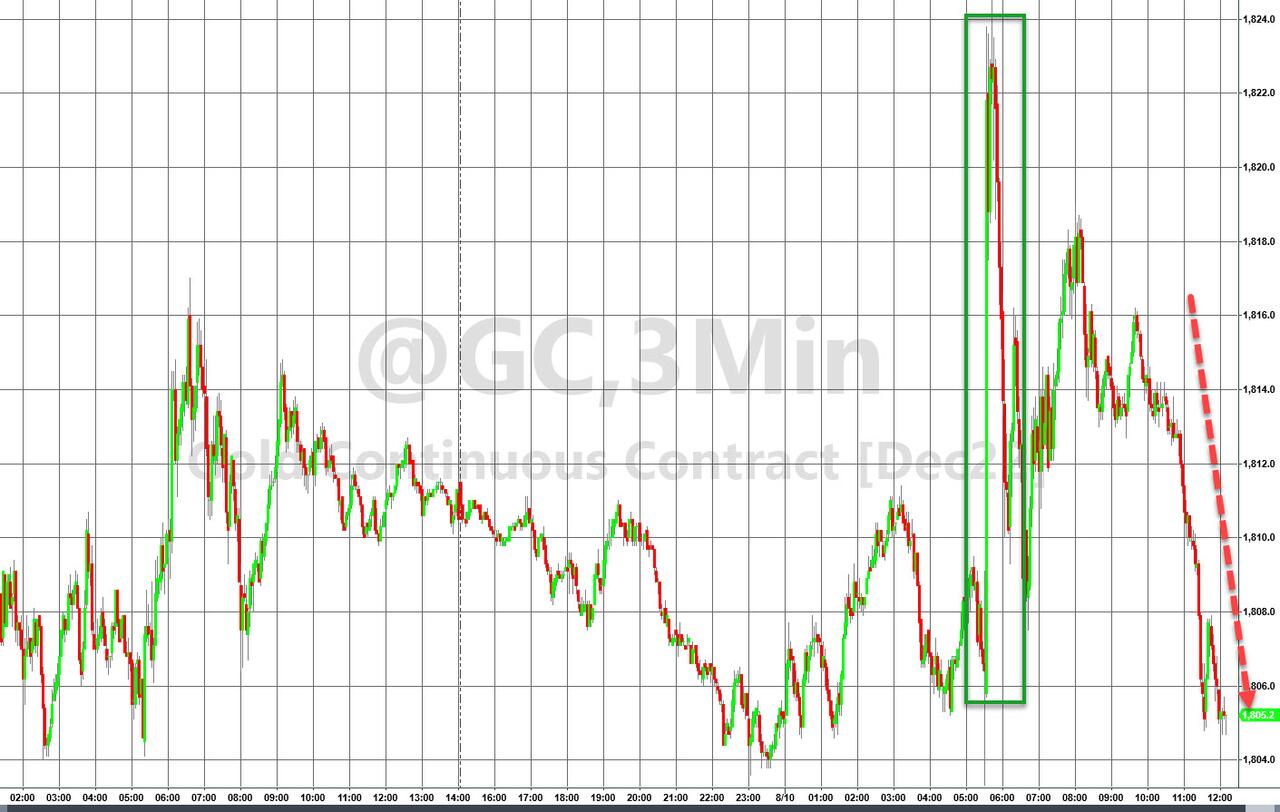
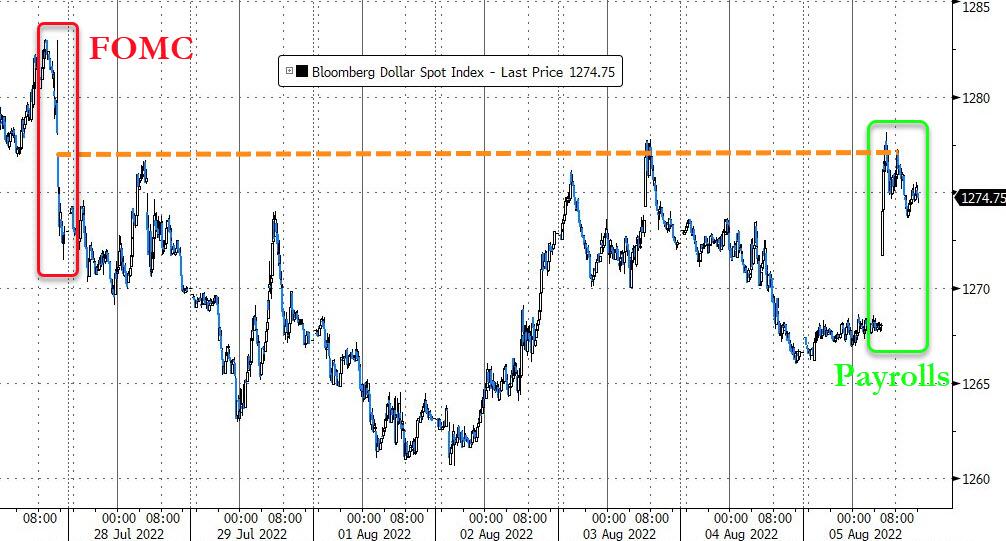
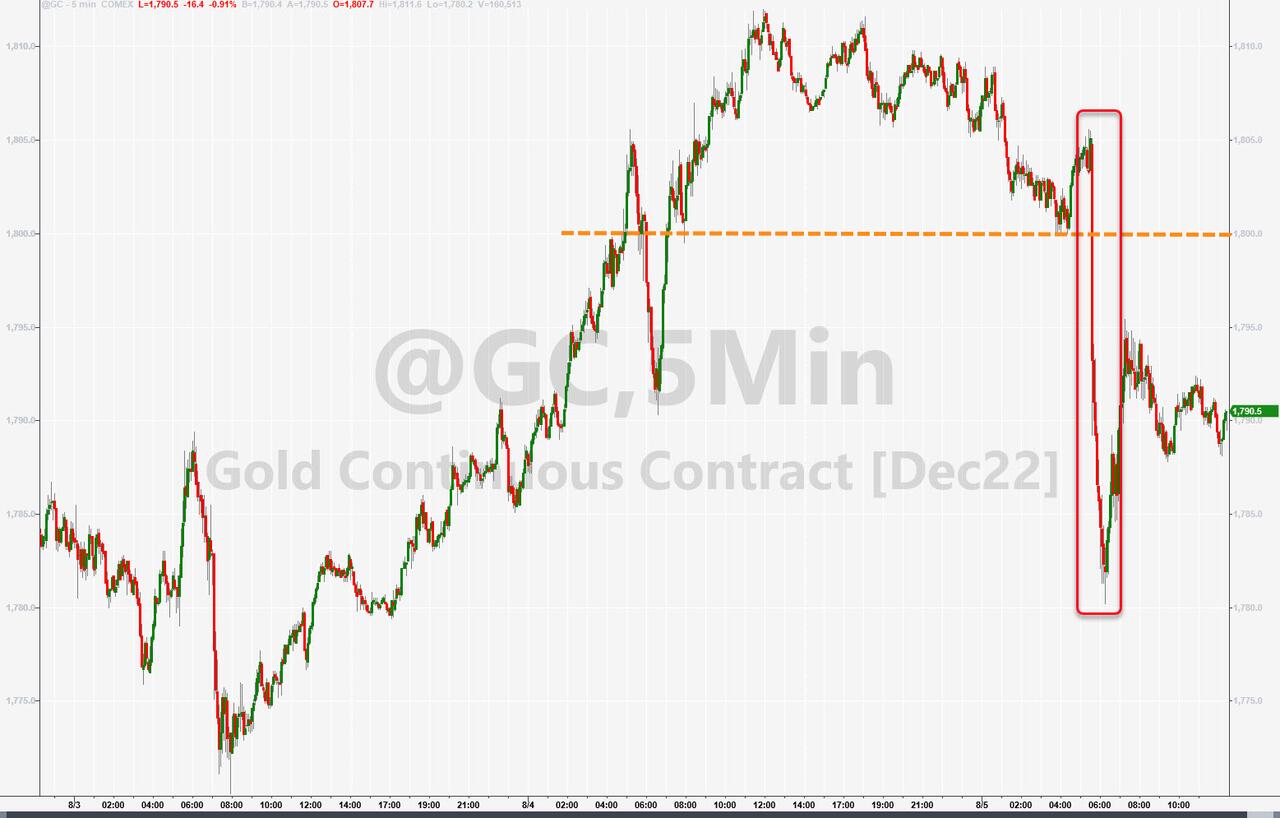
With yields heading higher, the US Dollar followed suit and reached its top level since June 2020, according to ZH. Gold was the victim of the dollar and bond yield surges and gave back some of its recent advances.

Read More

Snaking Aimlessly Along The Unchanged Lines

Ulli Market Commentary Contact

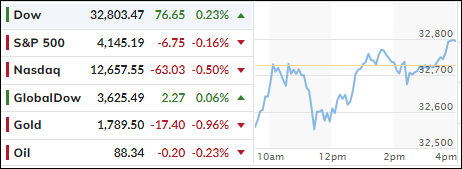
[Chart courtesy of MarketWatch.com]
  1. Moving the markets

The major indexes snaked aimlessly above and below their respective unchanged lines without making headway, as ephemeral gains were quickly surrendered with uncertainty about interest rates, while a flood of upcoming earnings reports kept the bulls and bears in check.

It was a rollercoaster ride with the 10-year bond yield touching 2.88%, which was its highest since late 2018. As recently as March 1, that yield stood at 1.71% and exploded upward by almost 10% due to the Fed announcing a more aggressive stance of fighting inflation.

The big unknown is how far bond yields will rise, and stocks fall, before the Fed caves and saves the markets again, as it did the end of 2018. Or will it be different this time?

Commodities continued their surge (DBC +1.14%) with Crude Oil heading towards $108, and Natural Gas climbing above $8 for the first time since 2008, as ZH pointed out. March’s massive short squeeze appears to have run out of ammo, the US Dollar ramped higher, while Gold briefly surpassed it $2k level before fading below it.

All eyes are on the earnings reports of the bellwether tech firms, which may set the directional tone for the remainder of the month. A big ingredient of these reports will be forward guidance, as increased costs will be a real challenge for all companies.

Read More

Weekly StatSheet For The ETF Tracker Newsletter – Updated Through 04/14/2022

Ulli Uncategorized Contact

ETF Data updated through Thursday, April 14, 2022

Methodology/Use of this StatSheet:

1. From the universe of over 1,800 ETFs, I have selected only those with a trading volume of over $5 million per day (HV ETFs), so that liquidity and a small bid/ask spread are assured.

2. Trend Tracking Indexes (TTIs)

Buy or Sell decisions for Domestic and International ETFs (section 1 and 2), are made based on the respective TTI and its position either above or below its long-term M/A (Moving Average). A crossing of the trend line from below accompanied by some staying power above constitutes a “Buy” signal. Conversely, a clear break below the line constitutes a “Sell” signal. Additionally, I use an 12% trailing stop loss on all positions in these categories to control downside risk.

3. All other investment arenas do not have a TTI and should be traded based on the position of the individual ETF relative to its own respective trend line (%M/A). That’s why those signals are referred to as a “Selective Buy.” In other words, if an ETF crosses its own trendline to the upside, a “Buy” signal is generated. Here too, I recommend trailing sell stop of 12%, or less, depending on your risk tolerance.

If you are unfamiliar with some of the terminology, please see Glossary of Terms and new subscriber information in section 9.     

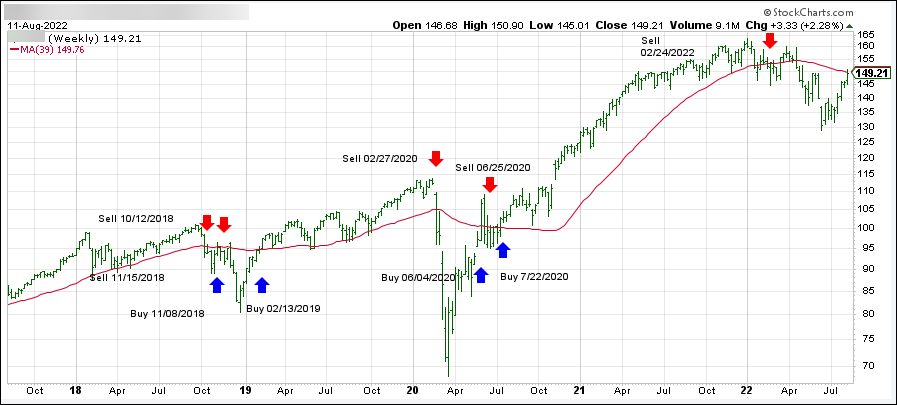
1. DOMESTIC EQUITY ETFs: SELL — since 02/24/2022

Click on chart to enlarge

Our main directional indicator, the Domestic Trend Tracking Index (TTI-green line in the above chart) has only broken above its long-term trend line (red) by +0.22% and remains in “SELL” mode—although it is on the edge of moving back to the Buy side.

Read More

Sliding Into The Easter Weekend

Ulli Market Commentary Contact

[Chart courtesy of MarketWatch.com]

  1. Moving the markets

Another early rally bit the dust with the major indexes surrendering morning gains and the S&P 500 and Nasdaq also giving back yesterday’s advances.

Added CNBC:

The S&P 500 is down 2% for the week on inflation fears as a Tuesday CPI report showed price increases not seen since 1981. The Nasdaq Composite is off 3.7% and the Dow is flat for the week.

Spiking bond yields pulled the rug out from under equities, with the 10-year adding 13 basis points to push the rate to 2.83%, a multi-year high, as inflation exacted its pound of flesh—again. The widely held 20-year bond ETF TLT got spanked again and lost 2% on the day bringing its YTD losses to -18.51%. Ouch!

As much as traders would have liked to push the 8.5% CPI and 11.2% PPI numbers on the back burner, the reality of a variety of bearish data points set in, as well as speculation on how the Fed will now respond, and south we went.  

Not helping the bulls was the release of US Retail Sales Growth, which was the slowest in 13 months with online spending plunging, as ZH pointed out.

Twitter was headline news, as Elon Musk offered to buy the company, but rumors played havoc with the price, as this chart shows, while $2.1 trillion in options expirations did their number on market volatility.

Another roller coaster ride occurred in the ever-ongoing battle between “value” and “growth,”  as well as in the “most shorted stocks” arena, but it the end, it turned out to be a losing week.

As yields rose, the US Dollar stormed higher and pulled gold slightly lower. The energy complex gained for the week, with oil prices surging, including Natural Gas, which almost went vertical.  

I hope you will enjoy a calm Easter weekend, because the markets will be anything but calm, when trading resumes next Monday.   

Read More

Positive Earnings Win Tug-Of-War With Surging Inflation

Ulli Market Commentary Contact

[Chart courtesy of MarketWatch.com]

  1. Moving the markets

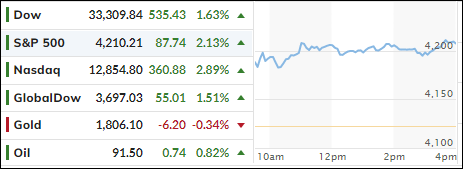
After three consecutive losing sessions, the major indexes managed to score a win, despite another horrific inflation number, which traders simply overlooked. Some corporate earnings came in better than expected (BlackRock, Fastenal, Delta) with the latter one announcing the return to profitability this quarter.

Other airlines, hotel, and travel stocks joined the rebound, which was led by the Nasdaq with a 2% gain.  

The much-awaited Producer Price Index (PPI) jumped a mind-boggling 11.2% YoY in March, while the MoM gain came in at 1.4%, far higher than the expected 1.1%. This follows yesterday’s CPI number, which surged 8.5% YoY in March.

As strange as it may sound, but in the face of the above numbers, bond yields pulled back with the 10-year settling at 2.697%, down 8 basis points.

Crude Oil ripped higher despite the greatest SPR (Strategic Petroleum Reserve) release ever, which was pushed into the background on news that Russia is shutting down oil production at a more rapid rate. That will likely reverse the tiny reduction in gas prices of the recent past.

Gold maintained its upward momentum and is heading closer to breaking its $2k glass ceiling again.

Read More

CPI Reaction: Melting Up—Then Melting Down

Ulli Market Commentary Contact

[Chart courtesy of MarketWatch.com]

  1. Moving the markets

Despite the CPI coming in at an annual rate of 8.5%, worse than expected (8.4%), the fact that the index increased a horrible 1.2% MoM was simply ignored, as traders, and computer algos were encouraged by the Core CPI (excluding food and energy), which “only” rose 0.3% in March vs. an expected gain of 0.5%.  

That got the bullish juices flowing, and up we went with the Dow at one point being in the plus by over 250 points. However, there was not much conviction behind the move, especially after the Fed’s Lael Brainard confirmed her hawkishness, as ZH noted:

The Fed will move “expeditiously” to raise interest rates and return surging inflation to its 2% target, and that a decision on the balance sheet “could be as soon as May, which would lead to reductions in that balance sheet starting in June.

That reversed the early optimism, and down we went with all 3 major indexes diving into the red, giving the bears something to cheer about. An early assist came from a short squeeze, but that attempt died on the vine.

After setting early intra-day highs, bond yields slipped with the 10-year closing at 2.725%, which was quite a drop after having touched its multi-decade downtrend resistance level of 2.83%, as ZH pointed out.

The US Dollar dumped and pumped and closed moderately higher. The energy sector ripped higher (VDE +1.67%) with Crude Oil back over $100 and the commodity index DBC gaining +2.96%.

Gold danced to the beat of its own drummer by ignoring the dollar’s comeback and gained a solid +1.14% for the day, thereby again approaching its $2k level.

Mainstream media has been focusing on who to blame for this inflationary environment with the fingers pointing to “Putin-flation,” an accusation that this chart by Bloomberg disputes.

Yes, a picture is truly worth a thousand words.

Read More