
On Risk And Complacency

Ulli Uncategorized Contact

I don’t quote Barron’s very often, but they featured a nice piece on risk titled “That’s Better Now.” Let’s look at some highlights:

Investment success last year meant embracing risk. Certainly, it wasn’t hard to find.

Following 2009’s sharp rally, investors had to confront their fears about weak U.S. housing and employment, Europe’s ugly sovereign balance sheets, May’s violent flash crash, a sharp swing in U.S. political sentiment, deficit-ridden state and local governments, and the effects of easy U.S. monetary policy in order to partake in a second-half stock-market surge that many reasonable people mistrusted. Risk was rewarded.

In such an unpredictable year, the mutual-fund families that delivered the best overall returns for their shareholders didn’t take money off the table, flee to defensive stocks or hide in Treasury bonds. That made for some unusual winners in our annual ranking of the best fund families. A prime example is the leader of the Barron’s/Lipper ranking: Dimensional Fund Advisors, a quantitative-fund group with many index-like qualities. DFA was followed by Nuveen Fund Advisors, newcomer Principal Management, Oppenheimer Funds, and Waddell & Reed Investment Management.

Overall, they topped their rivals with strong returns in areas like emerging-market stocks, which were up 19.54%, small- and mid-cap growth and value plays, which gained 27.74% and 24.19%, respectively, and global high-yield funds, which rose about 3.50%, according to Lipper.
…

CAN MUTUAL-FUND FAMILIES and their investors continue to dodge the raindrops for another year? Not only are stocks at higher levels and bond yields still low, none of 2010’s risks have disappeared and a new one — political upheaval across the Mideast and North Africa — has appeared. The unrest in Egypt and elsewhere is a challenge for big oil companies that depend on the region for much of their supply, says Henry Herrmann, CEO of Waddell & Reed. And the worries about U.S. states and municipalities have worsened of late, driving $13.37 billion out of municipal-bond funds in December, a trend Degroot warns could continue.

“This could be the trend in the year ahead — risk on, risk off — with people thinking ‘the world is coming to an end’ or ‘maybe I’m missing the trend,’ ” observes Degroot.

Possibly a little late, retail investors seem to be getting their courage up to wade into U.S. stocks again. From Jan. 1 to Jan. 26 of the New Year, $11.82 billion flowed into U.S. large-cap growth and value equity funds, more than triple the $2.82 billion that went into international stock funds, according to Lipper. In 2010, $74.88 billion flowed out of U.S. stock funds, while $42.71 billion came into international stock funds, and a gargantuan $213.25 billion poured into taxable-bond funds.

Not everyone agrees that risk levels are rising: “The risky stuff is more stable this year,” says Art Steinmetz, chief investment officer of Oppenheimer.
…

“Appetite for risk will work until it doesn’t,” adds Jeff Tjornehoj, senior research analyst at Lipper in Denver. “The time to take risk is when people are absolutely scared out of their minds.” That time may have passed.

[Emphasis added]

There is much more to this article so check out the link if this interests you. I think the last paragraph above sums it up nicely. Risk has clearly increased with the major indexes hovering at these multi-year high levels.

I have repeatedly said that no portfolio growth has really been accomplished since June 2008, because the past 2-1/2 years have been spent making up losses—nothing else.

Of course, we could march even higher from here although the markets are priced to perfection as are expectations of future economic developments. Add to that the usual menu of potential global uncertainties, and I have to question whether this rally will end well.

For a better and well researched historical perspective, Mish at Global Trends wrote a fine article on the subject, which you can read here. It’s a bit lengthy but well worth your time.
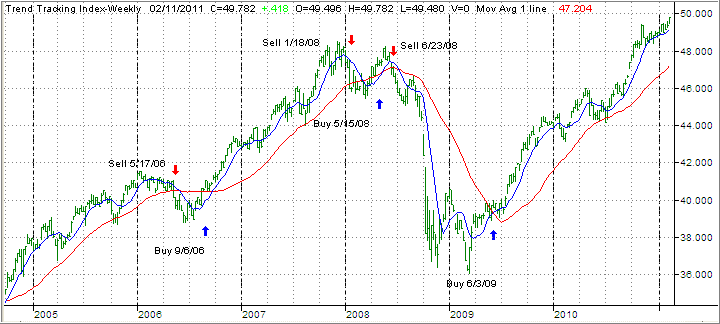
No Load Fund/ETF Tracker updated through 2/9/2011

Ulli Uncategorized Contact

My latest No Load Fund/ETF Tracker has been posted at:

http://www.successful-investment.com/newsletter-archive.php

Continued upside momentum pushed the major indexes to another winning week.

Our Trend Tracking Index (TTI) for domestic funds/ETFs has moved above its trend line (red) by +5.47% (last week +4.85%) and remains in bullish mode.

The international index has broken above its long-term trend line by +9.08% (last week +9.25%). A new Buy signal was triggered effective 9/7/10. If you decided to participate, be sure to use my recommended sell stop discipline.

[Click on charts to enlarge]

For more details, and the latest market commentary, as well as the updated No Load Fund/ETF Tracker StatSheet, please see the above link.

Short Post

Ulli Uncategorized Contact

No post today, since I finally had my long overdue cataract surgery done. It turned out to be successful, but my vision is still a little blurry, which makes reading and writing a bit of a challenge.

I should be back to normal within a day and plan on sending out Friday’s weekly newsletter as usual.

Overcoming Resistance

Ulli Uncategorized Contact


Rising shares of some of the heavyweights like McDonald’s, IBM and Apple definitely contributed to yesterday’s rally, as the S&P; 500 overcame major resistance in the 1,313 area, a level which was last reached in August 2008.

The advance occurred despite some headwind in form of China’s second interest hike in a month designed to control inflationary pressures. Gold and silver were the beneficiaries and finally rallied after having pulled back since the beginning of this year.

Of more concern is what impact China’s slow but continuous tightening will have on global economies as we go forward. A potential real estate bubble, and the desire to rein in inflation, are events whose outcome can’t exactly be measured or anticipated.

Much depends on the magnitude of their inflation fighting efforts. Nevertheless, for the time being the domestic U.S. market hears and sees no evil and continues to head higher.

I have written much about investor complacency and it is alive and well judging by the emails and phone calls I have received. I am not being negative here, but there is only so much a market can gain without any serious correction.

Day Of The Deals

Ulli Uncategorized Contact


Yesterday turned out to be another solid day in the market as a slew of takeover deals, along with continued confidence in the economy, provided the firepower to push the major indexes higher.

Even political turmoil in Egypt appeared to ease, which temporarily alleviated fears of more uncertainty.

While the markets did not end up closing at their highs, which was a bit of a negative, we have now reached some very lofty levels. The Nasdaq, for example, is now within striking distance of taking out its 2007 peak of 2,859; the point from which a pullback occurred, which subsequently turned into the 2008 crash.

If you have more investable funds to deploy, I suggest you move down on M-Index rankings in order to avoid too much volatility when the inevitable correction occurs. I have no idea when that will be, but at these levels, the economy better perform as anticipated, with no major disappointments, or this run up could be over in a hurry.

Revisiting The Biggest ETF Loser

Ulli Uncategorized Contact

Several readers have emailed me and were wondering if there was some credence to articles suggesting Natural Gas (UNG) as an investment was ready to explode.

Maybe there are new fundamental reasons, but I have heard most arguments every so often over the past few years as UNG plummeted further into abyss.

The following 5-year chart clearly depicts the misery those investors, who followed past buy recommendations, have gone through as this ETF gave a new meaning to the word gravity:

Here are some of the current momentum figures:

4-wk: -1.83%
8-wk: -3.13%
12-wk: +3.88%
YTD: -1.67%
%M/A: -11.87% (% below its long term trend line)

The natural tendency for investors is to want to pick the absolute bottom and ride the trend back up. The 3-months chart shows that indeed UNG has popped off its December bottom a few times:


However, so far all breakout attempts have been head fakes. Until UNG actually pierces and breaks clearly above its long-term trend line, defined as %/M/A in the weekly StatSheet, the downside risk is simply too high.

It’s better to be patient and wait for an actual breakout, which increases your odds that a true trend reversal has in fact taken place. Going bottom fishing right now is simply wishful thinking and may satisfy your gambling instinct, but may turn into a disappointing experience.

Disclosure: No holdings