Weekly StatSheet For The ETF/No Load Fund Tracker Newsletter – Updated Through 03/01/2012

Ulli ETF StatSheet Contact

ETF/Mutual Fund Data updated through Thursday, March 1, 2012
If you are not familiar with some of the terminology used, please see the Glossary of Terms.


1. DOMESTIC EQUITY MUTUAL FUNDS/ETFs: BUY — since 10/25/2011
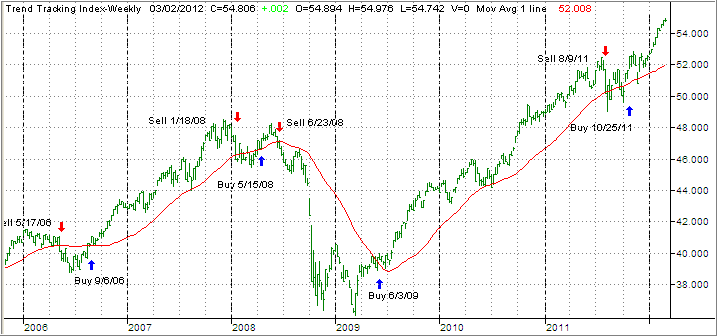
The domestic TTI broke through its long-term trend line generating a Sell for this area effective 8/9/2011. Over the recent past, we’ve seen the TTI hovering slightly below and above this dividing line between bullish and bearish territory. The clear break to the upside occurred on 10/24/11 and, effective 10/25/11, a new Buy signal for domestic equities went into effect.

As of today, our Trend Tracking Index (TTI—green line in above chart) has broken above its long term trend line (red) by +5.58%. Be sure to tune into my blog for the latest updates.
Read More

Major Market ETFs Open Month Higher

Ulli Market Commentary Contact

[Chart courtesy of MarketWatch.com]

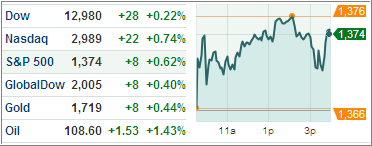
Stocks closed higher Thursday as investors weighed improved reading on the jobs front against slightly disappointing construction spending and manufacturing data. According to the Labor Department, the number of Americans filing first-time claims for unemployment benefits dropped 2,000 to 351,000 last week, the lowest since March 2008. Four-week average now stands lower by 5,500 at 354,000, statistics showed.

Separately, however, government report showed construction spending dropped 0.1 percent in January, the first monthly drop July. Another report showed incomes rose 0.3 percent while spending climbed 0.2 percent in January, both falling short of expectations.

The markets pared some of the early gains after U.S. manufacturing data came in weaker than expected. The Institute for Supply Management reading showed manufacturing activities slowing in Feb. The ISM manufacturing index fell 1.57 points to 52.4 in February though consensus estimates had put it at 54.7. Fortunately, any reading above 50 reflects overall expansion.

Read More

U.S. Stock Indexes Slide, UUP Gains, GLD Loses Shine

Ulli Market Review Contact

[Chart courtesy of MarketWatch.com]

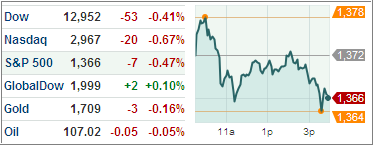
U.S. indexes reversed Tuesday’s gains after Fed Chairman Ben Bernanke hinted at stopping further liquidity expansion measures today. In other words, he took the punch bowl away for the time being by showing no monetary exuberance.

In a testimony before the Congress that started at 10 a.m. Wednesday, Bernanke said though continuing with liquidity enhancing measures is desirable, a faster-than-anticipated reduction in the jobless rate and higher energy costs may fuel inflation temporarily.  All the three indexes ended Feb. with a whimper while 10-year Treasury yields surged and prices of gold and silver sank.

The Dow Jones Industrial Average shed 0.4 percent, to close at 12,952.07. Despite today’s losses, the DJIA is up 2.5 percent in Feb. and 6 percent for the year. The S&P 500 declined 0.2 percent, to 1,368.83 with natural resource companies losing the most.

Read More

7 ETF Model Portfolios You Can Use – Updated through 2/28/2012

Ulli Model ETF Portfolios, Uncategorized Contact

The markets meandered since last week’s ETF Model Portfolio update, as the Dow repeatedly bounced against overhead resistance at the 13k milestone, while the S&P 500 had trouble piercing its glass ceiling at 1,370.

Investors were finally rewarded yesterday, as both levels were conquered with the indexes closing above them. This is always a crucial moment, since continued bouncing against a resistance level can easily cause a total trend reversal.

Our model portfolios followed market direction with #3, #4 and #7 almost tracking the S&P 500 performance year to date. Whether any of them match the index or not is not as important as is having appropriate diversification, since the downside will come into play again for sure; as always, the timing of it is just the unknown

Take a look at the latest ETF Model Portfolio update:

Read More

U.S. Stocks Rise With Consumer Confidence, UNG Dips With Oil, SLV Zooms

Ulli Market Review Contact

[Chart courtesy of MarketWatch.com]

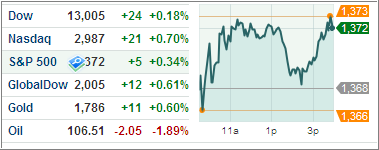
Soaring consumer confidence and falling oil prices triggered a rally in US stocks as the Dow Jones Industrial Average closed over the psychologically important 13,000 mark for the first time since May ’08.

The DJIA ended at 13,005.12, a gain of 0.2 percent, while the S&P 500 added 0.3 percent to close at 1,372.18, its highest level in four years. The NASDAQ Composite rose 20.60 points to 2,986.76, its fourth straight day of gains, and the highest level since December 2000.

Continued worry over contagion effect in the EU and U.S. notes purchased by the Federal Reserve drove yields on 10-year notes to near three-week low Tuesday. As stocks rebounded over strong consumer confidence news, Treasuries erased early gains indicating better risk appetite. Yields on 10-year notes remained near flat for the day at 1.93 percent.

Read More

US Stock Indexes Close Flat, Builder ETFs Rise As Pending Home Sales Near 2-Year High

Ulli Market Review Contact

[Chart courtesy of MarketWatch.com]

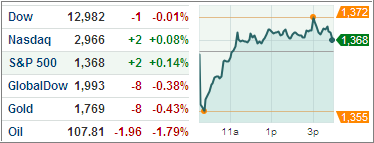
US stocks closed flat despite the domestic economy showing signs of improvement and Europe appearing less toxic. Early gains for the day, after stronger-than-expected housing data came in, were offset by a pullback in the energy sector.

The Dow Jones Industrial Average (DJIA) shed 0.01 percent, to end at 12,982 while the S&P 500 managed to add 1.9 points and closed 1,368. The NASAQ Composite added 2.4 points to Friday’s close to settle at 2,966.

The energy sector was down 0.4 percent as oil prices retraced from the $110 a barrel mark to pare previous gains.

Stocks were falling in early trade as reports of G20 ministers rebuffing Germany’s call for higher resources for the Eurozone appeared overnight. The Group of 20 countries said Europe must strengthen their financial firewall before other nations commit more money to the International Monetary Fund.

The G20 is planning to create bailout funds worth $2 trillion with $1 trillion from Europe’s temporary (EFSF) and permanent funds (ESM) and about $500 billion for the IMF.

Read More