Major Market ETFs Surge As Greece Inches Towards Debt-Swap; EWD Gains, GAZ Tanks

Ulli Market Review Contact

[Chart courtesy of MarketWatch.com]

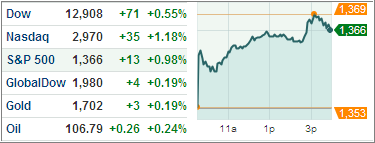
U.S. stocks surged on Thursday as the deadline for the history’s greatest sovereign debt-swap exercise, also crucial for Greece to secure the next-round of bailout money, passed.

Thursday’s deal is the (alleged) final barrier to Athens’ securing the second round of bailout money from the International Monetary Fund and the European Union to avoid a messy default weeks later. As risk appetite improved, Treasuries slumped for the second day due to weak demand for US government securities.

Yields on 10-year notes climbed 0.03 percentage points to 2.01 percent in the day’s trading while 30-year yields rose 0.04 percentage points to 3.17 percent. Ahead of tomorrow’s US payrolls data, Treasuries had briefly rallied as the Fed purchased $5.1 billion of US securities maturing between Aug. 2020 and Aug. 2021.

Read More

Strong Jobs Data Pushes Equity ETFs Up, ITB Bounces Back, VIX Tanks

Ulli Market Review Contact

[Chart courtesy of MarketWatch.com]

Equity ETFs made a strong comeback Thursday, recouping nearly half of previous day’s losses after latest job market data showed recovery is truly gaining traction. Sentiments improved further as news of a possible Greek PSI settlement by Thursday-deadline emerged.

Also the Fed devising a new method to keep interest rates low aimed at boosting investments helped the market. Treasuries traced back part of yesterday’s gains as risk appetite went up during the day’s trading.

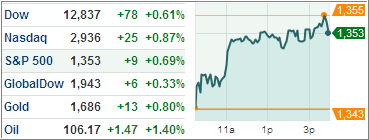
The Dow Jones Industrial Average (DJIA) added 0.6 percent, to touch 12,837.33. The Dow’s 23 components out of 30 advanced.

The S&P 500 Index (SPX) rose 0.7 percent to 1352.63 with the financial and the industrial sectors leading today’s gains. Utilities however, were out-of-favor in the 10-sector index and closed lower.

The tech-heavy NASDAQ Composite (COMP) added 0.9 percent to close at 2935.69 as trading remained choppy.

Following reports appearing in the WSJ that the Fed may print more money to buy long-term Treasuries or mortgages, and borrow it back at lower rates over the short-term to curb money-supply and inflation, government bonds pared some of yesterday’s gains.

Read More

7 ETF Model Portfolios You Can Use – Updated through 3/6/2012

Ulli Model ETF Portfolios Contact

Today’s sell off pulled the S&P 500 off its lofty level. Since last week’s report, the index gave back 2.11%, while the equity portion of our portfolios headed south as well. The bond ETFs offered a nice balance so that the bottom line effect was manageable.

There’s no doubt that the major indexes have been struggling to maintain their positions at these elevated levels, as the Dow has made numerous attempts to conquer the 13k milestone. While it actually breached it, the duration was very short just as the S&P 500 has struggled with the 1,375 level.

All eyes are now on this week’s jobs report, which may very well give us a hint as to further market direction.

Take a look at the latest ETF Model Portfolio update:

Read More

Dow Witnesses Biggest Fall In Three Months; VXX Soars On Higher Volatility, ERUS Sinks

Ulli Market Review Contact

[Chart courtesy of MarketWatch.com]

U.S. stocks suffered their biggest drop this year on Tuesday as fears of a disorderly Greek default loomed large.

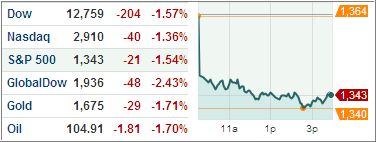
The DJIA sank by more than 200 points after the US markets witnessed a sell-off following weak economic data from Europe and rising yields on EZ government bonds. As Greece struggles to meet Thursday’s deadline to convince private sector lenders agree to higher haircuts on their bond-holdings, many investors chose to rebalance their portfolios ahead of the cut-off date.

The Dow lost 1.5 percent to close at 12,759, its biggest drop since Dec. 8, when it sank 1.6 percent. The S&P 500 dropped 1.5 percent to 1343.36, its worst day since Dec. 8 and the third straight day of losses. The tech-laden NASDAQ Composite lost 1.4 percent to end at 2,910.32, also its highest percentage drop since December 8.

Read More

U.S. Stocks Decline Despite Rising Service-Sector Index; GAZ Burns Bright, KWT Slumps

Ulli Market Review Contact

[Chart courtesy of MarketWatch.com]

U.S. stocks ended lower Monday despite the service-sector gauge advancing in February. The Institute for Supply Management’s non-manufacturing index came in better-than-expected. However, its employment index dropped, while the inflation-measuring price index jumped in January.

Not helping the markets were the Chinese lowest growth target in eight years for 2012 and a survey that showed a shrinking European economic activity.

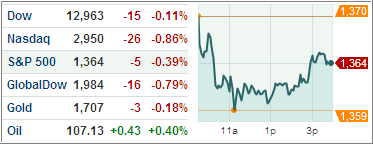
The Dow Jones Industrial Average shed 0.1 percent while the S&P 500 (SPX) lost 0.4 percent after natural resources retreated and consumer staples advanced. The tech-laden NASDAQ Composite was leading to the downside by dropping 0.9 percent.

Treasuries fell after U.S. service industries’ index recorded its fastest growth in a year, reinforcing the domestic recovery theory.

Read More

03-05-2012

Ulli Newsletter Archives Contact

The ETF/No Load Fund Tracker—Monthly Review—February 29, 2011

Major Market ETFs Maintain Upward Momentum

February started on a strong note after some January economic reports came in stronger than expected, driving both the DJIA and the S&P 500 to multi-month highs. The NASDAQ went on to touch its best level in a decade.

Fed Chairman Bernanke testified before the House of Representatives Budget Committee, and his statement that the economy is susceptible to shocks surprised no one. Even as Greece struggled with the second bailout round, concerns over Europe and domestic economic outlook were on the decline, he noted.

The gridlock over Greece spilled to the markets next week as aggressive selling was witnessed on Monday and ensuing losses made sure markets booked losses, snapping a streak of five weekly gains. However, by Thursday the market had accumulated modest gains made on Tuesday and Wednesday and the S&P 500 ended at its highest level in seven months.

Domestic upward momentum affected the international arena as well, as our International Trend Tracking Index (TTI) finally crossed its long-term trend line to the upside and generated a ‘Buy’ signal for that area effective February 8. I took the opportunity to add VEU (Vanguard All World-ex. U.S. index) for some clients, while for others I already had covered that slot with a couple of well performing country ETFs.

As uncertainties over Iran continued, oil prices continued to climb before closing at a multi-month high of $109.76 per barrel. The rise in oil prices drove the CRB Index 2.7 percent higher for the week. Along with Tech stocks, Utilities, Energy, Healthcare and Consumer Staple advanced while Financials and Telecom declined.

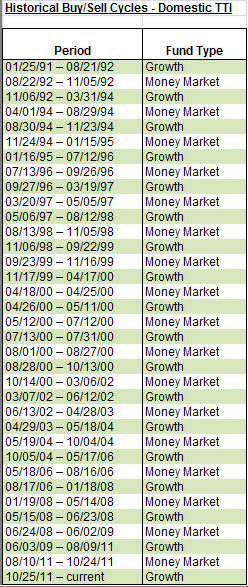
The final week saw some action with commodities tumbling though the S&P 500 managed to end the week higher for the eighth time in nine weeks. Our Domestic Trend Tracking Index (TTI) followed suit and has been ascending in a straight line since the beginning of the year (red arrow), as the chart below shows:
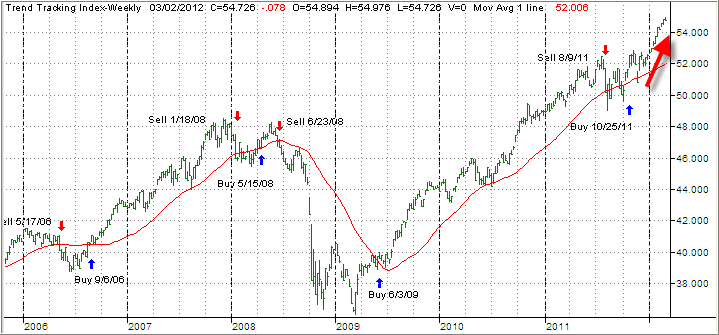
It’s glaringly obvious that this steep ascent can’t continue, because it has been supported primarily by loose monetary policy. Sooner or later some reality has to set in, and the question remains in my mind as to how much of a setback the markets will have to deal with.

While no one has that answer, or knows the timing of it, it simply pays to be alert to any directional changes, and I am prepared to deal with them via our trailing sell stops designed to limit downside risk.

In the meantime, Fed Chairman Bernanke delivered his semiannual monetary policy report on the last working day of the month. Though his observations weren’t surprising, his skipping a reference to future quantitative easing (QE3) definitely surprised many.  It seems to me that QE3 had been priced in the market and any lack thereof, along with possible weakening economic numbers, could very well be the impetus to end this euphoric rally all of a sudden.