ETFs/Mutual Funds On The Cutline – Updated Through 9/7/2012

Ulli ETFs on the Cutline Contact

Below are the latest ETF Cutline reports, which show how far above or below their respective long-term trend lines (39 week SMA) my currently tracked ETFs/MFs are positioned.

The first report covers the ETF Master List from Thursday’s StatSheet and includes 398 ETFs, of which currently 350 (last week 317) of them are hovering in bullish territory.

The second report includes only High Volume ETFs. To clarify, High Volume (HV) ETFs are defined as those with an average daily volume of $10 million or higher.

These ETFs are generated from my selected list of some 93 that I use in my advisor practice. It cuts out the “noise,” which simply means it eliminates those ETFs that I would never buy because of their volume limitations. 74 ETFs (last week 64) have managed to remain in bullish territory after the recent market volatility.

The third report covers Mutual Funds on the Cutline. There are currently 825 (last week 781) above the line and 36 below it out of the 861 that I follow.

Take a look:

1. ETF Master Cutline Report

2. ETF High Volume Cutline Report

3. MF Cutline Report

In case you are not familiar with some of the terminology used in the reports, please read the Glossary of Terms.

Last Week In Review: ETF News And Blog Posts To 9/9/2012

Ulli Market Review Contact

In case you missed it, here’s a summary of the ETF topics and market reviews I posted to my blog during the week ending on 9/9/2012.

After the ECB’s Draghi pulled out the big guns, the markets went into overdrive pushing the major indexes to multi-year highs. As I pointed out, nothing has actually been chiseled in stone; so far his ideas are merely promises and, as always, the devil will be in the details with Germany ultimately having the last word.

As we’ve witnessed over the past few months, neither the ECB nor the Fed really need to take any action to push the markets higher; the mere mention of the fact that new versions of QE still exist is enough to put a floor under equities.

It appears that current stock market levels are no longer a function of economics, but simply the result of central planning, as Wall Street has become addicted to the next fix from the Fed, whatever that will be.

Makes me wonder where the markets would be at, once the Fed runs out of ammunition and Wall Street has to face reality and accept the fact that either stimulus no longer exists or its effects have been negated. It will not be a pretty moment.

Over past week, we covered the following:

Read More

ECB’s Intended Bond Purchases Will Calm The Markets; But For How Long?

Ulli Market Commentary Contact

The European Central Bank’s decision to buy unlimited bonds from the secondary markets for the peripheral economies was the right decision, since it comes with strong conditions that will result in structural reforms and fiscal discipline, says Anders Aslund, Senior Fellow at the Peterson Institute for International Economics.

The so-called Outright Monetary Transactions or OMT by the central bank does not violate the Maastricht Treaty, which prohibits direct purchasing of government bonds since the bank will buy them from the secondary market.

Germany’s opposition that this amounts to lending the profligate governments, albeit indirectly, is thus allegedly not maintainable. Moreover Chancellor Angela Merkel herself backed the plan couple of weeks ago, he noted.

The OMT kicks in only when the struggling countries make a formal request for international aid, but neither Italy nor Spain has made any formal request so far. Is it because of the stigma attached?

Read More

New ETFs On The Block: Huntington US Equity Rotation Strategy ETF (HUSE)

Ulli Managed ETFs Contact

Columbus, Ohio-based regional bank Huntington Bancshares launched its second ETF in July-end that offers a different investment strategy involving active management of US domestic stocks.

The Huntington US Equity Rotation Strategy ETF (HUSE) seeks to achieve capital appreciation in excess of the broad S&P Composite 1500 index that includes large-, mid-, and small-cap companies and may be suitable for long-term investors. The fund’s weight exposure to domestic companies depends upon the manager’s, Huntington Assets Advisors, outlook on different sectors in changing market conditions. Huntington Asset Advisors currently manages 26 mutual funds with over $3 billion in assets.

The investment philosophy is relatively simple; managers will try to identify the most promising and the least promising sectors from the S&P Composite 1500 comprising of utilities, consumer staples, consumer discretionary, information technology, industrials, energy, healthcare, financials, materials and telecommunication services.

The S&P 1500 Composite consists of the S&P 500, 400, and 600 indexes and industries/sectors will be overweighted /underweighted based on a top down analysis.

Read More

09-07-2012

Ulli Newsletter Archives Contact

ETF/No Load Fund Tracker Newsletter For Friday, September 7, 2012

ETF/No Load Fund Tracker StatSheet

————————————————————-

THE LINK TO OUR CURRENT ETF/MUTUAL FUND STATSHEET IS:

https://theetfbully.com/2012/09/weekly-statsheet-for-the-etfno-load-fund-tracker-newsletter-updated-through-09062012/

————————————————————

Market Commentary

Friday, September 7, 2012

US EQUITIES EDGE UP ON FED STIMULUS HOPES; EUROPE RALLIES ON CHINA STIMULUS

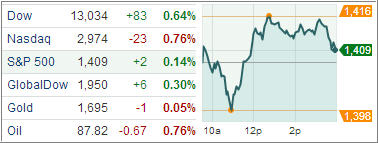
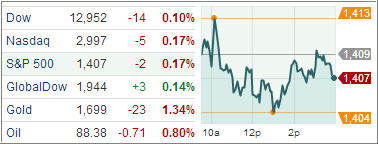
US stocks continued their upward journey Friday with the major indexes settling higher for the first time in three weeks and extending multi-year highs amid hopes the Fed will restart its asset purchase program as early as next week following the European Central Bank’s decision to initiate an unlimited bond buying program.

I like to point out that the ECB has not actually “done” anything so far; at this time it’s been merely talk of potential action which got the markets on a sugar high. We’ve seen this before over the past couple of years as all the best laid and talked about plans fizzled out and eventually ended up in the trash bin.

Nevertheless, the ECB, as well as the Fed, have succeeded in jawboning the markets higher, which is the new normal in this central planning effort. How long this can continue is the big unknown, as economic fundamentals from around the world paint an entirely different picture than what the levels of the major equity indexes have you believe.

While this certainly may go on for a while, longer term we are setting ourselves up for a super crash, as the artificial propping up of markets can simply not end on a positive note.

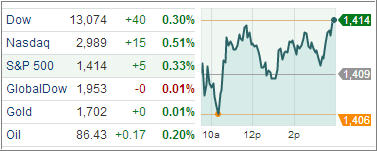
The Dow Jones Industrial Average (DJIA) climbed 15 points, up 1.7 percent for the week. Within the 30-component blue-chip index, breadth remained evenly matched with half of the stocks finishing higher for the day even as the index hit its highest level since December 2007.

The S&P 500 Index (SPX) rose 6 points, higher 2.2 percent over last week. Materials gained the most while consumer stocks hit the ground hardest among its 10 business groups.

Snapping its four-day losing streak, Treasuries rose as weaker-than-estimated August jobs data triggered speculations the Fed will restart its monetary stimulus program to accelerate growth as early as next week.

Meanwhile, the euro jumped to a three-month high against the greenback after lackluster US jobs data fueled speculations of another round of stimulus from the US Fed. The dollar index, a gauge of the dollar’s strength against a basket of six currencies, fell to 80.182 from 81.089 in late Thursday trading.

European stock markets rallied Friday amid news of fresh Chinese stimulus even though gains were trimmed after US August jobs data showed a mere 96,000 job gains versus 141,000 in July. The pan-European Stoxx Europe 600 index rose 0.2 percent to close the week 2.3 percent higher.

Spanish and Italian 10-year borrowing costs continued to fall with the yield on Spanish 10-year bonds sliding 42 basis points to 5.60 percent while Italian 10-year bond yields dropped 26 basis points to 5.04 percent.

In Frankfurt, strong gains by Commerzbank AG and Deutsche Bank pushed the German DAX 30 index higher 0.3 percent on the day. The index has gained 3.5 percent over the week.

In the ETF space, gold and silver-linked funds surged while the dollar plunged on weak jobs data. The State Street SPDR S&P Metals & Mining ETF (XME) jumped 5.12 percent along with precious metal-linked funds amid reports that China will spend an additional $150 billion to boost a cooling economy.

The iShares Silver Trust (SLV) jumped 3.06 percent as silver futures sprang more than three percent on the day. The Van Eck Market Vectors TR Gold Miners (GDX) rose 2.71 percent as gold futures climbed more than $30/ounce.

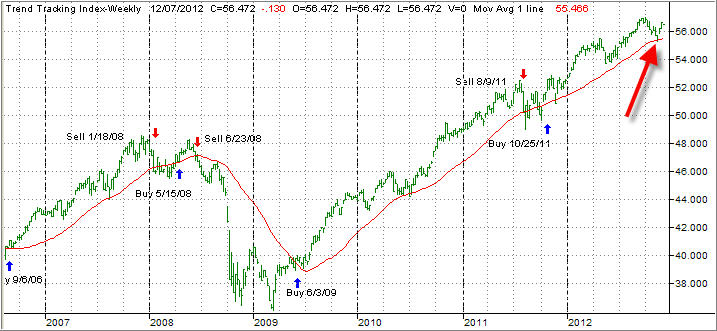
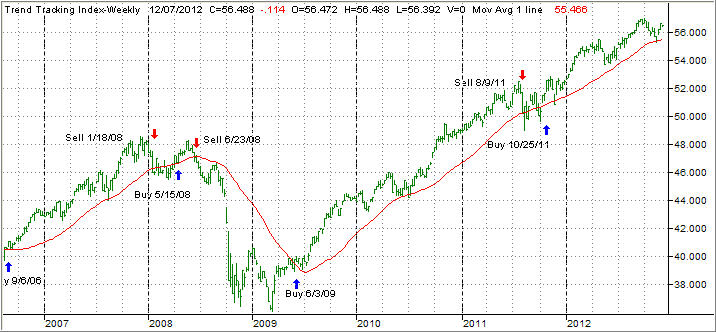
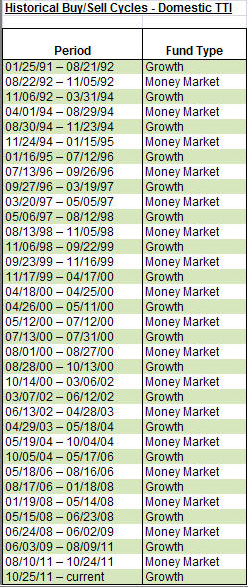
This week’s feeding frenzy did affect our Trend Tracking Indexes (TTIs), which rocketed higher with the markets.

Here’s how we ended this week:

Domestic TTI: +3.75% (last week +3.06%)

International TTI: +3.67% (last week +0.99%)

Have a great week.

Ulli…

Disclosure: No holdings

————————————————————-

READER Q & A FOR THE WEEK

All Reader Q & A’s are listed at our web site!
Check it out at:

http://www.successful-investment.com/q&a.php

A note from reader Keith:

Q: Ulli: I’m confused as to why you did not issue an international buy signal (much quicker than you did), if you are making your decisions based on the numbers (rather than seasonality- September is approaching which is usually a down month).

I think when the trend line is broken by more than 1% a buy signal must be issued or else you are not following your own methodology!

A: Keith: I do the same thing whenever a trend line crossing to the upside occurs. I wait a few trading days to be sure that the break is for real and the crossing has some staying power. This simply reduces potential whip-saws signals, but it will not eliminate them.

If you are an aggressive investor, you can jump in earlier if you like. It’s simply my preference to approach this a little more conservatively at these lofty levels, but that does not mean you can’t act quicker than I did.

———————————————————-

WOULD YOU LIKE TO HAVE YOUR INVESTMENTS PROFESSIONALLY MANAGED?

Do you have the time to follow our investment plans yourself? If you are a busy professional who would like to have his portfolio managed using our methodology, please contact me directly or get more details at:

https://theetfbully.com/personal-investment-management/

———————————————————

Back issues of the ETF/No Load Fund Tracker are available on the web at:

https://theetfbully.com/newsletter-archives/

ETF/No Load Fund Tracker Newsletter For Friday, September 7, 2012

Ulli Market Commentary Contact

ETF/No Load Fund Tracker StatSheet

————————————————————-

THE LINK TO OUR CURRENT ETF/MUTUAL FUND STATSHEET IS:

https://theetfbully.com/2012/09/weekly-statsheet-for-the-etfno-load-fund-tracker-newsletter-updated-through-09062012/

————————————————————

Market Commentary

Friday, September 7, 2012

US EQUITIES EDGE UP ON FED STIMULUS HOPES; EUROPE RALLIES ON CHINA STIMULUS

US stocks continued their upward journey Friday with the major indexes settling higher for the first time in three weeks and extending multi-year highs amid hopes the Fed will restart its asset purchase program as early as next week following the European Central Bank’s decision to initiate an unlimited bond buying program.

I like to point out that the ECB has not actually “done” anything so far; at this time it’s been merely talk of potential action which got the markets on a sugar high. We’ve seen this before over the past couple of years as all the best laid and talked about plans fizzled out and eventually ended up in the trash bin.

Nevertheless, the ECB, as well as the Fed, have succeeded in jawboning the markets higher, which is the new normal in this central planning effort. How long this can continue is the big unknown, as economic fundamentals from around the world paint an entirely different picture than what the levels of the major equity indexes have you believe.

While this certainly may go on for a while, longer term we are setting ourselves up for a super crash, as the artificial propping up of markets can simply not end on a positive note.

Read More