S&P Defends Its 2,500 Level

Ulli Market Commentary Contact

[Chart courtesy of MarketWatch.com]
  1. Moving the Markets

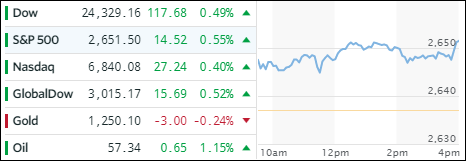
The major indexes zigzagged throughout the session but ended up on a sour note by trending towards the day’s lows. The S&P 500 managed to defend its 2,500 level successfully—so far. Not helping the bulls for the second day in a row was Apple (AAPL), which dropped another -1.72% causing the Nasdaq to surrender -0.51%.

It was the ‘morning after’ the Fed’s latest policy statement and investors were already getting nervous when news from bond market made the rounds that the Fed “may risk a misstep if it follows the current path.” That was enough to keep equities in a tight trading range all day.

On the ETF side, red numbers prevailed as well with the Dividend ETF (SCHM) faring the worst with -0.38% closely followed by the International SmallCaps (SCHC) with -0.36%. Bucking the downward trend were Aerospace & Defense (ITA) with a gain of +0.57% and Transportations (IYT) with +0.21%.

Interest rates stopped their ascent to higher levels with the 10-year bond yield slipping 1 basis point to 2.27%. Gold got hammered and lost the battle to protect its $1,300 level; at least for the time being. The US dollar (UUP) pulled back after yesterday’s large move higher by surrendering -0.29%.

Read More

Fed Plans To Scale Back Stimulus; US Dollar Spikes; Dow & S&P Set New Records

Ulli Market Commentary Contact

[Chart courtesy of MarketWatch.com]
  1. Moving the Markets

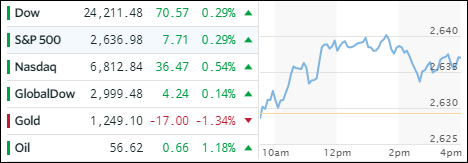
I had to laugh this morning when some news reports called the Nasdaq as having “plunged” in view of Apples weakness (-1.68%). It turned out that the Nasdaq merely retreated a meager -0.3% which appears to be, in that ‘new normal’ world we’re living in, quite a noteworthy drop. Go figure…

Of course, all eyes were on the Fed’s announcement about interest rates and the scaling back of the stimulus program. Indeed, they did come clean and projected the month of October to be starting point for the ‘great unwind’ of their massive $4.5 trillion balance sheet. However, they added that the reduction would be conducted “gradually and predictably,” at a rate of some $10 billion a month. They also signaled that a December rate hike may be still on the table.

As you can see from the above chart, the reaction was the usual one, namely a quick but modest sell-off followed by a rebound with only the Dow and S&P managing to climb back into the green and in the process setting new records. In ETF space, Transportations (IYT) came roaring back sporting a solid +1.48% gain. Aerospace & Defense (ITA) and MidCaps (SCHM) did well by adding +0.63% and 0.45% respectively. On the downside, our winner YTD, namely Semiconductors (SMH) lost -1.33%, while the International SmallCaps (SCHC) gave back a more modest -0.31%.

The yield on the 10-year bond rose by 1 basis point to end the session at 2.24%. Trading in a broad range was the US Dollar (UUP), which ended up +0.80% higher, however, it still hovers below its 50-day M/A and in bear market territory.

Read More

Wall Street Bets On ‘No Interest Rate Hike’

Ulli Market Commentary Contact

[Chart courtesy of MarketWatch.com]
  1. Moving the Markets

Despite past warnings by the Fed that more interest hikes might be forthcoming, reality appears to show a different picture. As I have posted almost daily, the 10-year bond yield spiked and made its high for the year in early March at 2.62%, after which it zigzagged to a low of 2.05% earlier this month, and then started to rebound. Given that, it’s no surprise that traders anticipate ‘no change’ when the Fed announces its latest policies tomorrow. Much attention will be paid to the economic impacts of Hurricanes Irma and Harvey, the overall inflation picture and the Washington’s fiscal stimulus outlook.

The major indexes inched higher led by Financials (XLF) with +0.68%. Aerospace & Defense benefited as well with ITA gaining +0.79%. In the equity ETF arena, International SmallCaps (SCHC) were the winner with a +0.53% advance. We saw MidCaps (SCHM) and Transportations (IYT) ending the day in the red with -0.20% and -0.06% respectively.

Treasury yields rose modestly ahead of the Fed’s announcement, Gold eked out a small gain, and the US Dollar index (UUP) resumed its slide after 2 up days by giving back -0.29%.

Read More

Bullish Mood Prevails

Ulli Market Commentary Contact

[Chart courtesy of MarketWatch.com]
  1. Moving the Markets

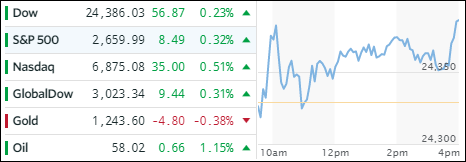
Despite sudden market weakness developing late in the session, with technology and biotech being spooked the most, the major indexes recovered a good chunk of their early gains and ended in the green with the Dow notching its 40th record close of the year. Helping matters were reduced tensions between N. Korea and the U.S. over the weekend.

In ETF space, Transportations (IYT) came roaring back and added a solid +2.21%. Taking second place with +1.74% was the Aerospace & Defense ETF (ITA) while Semiconductors (SMH) gained +1.39%. On the downside, the Dividend ETF (SCHD) suffered a -0.51% loss.

Gold retreated as well as interest rates rose with 10-year bond yield spiking 3 basis points to 2.23%. As a result, the 20-year Bond (TLT) lost -0.58%. The current slide in rates, which started the beginning of July and hit a low of 2.05% for the 10-year bond early September, appears to have reversed, but it’s too early to tell if it’s just a dead cat bounce or the beginning of a new major uptrend. The US dollar (UUP) followed suit and gained +0.25%.

Read More

One Man’s Opinion: The Trouble With Asset Bubbles: If You Stop Pumping, They Pop

Ulli Market Review Contact

By Charles Hugh Smith

The trouble with inflating asset bubbles is that you have to keep inflating them or they pop. Unfortunately for the bubble-blowing central banks, asset bubbles are a double-bind: you cannot inflate assets forever. At some unpredictable point, the risk and moral hazard that are part and parcel of all asset bubbles trigger an avalanche of selling that pops the bubble.

This is another facet of The Fed’s Double-Bind: if you stop pumping asset bubbles, they pop as participants realize the music has stopped, and if you keep pumping them, they expand to super-nova criticality and implode.

There are several dynamics at play in this double-bind.

1. The process of inflating a bubble (for example, the current bubbles in stocks and real estate) requires pushing investors and speculators alike into risky asset classes. This puts the market at increasing risk as everyone is pushed to one side of the boat.

2. Those on the other side of the boat (i.e. shorts) are slowly but surely eradicated as the pumping keeps inflating the bubble. When the bubble finally bursts, there are no shorts left to cover, i.e. buy stocks at lower prices to reap their profits.

3. As the bubble continues to expand, the money available to enter the market and keep prices rising declines. The very success of the pumping process strips the markets of new sources of new money, leading to a point where normal selling exceeds new-money buying and the bubble collapses.

Read More

ETFs On The Cutline – Updated Through 09/15/2017

Ulli ETFs on the Cutline Contact

Below please find the latest High Volume ETFs Cutline report, which shows how far above or below their respective long-term trend lines (39 week SMA) my currently tracked ETFs are positioned.

This report covers the HV ETF Master List from Thursday’s StatSheet and includes 366 High Volume ETFs ETFs, defined as those with an average daily volume of more than $5 million, of which currently 294 (last week 277) are hovering in bullish territory. The yellow line separates those ETFs that are positioned above their trend line (%M/A) from those that have dropped below it.

Take a look:

The HV ETF Master Cutline Report            

In case you are not familiar with some of the terminology used in the reports, please read the Glossary of Terms.

If you missed the original post about the Cutline approach, you can read it here.