Weekly StatSheet For The ETF Tracker Newsletter – Updated Through 03/01/2018

Ulli ETF StatSheet Contact

ETF Data updated through Thursday, March 1, 2018

Methodology/Use of this StatSheet:

  1. From the universe of over 1,800 ETFs, I have selected only those with a trading volume of over $5 million per day (HV ETFs), so that liquidity and a small bid/ask spread are assured.
  2. Trend Tracking Indexes (TTIs)

Buy or Sell decisions for Domestic and International ETFs (section 1 and 2), are made based on the respective TTI and its position either above or below its long-term M/A (Moving Average). A crossing of the trend line from below accompanied by some staying power above constitutes a “Buy” signal. Conversely, a clear break below the line constitutes a “Sell” signal. Additionally, I use a 7.5% trailing stop loss on all positions in these categories to control downside risk.

  1. All other investment arenas do not have a TTI and should be traded based on the position of the individual ETF relative to its own respective trend line (%M/A). That’s why those signals are referred to as a “Selective Buy.” In other words, if an ETF crosses its own trendline to the upside, a “Buy” signal is generated. Since these areas tend to be more volatile, I recommend a wider trailing sell stop of 7.5% -10% depending on your risk tolerance.

If you are unfamiliar with some of the terminology, please see Glossary of Terms and new subscriber information in section 9.


  1. DOMESTIC EQUITY ETFs: BUY — since 4/4/2016

Click on chart to enlarge

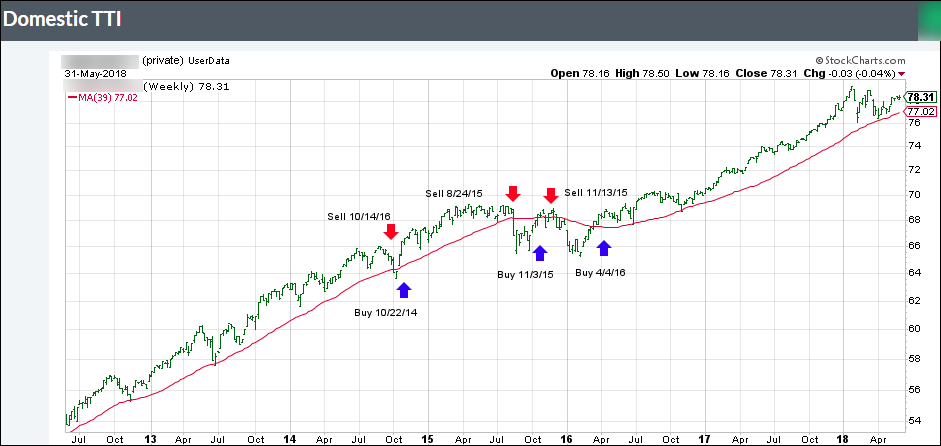
Our main directional indicator, the Domestic Trend Tracking Index (TTI-green line in the above chart) is positioned above its long-term trend line (red) by +2.33% after having generated a new Domestic Buy signal effective 4/4/2016 as posted.

Read More

Trifecta Of Events Sends Markets Into Tailspin

Ulli Market Commentary Contact

[Chart courtesy of MarketWatch.com]
  1. Moving the markets

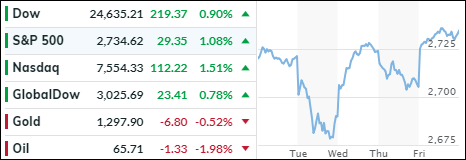
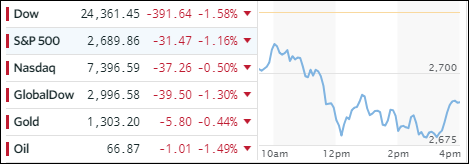
For the third day in a row, the major indexes got spanked again notching their worst decline in some three weeks as a trifecta of events combined to give the bears the upper hand.

First, there was Fed chair Powell, who has left the markets guessing how he feels about inflationary pressures by pronouncing on his second day on Capitol Hill that “we don’t want to fall behind the curve on inflation,” which was interpreted as hawkish.

Second, Fed governor Dudley joined the hawkish talk by educating the uninformed that 4 rate hikes in 2018 should be still considered ‘gradual.’

Third, President Trump added insult to an already weakening market and delivered the knock-out punch by announcing that he would impose tariffs on steel (25%) and aluminum (10%) imports adding to concerns about upcoming trade wars hurting corporations and consumers. That’s all it took to spook any remaining bulls as stocks, bond yields and the US Dollar headed south.

The 10-year bond yield gave back 6 basis points to close at 2.81%, while the US Dollar (UUP) lost -0.34%, and the major indexes each gave back in excess of 1%. Our Trend Tracking Indexes (TTIs), section 3 below, remain bullish and none of our trailing sell stops were triggered during today’s drubbing.

Read More

Stocks Have That Sinking Feeling…Worst Month In Two Years

Ulli Market Commentary Contact

[Chart courtesy of MarketWatch.com]
  1. Moving the markets

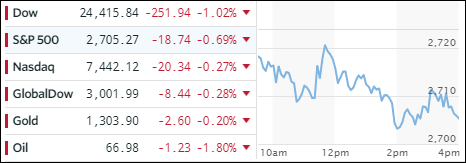
Today, it was economic data points that caused increased market volatility and sent the major indexes into a tailspin closing at the lows of the day. We started the session on a positive note, then bounced around the unchanged line for a while and finally accelerated to the downside with the S&P and Dow registering its worst month in two years.

Today, as well as for most of the month, there was no place to hide, with MarketWatch summing it up best:

Equities have struggled throughout February, with the Dow and the S&P 500 dropping into correction territory earlier this month, defined as a 10% drop from a recent high. The monthly losses were broad, with all 11 primary S&P 500 industry groups closing in negative territory.

With comments from new Fed chief Powell having sparked yesterday’s sell-off, today the culprit appeared to be poor economic data. First, GDP growth was reduced to 2.5% from 2.6% in the fourth quarter. This was followed by the Chicago PMI, which slipped to a six-month low in February, and Pending home sales, which plunged the most since 2010 (-4.7% in January vs. an expected +0.5%).

Surprisingly, bad news like these, are suddenly perceived as actually being bad news, while similar poor economic readings were simply overlooked during the past year as the bull market raged on. Maybe we have now reached a point where a sense of reality not only has set in but needs to be dealt with.

In terms of overall market direction, we are still bullish but have to be aware that this situation could change and that the bounce-back of the past 3 weeks really has legs and is not a just continuation of the short-term downtrend started early in February. After all, in the early phase potential bear markets start slowly and demonstrate violent rebound abilities.

Read More

Rate Hike Fears Take Front And Center; Markets Shift Into Reverse

Ulli Market Commentary Contact

[Chart courtesy of MarketWatch.com]
  1. Moving the markets

Yesterday’s calming speeches by 2 of the Fed’s mouthpieces (Bullard and Quarles) regarding inflation and interest rates are not only in the rear view mirror now but long forgotten as new Fed chair Powell  took center stage and gave his first congressional testimony.

He focused on the strengthening economy with the result that traders immediately assumed that any improvements will be associated with more aggressive tightening of monetary policy. He elaborated as follows:

“We’ve seen continuing strength in the labor market. We’ve seen some data that will, in my case, add some confidence to my view that inflation is moving up to target. We’ve also seen continued strength around the globe, and we’ve seen fiscal policy become more stimulative.”

That was enough to send the major indexes into a tailspin thereby wiping out a good chunk of yesterday’s gains. It’s clear from the market reaction throughout this month that bulls and bears are engaged in a constant tug-of-war with interest rates (10-year bond yield +4 basis point to 2.90%), the short-term outcome of which can sway traders in either direction depending on who speaks and if the words used are hawkish or dovish.

Long-term the major trend remains up, as shown by our Trend Tracking Indexes (TTIs), but it appears that volatility is back on the table, which means that we may be stuck in zigzag mode for a while until the next breakout occurs.

Read More

Equities Spike As Bond Yields Pull Back

Ulli Market Commentary Contact

[Chart courtesy of MarketWatch.com]
  1. Moving the markets

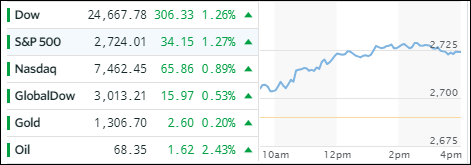
After several failed rally attempts early last week, the bulls regained the upper hand with the major indexes advancing for the third day in a row. Fears, that the Fed might be on a rate hike binge, were alleviated when 2 of the Fed’s mouth pieces took front and center and calmed down nervous traders.

First, Fed President Bullard opined that “the so-called neutral US interest rate may not rise much over the next two years.” Then Fed Governor Quarles soothed raw nerves even further by saying that he sees ‘encouraging signs’ of a turning point in the economy’s long-run growth prospects and that “faster growth will not automatically lead to out-of-control inflation.” That’s all it took, and the markets shifted into overdrive.

The technology sector led the rally with Semiconductors (SMH) taking top billing with a solid +2.12% gain, followed by Transportations (IYT +1.80%), Financials (XLF +1.51%) and Large Caps (SCHX +1.11%). All of our current holdings closed in the green.

Lower interest rates assisted the rally with the 10-year bond yield retreating 2 basis points to 2.86%. After its recent zigzag, the US Dollar (UUP) slipped -0.13%, which had no effect on market behavior.

Read More

ETFs On The Cutline – Updated Through 02/23/2018

Ulli ETFs on the Cutline Contact

Below please find the latest High Volume ETFs Cutline report, which shows how far above or below their respective long-term trend lines (39 week SMA) my currently tracked ETFs are positioned.

This report covers the HV ETF Master List from Thursday’s StatSheet and includes 366 High Volume ETFs ETFs, defined as those with an average daily volume of more than $5 million, of which currently 219 (last week 224) are hovering in bullish territory. The yellow line separates those ETFs that are positioned above their trend line (%M/A) from those that have dropped below it.

Take a look:

The HV ETF Master Cutline Report

In case you are not familiar with some of the terminology used in the reports, please read the Glossary of Terms.

If you missed the original post about the Cutline approach, you can read it here.