Snap-Back Rally Propels Equities Higher

Ulli Market Commentary Contact

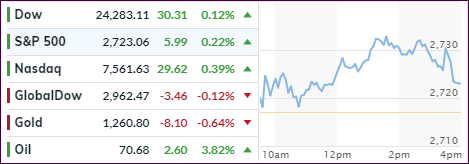
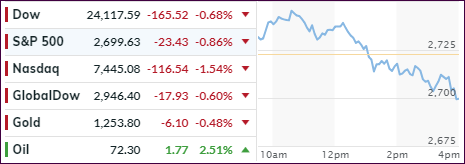
[Chart courtesy of MarketWatch.com]
  1. Moving the markets

The much feared wave of selling that dominated last week came to a sudden end when the major indexes opened higher, pulled back slightly and then rocketed into the close thereby recording their largest one-day percentage gains since the middle of 2015. The bulls finally showed signs of life supported by reports that behind the scenes talks between the US and China, to avoid a global trade war, showed some promise.

Technically speaking, today’s rebound was a repeat of the one we saw on February 8 when the S&P 500 bounced off its 200-day M/A, which was exactly what happened today. So, today’s market action can be just as much attributed to technical factors as the trade talk rumors.

Nevertheless, today’s recovery wiped out just about half of the losses sustained last week. As I mentioned in Friday’s post, the “Sell” signal generated by the International TTI would be subject to this morning’s market behavior. This what I said:

Today’s action sent our Trend Tracking Indexes (TTIs) much lower (see section 3), and we have a split picture. While the Domestic one remains in bullish territory by +0.83%, the International one has breached its long-term trend line to the downside by -0.45%, which means a “Sell” signal for this arena has been generated and all broadly diversified international ETFs should be sold.

They way I do this in my advisor practice is that I will first observe the markets on Monday morning to see if a rebound is in the making. If there is, I will hold off with my liquidation plans. If the markets, however, show continued weakness, I will follow through and sell those ETFs that are affected.

Needless to say, the rebound was in the making, and I held off with my liquidations plans for the time being. They will be revisited once the TTI drops back below its long-term moving average.

Green was the dominant color of the day, and all of our current ETF holdings rallied to varying degrees. Heading the group were Semiconductors (SMH +3.98%), Emerging Markets (SCHE +3.24%) and Financials (XLF +3.24%).

Interest rates moved up with the 10-year bond yield gaining 3 basis points to 2.85%, while the US Dollar (UUP) took a dive and lost -0.47%.

While today’s rebound was certainly welcome after last week’s drubbing, it’s far from certain whether this is another dead cat bounce, that will come back down to test the S&P’s 200-day M/A again, or an attempt to take out the all-time highs. We have to be prepared to deal with either possibility where the latter requires no action on our part while the former might bring another “Sell” signal into play.

Read More

ETFs On The Cutline – Updated Through 03/23/2018

Ulli ETFs on the Cutline Contact

Below please find the latest High Volume ETFs Cutline report, which shows how far above or below their respective long-term trend lines (39 week SMA) my currently tracked ETFs are positioned.

This report covers the HV ETF Master List from Thursday’s StatSheet and includes 366 High Volume ETFs ETFs, defined as those with an average daily volume of more than $5 million, of which currently 109 (last week 204) are hovering in bullish territory. The yellow line separates those ETFs that are positioned above their trend line (%M/A) from those that have dropped below it.

Take a look:

The HV ETF Master Cutline Report

In case you are not familiar with some of the terminology used in the reports, please read the Glossary of Terms.

If you missed the original post about the Cutline approach, you can read it here.

ETF Tracker Newsletter For March 23, 2018; International “Sell” Signal Triggered

Ulli ETF Tracker Contact

ETF Tracker StatSheet

https://theetfbully.com/2018/03/weekly-statsheet-for-the-etf-tracker-newsletter-updated-through-03-22-2018/

 DOWNSIDE MOMENTUM ACCELERATES

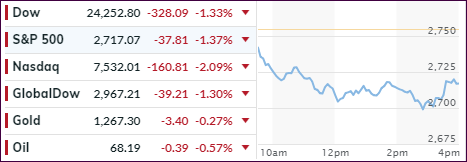
[Chart courtesy of MarketWatch.com]
  1. Moving the markets

For a while it looked like the major indexes were able to stage a modest rebound by trending slightly below and above their unchanged lines. However, that dream was short-lived as downward momentum suddenly accelerated and equities ended up diving into the close to finish an ugly week not just for domestic but global markets as well as US, European and Asian stocks all tumbled sharply in unison.

ZeroHedge summed up the carnage like this:

  1. *Dow average falls 426 points to lowest since nov. 22
  2. *S&P 500 sinks 5.9% in week, biggest drop in more than two years
  3. *Nasdaq 100 plunges 7.3% in week, most since august 2015

Technical damage was done, and especially the S&P 500 is now within striking distance of breaking below its widley watched 200-day M/A (+0.12%). Any break below could accelerate downward momentum further.

However, last time we got this close was on February 8, when it appeared that a return to bear market territoy was imminent, but we ended up bouncing off the 200-day M/A and back into bullish mode. Whether this will happen again is anyone’s guess, but the likelyhood of a bearish outcome has now increased not just due to chart patterns but also to an overall gloomy global market picture.

Today’s action sent our Trend Tracking Indexes (TTIs) much lower (see section 3), and we have a split picture. While the Domestic one remains in bullish territory by +0.83%, the International one has breached its long-term trend line to the downside by -0.45%, which means a “Sell” signal for this arena has been generated and all broadly diversified international ETFs should be sold.

They way I do this in my advisor practice is that I will first observe the markets on Monday morning to see if a rebound is in the making. If there is, I will hold off with my liquidation plans. If the markets, however, show continued weakness, I will follow through and sell those ETFs that are affected.

Continued weakness will also tell me that the likelyhood has increased that the Domestic ETFs are likely to follow to the downside. Historically, my indicators have shown that the International one tends to be the “canary in the coalmine’ on the upside as well as on the downside.

While anything is possible, I have learned over the past 30 years that, when following the Trend Tracking signals, you have to follow each one of them. Why? Because you never know if the next “Sell” signal is the one that helps you avoid the “big drop.” After all, attempting not to participate in epic potential bear markets is why we follow this methodology in the first place.

Read More

Weekly StatSheet For The ETF Tracker Newsletter – Updated Through 03/22/2018

Ulli ETF StatSheet Contact

ETF Data updated through Thursday, March 22, 2018

Methodology/Use of this StatSheet:

  1. From the universe of over 1,800 ETFs, I have selected only those with a trading volume of over $5 million per day (HV ETFs), so that liquidity and a small bid/ask spread are assured.
  2. Trend Tracking Indexes (TTIs)

Buy or Sell decisions for Domestic and International ETFs (section 1 and 2), are made based on the respective TTI and its position either above or below its long-term M/A (Moving Average). A crossing of the trend line from below accompanied by some staying power above constitutes a “Buy” signal. Conversely, a clear break below the line constitutes a “Sell” signal. Additionally, I use a 7.5% trailing stop loss on all positions in these categories to control downside risk.

  1. All other investment arenas do not have a TTI and should be traded based on the position of the individual ETF relative to its own respective trend line (%M/A). That’s why those signals are referred to as a “Selective Buy.” In other words, if an ETF crosses its own trendline to the upside, a “Buy” signal is generated. Since these areas tend to be more volatile, I recommend a wider trailing sell stop of 7.5% -10% depending on your risk tolerance.

If you are unfamiliar with some of the terminology, please see Glossary of Terms and new subscriber information in section 9.


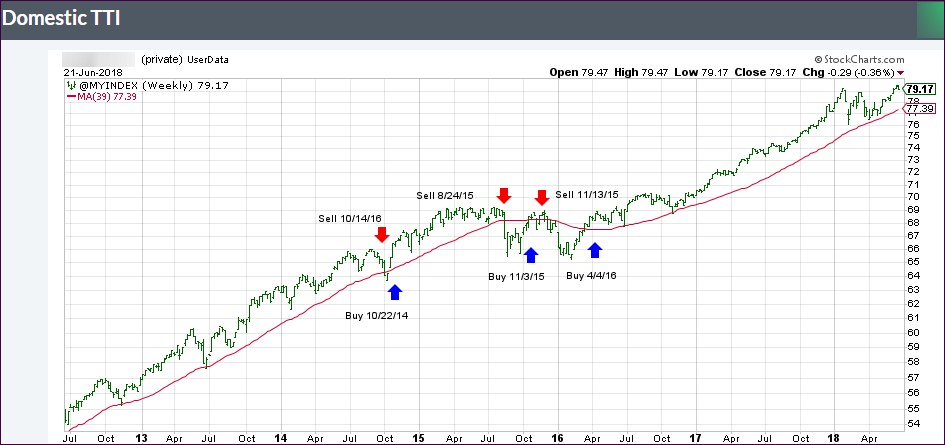
  1. DOMESTIC EQUITY ETFs: BUY — since 4/4/2016

Click on chart to enlarge

Our main directional indicator, the Domestic Trend Tracking Index (TTI-green line in the above chart) is positioned above its long-term trend line (red) by +1.69% after having generated a new Domestic Buy signal effective 4/4/2016 as posted.

Read More

Trade War Threats Hammer Markets; ‘Buy’ Signals Remain Intact

Ulli Market Commentary Contact

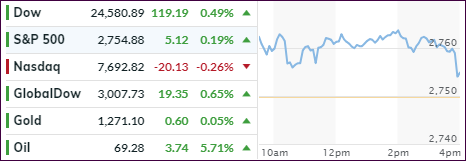
[Chart courtesy of MarketWatch.com]
  1. Moving the markets

I was thinking this morning that something had changed in the markets over the past week or so. All of a sudden, stocks seem to react to day-to-day headline events and no longer consider ‘any’ news as good news for the bullish crowd, which is what we saw throughout 2017.

Supporting a similar view was ZeroHedge with their following comments after today’s market close:

All of a sudden, ‘stuff’ matters:

  1. Powell hawkish
  2. Trump lawyer resigns
  3. Trump trade wars start
  4. Funding market stress surges
  5. Credit markets spike
  6. Facebook new lows
  7. Tech tax and regulation

As a result, the markets dumped right after the opening bell and never looked back. Sparking the downturn was the continued threat of a trade war with China, which had been temporarily moved to the back burner, while Facebook’s data harvesting scandal took front and center earlier this week.

To be clear, Facebook’s troubles were persistent in pulling down the tech sector today with the Fed’s interest rate policy and the ongoing game of musical chairs in the White House all combining to the uncertainty in the market place. The fallout was broad with 10 of the 11 S&P sectors ending down for the day, as only utilities managed to buck the trend to gain +0.4%.

Markets pulled back worldwide with especially European stocks having an ugly day, while in China the tech sector was beaten badly. Financials (XLF) went down hard as a result of US and EU banks tumbling. The cost of funding (for corporations) soared, which may have a severe effect on scheduled stock buybacks, which are supposed to be “the” driver for equities this year. These elevated costs may have corporations reconsider the buy-back option.

Interest rates dropped and proved to be a safe haven. The 10-year bond yield gave back 6 basis points to close at 2.83% while the US Dollar (UUP) gained a modest +0.13%.

Our Trend Tracking Indexes (TTIs) dove but remain in bullish territory. For more details, please see section 3 below.

Read More

Indexes Slip On Hawkish Fed

Ulli Market Commentary Contact

[Chart courtesy of MarketWatch.com]
  1. Moving the markets

Despite the major indexes gyrating wildly above their respective unchanged lines, ahead of the Fed, in the end, the elevated levels did not hold and we slipped slightly into the red. The big winners after the interest rate hike were Gold and Crude Oil.

There wasn’t really anything in the Fed announcement that was unexpected. Not only were rates hiked by 0.25% as predicted, but additional hikes for 2018 appear to be capped at only 2 more. The only fly in the ointment was the Fed’s upping of its forecast for the number of rate increases it expects in 2019 causing volatility to increase during the remainder of the session.

In ETF land things looked better with most of our broad holdings advancing as only LargeCaps (SCHX) ended up in the red by -0.14%. Leading to the upside were International SmallCaps (SCHC +0.55%), Emerging Markets (SCHE +0.51%) and International ETFs (SCHF +0.24%).

The yield on the 10-year bond went for a wild ride by first rallying towards the 2.93% level, and then dropping sharply to end the day unchanged at 2.89%. The US Dollar (UUP) never got off the ground and took a dive the entire session and lost -0.80%; and that was despite the Fed’s announcement as being of a hawkish nature, which should have been bullish for the dollar. Go figure…

Read More