Going Backwards—AKA Pump And Dump

Ulli Market Commentary Contact

[Chart courtesy of MarketWatch.com]
  1. Moving the markets

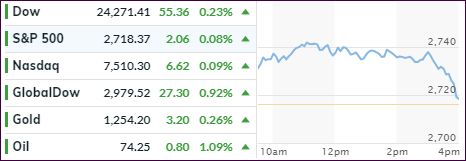
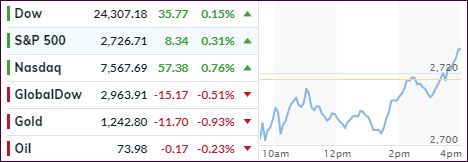
Yesterday’s late recovery rally continued this morning, but suddenly died, as momentum reversed, which sent the major indexes diving into the red. Weakness in tech and financials eclipsed positive moves in the telecom, energy and real estate sectors.

Contributing to the tech sectors downward swing was Micron Technology, which appears to have been a casualty of the US/China trade war after China announced that it was blocking the firm from selling some of its chips in China. It was made clear, however, that this was only on a temporary basis.

The strong US opening was assisted by prior gains in European markets where a last-minute deal on immigration in Germany saved not only Chancellor Merkel’s coalition but also possibly her job.

In the end, volume was low as many traders were absent, and will probably remain so during this Holiday shortened week. Low volume moves can be extreme, but they may not be necessarily a prognosticator of things to come.  That’s why I would not read too much into this week’s activity.

Happy 4th of July!
Read More

Escalating Trade Tensions—Markets Recover

Ulli Market Commentary Contact

[Chart courtesy of MarketWatch.com]
  1. Moving the markets

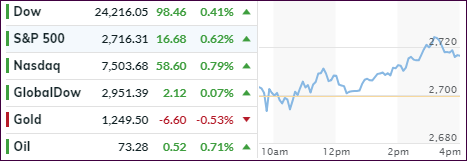
It was weak start to the 3rd quarter with the major indexes diving right after the opening bell, with the old stand-by, namely escalating trade tension, being the culprit and weighing on sentiment.

Despite this negative influence, a mid-day recovery, on the back of a rally in technology, turned things around and early losses were reversed, and we ended up seeing green numbers at the close.

Despite a positive finish, the trade battles go on, as the European Union (EU) has now threatened to respond with tariffs of $300 billion in US goods after Trump’s warning to slap a 20% tariff on auto imports from the EU.

And the game goes on: Tit for tat until eventually hopefully cooler heads will prevail and establish fair and just deals that everyone can agree to. In the meantime, the markets will remain in roller-coaster mode and react to the latest headline du jour.

On deck, and widely ignored, is the fact that the Fed’s QT program (Quantitative Tightening) will increase to $50 billion/month late in July from its current $30 billion. Makes me wonder how the markets will react, because, at the same time, the EU is fiddling with its reduction in QE (Quantitative Easing)?

Read More

ETFs On The Cutline – Updated Through 06/29/2018

Ulli ETFs on the Cutline Contact

Below please find the latest High Volume ETFs Cutline report, which shows how far above or below their respective long-term trend lines (39 week SMA) my currently tracked ETFs are positioned.

This report covers the HV ETF Master List from Thursday’s StatSheet and includes 366 High Volume ETFs ETFs, defined as those with an average daily volume of more than $5 million, of which currently 119 (last week 136) are hovering in bullish territory. The yellow line separates those ETFs that are positioned above their trend line (%M/A) from those that have dropped below it.

Take a look:

The HV ETF Master Cutline Report

In case you are not familiar with some of the terminology used in the reports, please read the Glossary of Terms.

If you missed the original post about the Cutline approach, you can read it here.

ETF Tracker Newsletter For June 29, 2018

Ulli ETF Tracker Contact

ETF Tracker StatSheet

https://theetfbully.com/2018/06/weekly-statsheet-for-the-etf-tracker-newsletter-updated-through-06-28-2018/

GAINING FOR THE DAY, LOSING FOR THE WEEK AND CLOSING MIXED YTD

[Chart courtesy of MarketWatch.com]
  1. Moving the markets

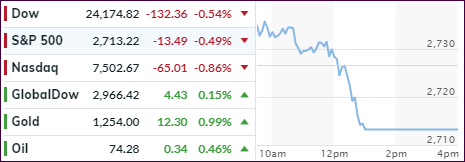
 An early rally flamed out as money managers squeezed in some quarter-ending window dressing causing volatility to the up- and downside, as the major indexes barely edged out some green numbers.

With the first half of 2018 now in the books, things did not turn out very well when considering that global stocks lost over $10 trillion. This chart demonstrates the distribution of winners and losers with the latter clearly leading, while the major indexes showed a mixed picture.

Domestically, YTD, the Dow lagged with -1.8%, followed by the S&P 500 (+1.7%), only thanks to a 2-day rebound yesterday and today. Taking top billing were the Nasdaq (+8.8%) and the Russell 2000 with +7.7%.

On the global stage, it appears that things have calmed down, at least for the moment, with China reportedly easing restrictions on foreign investment in certain sectors. Today, the EU leaders announced a deal over the crisis of migration, a tug-of-war that had been especially hard fought by the embattled German chancellor Merkel.

We’re now facing the second half of 2018 and future market performance will depend on a variety of conditions. These questions are on my mind currently:

  1. Can the economy continue to grow, or will it start sputtering as some reports suggest?
  2. Will employment conditions stay healthy with inflation being offset by wage growth?
  3. Will intended interest rate hikes be absorbed by a sufficiently growing economy?
  4. Will an EU banking crisis occur (Black Swan event) and can it be contained before spreading across the Atlantic?
  5. Will inflation accelerate to a point where rates need to rise sharply and affect stock markets negatively?

While no one has the answers, one thing is for sure. The second half promises to be anything but boring.

Read More

Weekly StatSheet For The ETF Tracker Newsletter – Updated Through 06/28/2018

Ulli ETF StatSheet Contact

ETF Data updated through Thursday, June 28, 2018

Methodology/Use of this StatSheet:

  1. From the universe of over 1,800 ETFs, I have selected only those with a trading volume of over $5 million per day (HV ETFs), so that liquidity and a small bid/ask spread are assured.
  2. Trend Tracking Indexes (TTIs)

Buy or Sell decisions for Domestic and International ETFs (section 1 and 2), are made based on the respective TTI and its position either above or below its long-term M/A (Moving Average). A crossing of the trend line from below accompanied by some staying power above constitutes a “Buy” signal. Conversely, a clear break below the line constitutes a “Sell” signal. Additionally, I use a 7.5% trailing stop loss on all positions in these categories to control downside risk.

  1. All other investment arenas do not have a TTI and should be traded based on the position of the individual ETF relative to its own respective trend line (%M/A). That’s why those signals are referred to as a “Selective Buy.” In other words, if an ETF crosses its own trendline to the upside, a “Buy” signal is generated. Since these areas tend to be more volatile, I recommend a wider trailing sell stop of 7.5% -10% depending on your risk tolerance.

If you are unfamiliar with some of the terminology, please see Glossary of Terms and new subscriber information in section 9.


  1. DOMESTIC EQUITY ETFs: BUY — since 4/4/2016

Click on chart to enlarge

Our main directional indicator, the Domestic Trend Tracking Index (TTI-green line in the above chart) is positioned above its long-term trend line (red) by +1.55% after having generated a new Domestic Buy signal effective 4/4/2016 as posted.

Read More

Financials And Tech Show Strength; International “Sell” Signal Confirmed

Ulli Market Commentary Contact

[Chart courtesy of MarketWatch.com]
  1. Moving the markets

Another slow start followed by a bounce back, which had legs for a change, gave the major indexes a victory session, although a modest one. Whether this was just another dead-cat bounce remains to be seen, but bullish momentum was not overwhelming thereby confirming our Domestic “Sell” signal affecting “broadly diversified international equity ETFs.”

I sold our last holding this morning, and we will not re-enter this arena until our International TTI (section 3) crosses solidly back above its long-term trend line.

All of Europe, except for Great Britain, got spanked and deep red was the preferred color on their stock exchanges. Domestically, the Dow’s troubles with its 200-day M/A continued as it closed the 4th day below it, which is not a good sign for the bullish crowd.

Scanning across markets, we see that the dollar slipped while Bond yields rose modestly. Foreign exchange markets (FX) showed a mixed picture with the Argentine Peso collapsing to a new low, while the Mexican Peso rallied ahead of elections. Not to be outdone, the Chinese Yuan continued its swan-dive like imitation by slumping for the 11th straight day.

Regarding domestic markets, we have simply been stuck in a trading range for the first half of this year. Look at this chart of the S&P 500:

Read More