Weekly StatSheet For The ETF Tracker Newsletter – Updated Through 08/02/2018

Ulli ETF StatSheet Contact

ETF Data updated through Thursday, August 2, 2018

Methodology/Use of this StatSheet:

  1. From the universe of over 1,800 ETFs, I have selected only those with a trading volume of over $5 million per day (HV ETFs), so that liquidity and a small bid/ask spread are assured.
  2. Trend Tracking Indexes (TTIs)

Buy or Sell decisions for Domestic and International ETFs (section 1 and 2), are made based on the respective TTI and its position either above or below its long-term M/A (Moving Average). A crossing of the trend line from below accompanied by some staying power above constitutes a “Buy” signal. Conversely, a clear break below the line constitutes a “Sell” signal. Additionally, I use a 7.5% trailing stop loss on all positions in these categories to control downside risk.

  1. All other investment arenas do not have a TTI and should be traded based on the position of the individual ETF relative to its own respective trend line (%M/A). That’s why those signals are referred to as a “Selective Buy.” In other words, if an ETF crosses its own trendline to the upside, a “Buy” signal is generated. Since these areas tend to be more volatile, I recommend a wider trailing sell stop of 7.5% -10% depending on your risk tolerance.

If you are unfamiliar with some of the terminology, please see Glossary of Terms and new subscriber information in section 9.


  1. DOMESTIC EQUITY ETFs: BUY — since 4/4/2016
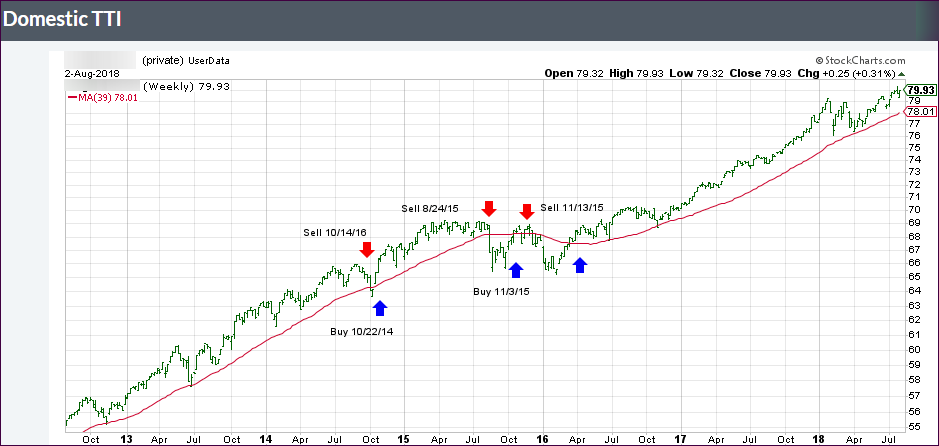
Click on chart to enlarge

Our main directional indicator, the Domestic Trend Tracking Index (TTI-green line in the above chart) is positioned above its long-term trend line (red) by +2.59% after having generated a new Domestic Buy signal effective 4/4/2016 as posted.
Read More

Apple Saves The Day

Ulli Market Commentary Contact

[Chart courtesy of MarketWatch.com]
  1. Moving the markets

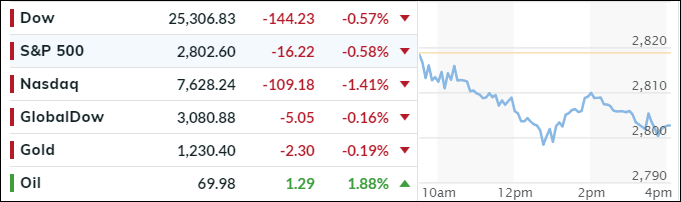
With no adverse trade news making the headlines, it was Apple’s (AAPL) day to shine as it not only lifted the indexes but also managed to become the first $1 trillion company—ever.

The S&P 500 and the Nasdaq gained solidly after a slow start at the opening, but then rocketed higher without looking back. Despite Apple’s valiant effort to support the markets, it just fell a tad short of pushing the Dow into the green. Nevertheless, the Dow’s comeback from -240 points at the opening to almost unchanged sure qualifies as a “rally” as well.

Apple’s run came on the heels of a strong earnings report, along with an upbeat outlook, which even pushed trade concerns to the back burner, at least for the moment. Not to worry, those will be back as a response to Trump’s tariff increase from 10% to 25% will sure be forthcoming.

Speaking of tariff threats and sanctions, at least for today, the scene shifted to Turkey where the Lira tumbled to record lows while in China the Yuan took another steep plunge (as did their stocks). That makes me wonder if Trump’s latest increase to 25% need to be higher to compensate for the latest Yuan devaluation?

I am being facetious, of course, but it looks that this movie is far from being over, and the battles will continue unabated. This leaves me pondering the obvious question: “How long will it take until the US markets will be affected?

Read More

An Early Rally Fizzles But Tech Gains

Ulli Market Commentary Contact

[Chart courtesy of MarketWatch.com]
  1. Moving the markets

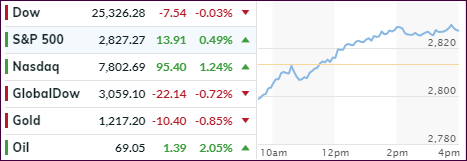
There was some afterglow this morning with the major indexes storming into positive territory on the heels of Apple’s blow out earnings report, which was released yesterday afternoon.

However, the initial euphoria was short-lived and faded as reality set in via a variety of events pushing 2 of the 3 indexes back into the red. The Nasdaq stayed above its unchanged line only due to Apple’s strong performance.

The Fed confirmed via its FOMC statement that the economy remains strong and that 2 more rate hikes were in store for 2018. Bonds reacted, and the 10-year yield advanced 4 basis points and closed right on its overhead glass ceiling of 3%. It sure looks like that the high of this year (3.11%) will be taken out shortly.

Despite the Fed’s jawboning about a “strong” economy, US manufacturing did a 180 by slumping to its weakest this year with prices surging and orders tumbling. I guess it’s all in the earnings. With 80% of the S&P stocks having reported better-than-expected second quarter earnings, which is well above the historical average of 67%, nothing else matters.

But, the bullish spirits were dampened somewhat by the ongoing trade differences between the US and China. Trump has now upped the ante to propose raising tariffs on $200 billion worth of Chinese products not by 10%, as previously announced, but 25%.

I can’t wait for the rebuttal. If it’s big enough, it sure will have a market moving effect the bears will like.

Read More

Finding Positive Momentum

Ulli Market Neutral ETFs Contact

[Chart courtesy of MarketWatch.com]
  1. Moving the markets

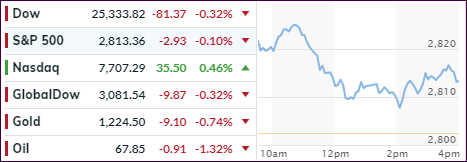
For a change, the major market indexes managed to move higher in sync with the Nasdaq (QQQ) successfully bouncing off its 4-month trend line to close solidly in the green. News reports that the latest trade talks with China had resolved nothing pulled the indexes off their mid-day highs but kept them above their respective unchanged lines.

The gains were broad with 8 of the primary 11 S&P sectors closing higher with the leaders being healthcare (XLV) and industrials adding 1% and 2.1% each.

Quarterly earnings reports remain front and center and while the “beats” are garnering most of the attention, there is still the dark cloud of “trade talks” lurking in the background threatening to disrupt upward momentum at any time.

However, as I am writing this, Apple’s earnings have been released, and they hit an all-time high on services and offered “stellar” guidance pushing its stock price up by some 4% in after hours trading. That should help giving a boost to the Nasdaq tomorrow.

For the month, all major indexes ended in the green with Transportations (IYT) leading the way while SmallCaps and the Nasdaq were the laggards, the latter of which was severely impacted by the crashes of FB and NFLX.

Read More

Tech Weakness Keeps Markets Slipping

Ulli Market Commentary Contact

[Chart courtesy of MarketWatch.com]
  1. Moving the markets

I am on the road today and tomorrow, so the market reports may be delayed…

The technology sector (QQQ) continued unraveling by not only logging a third straight session in the red but also closing at its lowest level in more than 3 weeks. It’ll be interesting to see if the 4-month long support line will hold and serve as support as it has done several times in the past.

Any break below it, however, may spell trouble for this sector and could mean much lower prices ahead. There is a clear spillover effect to the S&P 500, which is made up of some 26% technology. Or, looking at it one step further, 15.5% of the index consists of only 5 tech names. That means further down moves will certainly have a collateral effect.

All eyes are now on Apple’s earnings due out late tomorrow. Any surprise to the upside may very well have the power to pull tech out of the doldrums. It seems that Wall Street expects companies to not only to beat earnings and revenue but also present a great outlook or be punished as happened with Facebook.

In the end, it was Morgan Stanley (MS) turn to throw some words of wisdom around:

The bottom line for us is that we think the selling has just begun and this correction will be biggest since the one we experienced in February. However, it could very well have a greater negative impact on the average portfolio if it’s centered on Tech, Consumer Discretionary and small caps, as we expect. 

Nobody knows for sure if this is how things will play out, but I am comfortable with the fact that we have an exit strategy in place, should MS’s ominous statement turn into reality.

Read More

ETFs On The Cutline – Updated Through 07/27/2018

Ulli ETFs on the Cutline Contact

Below, please find the latest High Volume ETFs Cutline report, which shows how far above or below their respective long-term trend lines (39 week SMA) my currently tracked ETFs are positioned.

This report covers the HV ETF Master List from Thursday’s StatSheet and includes 366 High Volume ETFs ETFs, defined as those with an average daily volume of more than $5 million, of which currently 175 (last week 150) are hovering in bullish territory. The yellow line separates those ETFs that are positioned above their trend line (%M/A) from those that have dropped below it.

Take a look:

The HV ETF Master Cutline Report

In case you are not familiar with some of the terminology used in the reports, please read the Glossary of Terms.

If you missed the original post about the Cutline approach, you can read it here.