Weekly StatSheet For The ETF Tracker Newsletter – Updated Through 11/14/2019

Ulli ETF StatSheet Contact

ETF Data updated through Thursday, November 14, 2019

Methodology/Use of this StatSheet:

1. From the universe of over 1,800 ETFs, I have selected only those with a trading volume of over $5 million per day (HV ETFs), so that liquidity and a small bid/ask spread are assured.

2. Trend Tracking Indexes (TTIs)

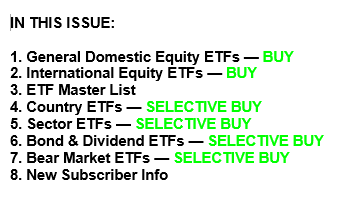
Buy or Sell decisions for Domestic and International ETFs (section 1 and 2), are made based on the respective TTI and its position either above or below its long-term M/A (Moving Average). A crossing of the trend line from below accompanied by some staying power above constitutes a “Buy” signal. Conversely, a clear break below the line constitutes a “Sell” signal. Additionally, I use a 7.5% trailing stop loss on all positions in these categories to control downside risk.

3. All other investment arenas do not have a TTI and should be traded based on  the position of the individual ETF relative to its own respective trend line (%M/A). That’s why those signals are referred to as a “Selective Buy.” In other words, if an ETF crosses its own trendline to the upside, a “Buy” signal is generated. Since these areas tend to be more volatile, I recommend a wider trailing sell stop of 7.5% -10% depending on your risk tolerance.

If you are unfamiliar with some of the terminology, please see Glossary of Terms and new subscriber information in section 9.     

1. DOMESTIC EQUITY ETFs: BUY — since 02/13/2019

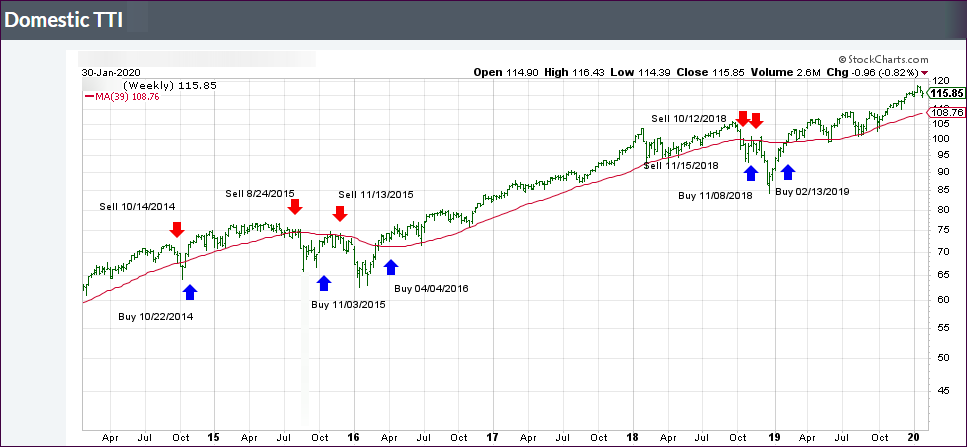
Click on chart to enlarge

Our main directional indicator, the Domestic Trend Tracking Index (TTI-green line in the above chart) is now positioned above its long-term trend line (red) by +5.58% after having generated a new Domestic “Buy” signal effective 2/13/19 as posted.

Read More

Trade Pessimism Keeps Markets In Check

Ulli Market Commentary Contact

[Chart courtesy of MarketWatch.com]
  1. Moving the markets

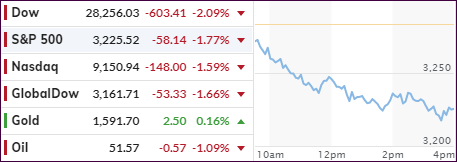
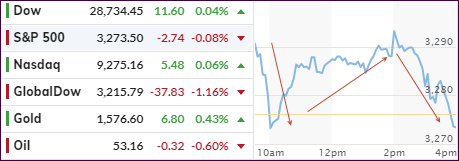
The bouncing below the unchanged lines went on throughout the session with the major indexes having a hard time seeing green, with only the S&P 500 and Dow briefly peeking into positive territory.

The cause for this lack of upward momentum turned out to be usual culprit, namely the latest trade reports casting a big shadow on some of the alleged process. For one, the White House “conceded that the original target date may slip,” but they denied reports of a setback.

Other bon mots included things like “China was absolutely delaying the truce with its approach,” and “there is a lot of jockeying going on—it’s a standoff, in part,” all of which did nothing to calm the markets. However, the positive in all that was that the indexes remained stable and closed within a fraction of their respective unchanged lines.

Even the mid-day tumble was stopped by an influx of dip buyers making this pullback an event now long forgotten and only visible in the rear-view mirror. So, the trade movie continues with all of its idiosyncrasies, as the market-implied odds of a trade deal are worsening from day to day.

On a side note, I had to crack up today when I heard the latest interpretation of using politically correct language, an area that seems to have taken on a life of its own. You’ll be delighted to hear that a new word is spreading in the investment community.

We all, especially the buy-and-hold crowd, certainly remember the crash of 2008, which decimated many portfolios, and I believe the next one will even be more destructive, whenever it arrives. To lessen the pain, some joker suggested we call such an event no longer a “crash” but rather “a sudden value reassessment.”

Well, I don’t know about you, but I would feel far more comfortable losing 50% of my portfolio due to “a sudden value reassessment” than due to a “crash,” wouldn’t you agree?

Read More

Slumping And Pumping

Ulli Market Commentary Contact

[Chart courtesy of MarketWatch.com]
  1. Moving the markets

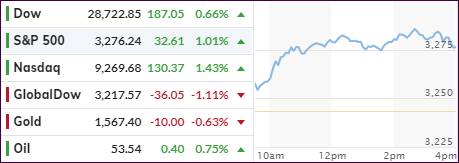
It was another trading day during which uncertainty ruled. The major indexes survived an early sell-off and bounced back only to be slammed back down below their respective unchanged lines.

Give credit to the mid-day slam to a US-China trade problem, caused by reports that that a snag was hit over farm purchases. Then China barked by “resisting US requests for tech-transfer curbs and any enforcement mechanism.” Needless to say, the markets were not amused and down we went, while at the same time the latest short squeeze appeared to have run out of ammunition.

In the end, however, the indexes managed a comeback into the green with the weakling being the Nasdaq, which bumped against its unchanged line but failed to conquer it.

However, I consider one development today an important one, namely that the recent bond sell-off, during which the widely followed 10-year yield spiked dramatically, thereby taking the starch out of low volatility ETFs like SPLV, appeared to have reversed. After pushing towards the 2% level, the yield pulled back and closed at 1.88%, which allowed SPLV finally to have a good day by gaining +0.78% vs. the meager +0.05% the S&P 500 (SPY) generated.  

While the 5-week old rally continues to roll on, today’s gains were small, but they were gains, nonetheless. I keep harping on the importance of liquidity as being “the driver” for further advances. Well, the Fed has pumped some $280 billion into the system over the past 7 weeks, which all but guarantees the momentum necessary to support the bullish theme.

Never mind that the October budget deficit surged 34% to $134 billion, which was its worst in five years. There is nothing but red ink in our future, but who cares about such minor details, if it stokes the liquidity engine.

Read More

Shifting In Reverse; An Early Rally Peters Out

Ulli Market Commentary Contact

[Chart courtesy of MarketWatch.com]
  1. Moving the markets

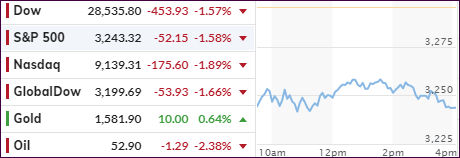
An early rally petered out, as the S&P 500 briefly surpassed another milestone, namely the 3,100 level, and then faded towards its unchanged line. The move was based on nothing but hope that Trump would later, during a scheduled speech, elaborate about the China trade deal.

Focused on that target, and that good news might be on the horizon, the army of computer algos combined forces and gave an assist via a short squeeze, which later puked, just as happened yesterday.

Trump’s comments disappointed somewhat, although he said “a significant phase one” trade deal could happen soon, but that he would accept it only if the agreement worked out to the advantage of U.S. workers and businesses. While that is a noble idea, it’s not one the headline scanning algos took as a positive, so down we went with most the early gains evaporating and the Dow turning negative.

The fly in ointment, contributing to the pullback, was a rebuttal by the unofficial Chinese mouthpiece Global Times, which tweeted:

Quite a lot of criticisms and complaints about China from President Trump in his latest speech, but hardly anything new. Similar statements of senior US officials have bored people. It seems this US administration really believes a lie repeated a thousand times becomes truth.

Cautious optimism also went out the window due to a Wednesday deadline looming as to whether Trump will put off the intended 25% tariffs on European auto imports. If he doesn’t, that could be a drag on the markets, which makes me believe that this decision will be pushed back.

More uncertainty is on the way with Fed head Powell to be scheduled to give a congressional testimony on the state of the economy, which is due tomorrow at noon. We may very well see much treading of water in the indexes until Powell’s speech is dissected down to his every word.

Read More

Stalling… But Not Running Out Of Steam

Ulli Market Commentary Contact

[Chart courtesy of MarketWatch.com]
  1. Moving the markets

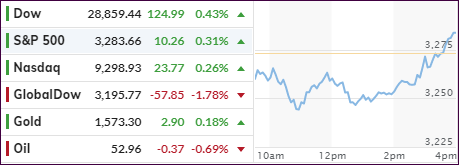
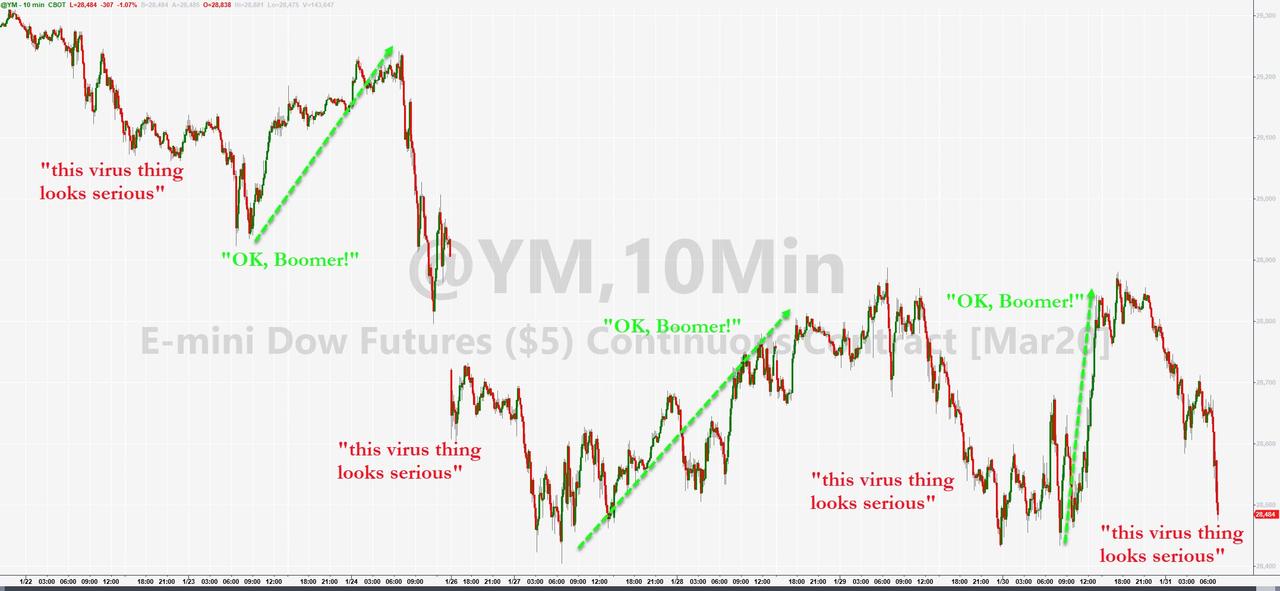
Not just US futures, but global markets as well, hit the skids early on, a sight which we have not seen in some 5 weeks, as the markets have been on a tear ever since dumping during the first 2 days of October.

The two catalysts for the early thrashing was simply lack of optimism on the trade front with Trump saying that discussions with China were going “very nicely” but cautioned that recent reports about an agreement to roll back tariffs weren’t accurate. He added that “the level of tariff lift is incorrect” without further elaborating.

Adding to this uncertainty was a sudden explosion in violence during the 24th straight week of protests in Hong Kong with one protester seriously injured while another one was set on fire.

That was enough to send the markets reeling, but a pullback of some sort was way overdue, and today’s events simply provided a reason, which was also helped by the fact that the bond markets were closed for the holiday.  

Then a White Knight appeared in the form of the much beaten up Boeing Corporation, which announced that its maligned and grounded fleet of 737 MAX couldsee return to service early next year.”

That was exactly the impetus the computer algos needed, the bottom was established, and up we went. The Dow was the main beneficiary by going green, with the other two major indexes heading towards their unchanged lines but falling short of closing above it.

The major market trend remains up, but I would not be surprised to see some weakness over the next few trading days, unless of course, a new lipstick is applied to that trade pig.

Read More

ETFs On The Cutline – Updated Through 11/08/2019

Ulli ETFs on the Cutline Contact

Below, please find the latest High-Volume ETF Cutline report, which shows how far above or below their respective long-term trend lines (39-week SMA) my currently tracked ETFs are positioned.

This report covers the HV ETF Master List from Thursday’s StatSheet and includes 322 High Volume ETFs, defined as those with an average daily volume of more than $5 million, of which currently 282 (last week 281) are hovering in bullish territory. The yellow line separates those ETFs that are positioned above their trend line (%M/A) from those that have dropped below it.

Take a look:                                                                   

The HV ETF Master Cutline Report

In case you are not familiar with some of the terminology used in the reports, please read the Glossary of Terms. If you missed the original post about the Cutline approach, you can read it here.