Weekly StatSheet For The ETF Tracker Newsletter – Updated Through 05/16/2019

Ulli ETF StatSheet Contact

ETF Data updated through Thursday, May 16, 2019

Methodology/Use of this StatSheet:

1. From the universe of over 1,800 ETFs, I have selected only those with a trading volume of over $5 million per day (HV ETFs), so that liquidity and a small bid/ask spread are assured.

2. Trend Tracking Indexes (TTIs)

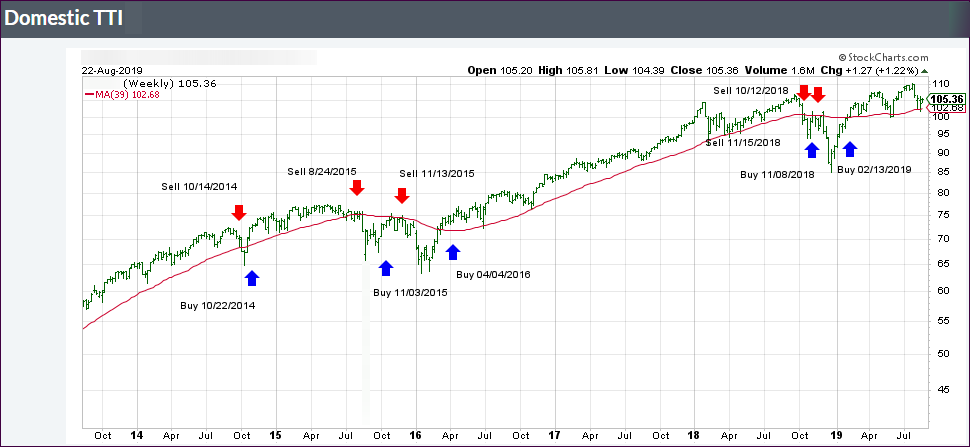
Buy or Sell decisions for Domestic and International ETFs (section 1 and 2), are made based on the respective TTI and its position either above or below its long-term M/A (Moving Average). A crossing of the trend line from below accompanied by some staying power above constitutes a “Buy” signal. Conversely, a clear break below the line constitutes a “Sell” signal. Additionally, I use a 7.5% trailing stop loss on all positions in these categories to control downside risk.

3. All other investment arenas do not have a TTI and should be traded based on  the position of the individual ETF relative to its own respective trend line (%M/A). That’s why those signals are referred to as a “Selective Buy.” In other words, if an ETF crosses its own trendline to the upside, a “Buy” signal is generated. Since these areas tend to be more volatile, I recommend a wider trailing sell stop of 7.5% -10% depending on your risk tolerance.

If you are unfamiliar with some of the terminology, please see Glossary of Terms and new subscriber information in section 9.     

1. DOMESTIC EQUITY ETFs: BUY — since 02/13/2019

Click on chart to enlarge

Our main directional indicator, the Domestic Trend Tracking Index (TTI-green line in the above chart) is now positioned above its long-term trend line (red) by +3.86% after having generated a new Domestic “Buy” signal effective 2/13/19 as posted.

Read More

Notching A Third Day Of Gains

Ulli Market Commentary Contact

[Chart courtesy of MarketWatch.com]
  1. Moving the markets

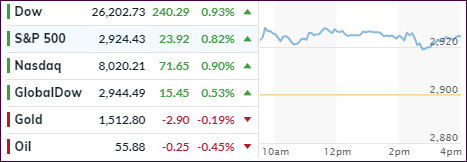
A third day of gains kept the bulls in charge with the major indexes ending up solidly in the green, as it turned out that a worsening global trade picture is now considered a good thing for equities. Go figure…

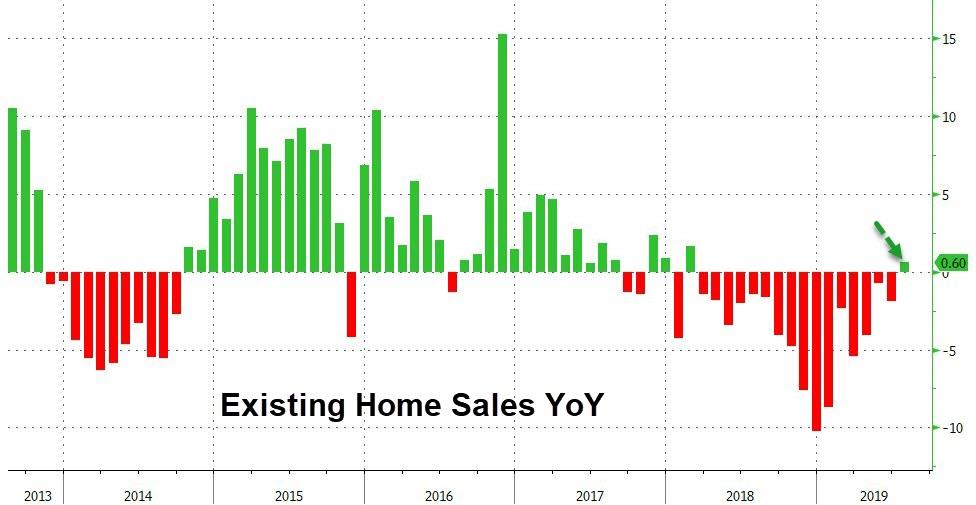
To be fair, an early assist came from a couple of blue-chip stocks, whose upbeat earnings helped to get things started in the bullish direction. Also, U.S. Labor and Housing market numbers were better than expected, all of which alleviated some of the ever-present worries over trade escalations.

Conveniently ignored was the decoupling of stocks and bonds, which headed in different directions but will have to eventually fall back in sync. The question is: “will it be in favor of stocks or bonds?

If you think that traders have a handle on what goes on in the markets, you may be pleased to hear that this is not the case. Here are some nuggets I’ve found when evaluating if we are in a ‘risk on’ or ‘risk off’ mode:

Trade tensions have eased. Trade tensions have ratcheted up.

Things will get better. They have to. It’ll get worse before it gets better. Neither side can afford to back down.

Use game theory to figure this whole situation out. Use it to create a game plan.

React to every comment. It’s the only way to survive.

Buy the dip. Derisk.

And, of course, what is really the punchline: The global economy is set to grow and is in a “good place;” the numbers are cratering fast.

Which is it?

One trader added this bon mot: Nobody know what’s going on, but everyone is buying just in case.

There you have it. It appears to be a mad house with everyone scrambling for explanations, which would be funny, if this whole environment wouldn’t be so critical for the survival of your portfolio.

I think the only reasonable thing to do is to have a clearly defined exit strategy, just in case this house of cards comes crumbling down, which it eventually will.  

Read More

Trade Hope Keeps Rally Alive

Ulli Market Commentary Contact

[Chart courtesy of MarketWatch.com]
  1. Moving the markets

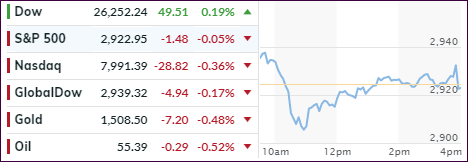
A market opening in the red turned into a positive, as trade hope was kept alive on that other trade war front, namely Europe. We heard that an unexpected bit of good news spread like wildfire when Trump announced that he plans to delay imposing tariffs on EU auto imports by six months.

That was good enough to change the mood on Wall Street to bullish, as it meant at least a temporary trade-ceasefire on one front, while the escalation with China could continue and morph into an outright trade war.

Domestically, retailers are seeing declining purchases for the second time in 3 months. This means consumer spending confirms a slowing economy, despite the widely touted low unemployment rate, which is supposed to represent a healthy labor market.

This weakness goes along with global data, which showed disappointment, as the Global surprise index kept heading south, which makes the current rally questionable as to whether it sits on a solid footing or is merely based on wishful thinking along with hope for more stimulus.

Thanks to ZH, we now have an updated chart showing that global money supply and fundamentals, as represented by the Citi Economic Surprise Index, are no longer supporting equities. We’ll have to wait and see ‘if’ and ‘when’ that reality sinks in. 

Read More

Comeback Tuesday

Ulli Market Commentary Contact

[Chart courtesy of MarketWatch.com]
  1. Moving the markets

A nice rebound rally, which wiped out some of yesterday’s steep losses, ran into resistance late in the session, but the major indexes managed to close in the green for a change. Trade anxieties remained and contributed to the indexes coming off their best levels

Trump stepped up to the plate again attempting to calm Wall Street traders with soothing words like it should be clear in “3-4 weeks” if a U.S. delegation’s recent trip to China was successful. This was followed by “I have a feeling it’s going to be very successful.”

He also added “when the time is right, we will make a deal with China. My respect and friendship with President Xi is unlimited but, as I have told him many times before, this must be a great deal for the United States or it just doesn’t make any sense.”

For the time being, the markets took it as a positive and pushed stocks higher. For how long that remains to be seen and how clever the administration will be in putting more lipstick on that trade pig. I suppose we will soon find out if today was nothing more than a dead-cat-bounce in an ongoing correction.

The direction of the global money supply makes that a valid argument. 

Read More

U.S.-China Trade Mayhem Crushes Equities

Ulli Market Commentary Contact

[Chart courtesy of MarketWatch.com]
  1. Moving the markets

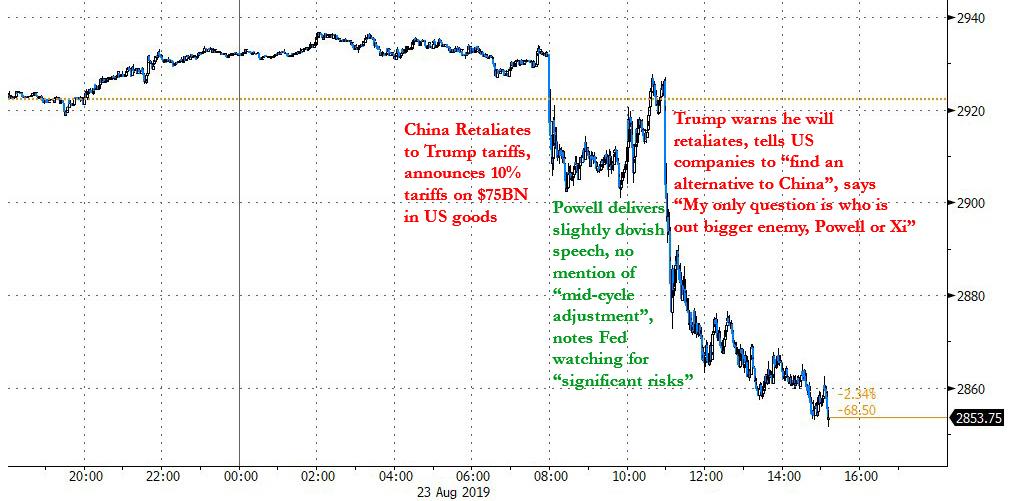
It was clear to me on Sunday afternoon, that today would be bad day in the markets when China’s Premier Liu He tweeted that China is planning to retaliate, and three core concerns would have to be addressed:

China has made public 3 core concerns that must be addressed &it won’t make concessions on. From perspective of China’s politics, there is little room for compromises. They will insist. This political logic won’t be changed no matter how much additional tariffs the US will impose.

Trump did not back down and upped the ante with:

….The only problem is that they know I am going to win (best economy & employment numbers in U.S. history, & much more), and the deal will become far worse for them if it has to be negotiated in my second term. Would be wise for them to act now, but love collecting BIG TARIFFS!

That pretty much set the negative tone in the futures market, and subsequently at the opening of the regular session this morning, with the major indexes doing their best imitation of a swan dive.

Since the beginning of the year, markets had priced in a best-case trade scenario, helping the rebound rally going. That theme has now, however, shifted towards a worst-case scenario pushing up volatility and giving the bears the upper hand.

The shock that trade retaliation materialized, will most likely change the bullish theme we’ve witnessing since Christmas. Unless, of course, the Fed changes its mind again and follows the White House’s suggestion to lower interest rates by a full 1%. Then we could see a sudden reversal in sentiment and, at least temporarily, a resumption of the prior uptrend.

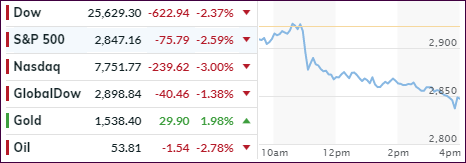
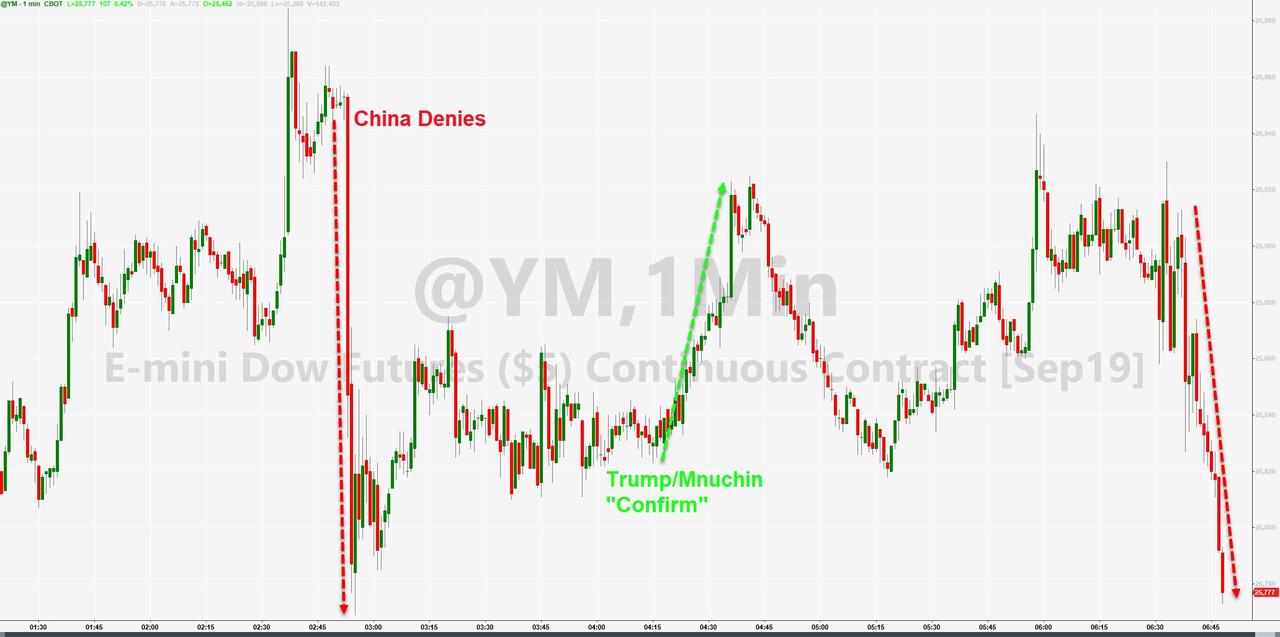
It was an ugly day with the Dow being down some 700 points but managed to crawl off its lows thanks to selected jawboning by Mnuchin and Trump. ZH reports that this was not only the worst day for stocks since January 2nd, but we’re also marching towards the worst May in 50 years.

The losses were broad with the FANG stocks getting hammered, while AAPL gapped down and got smashed below its 200-day M/A.

Bond yields dropped helping the low volatility ETFs, like SPLV, hold up far better than the indexes. To wit, SPY lost -2.51%, while SPLV gave back a modest -0.64%.

None of our trailing sell stops were triggered, but the International TTI pierced its long-term trend line to the downside by -0.66%. I will wait and see if this drop into bearish territory will hold before issuing a ‘Sell’ signal for that arena. 

Read More

ETFs On The Cutline – Updated Through 05/10/2019

Ulli ETFs on the Cutline Contact

Below, please find the latest High-Volume ETF Cutline report, which shows how far above or below their respective long-term trend lines (39-week SMA) my currently tracked ETFs are positioned.

This report covers the HV ETF Master List from Thursday’s StatSheet and includes 322 High Volume ETFs, defined as those with an average daily volume of more than $5 million, of which currently 245 (last week 273) are hovering in bullish territory. The yellow line separates those ETFs that are positioned above their trend line (%M/A) from those that have dropped below it.

Take a look:                                                                   

The HV ETF Master Cutline Report

In case you are not familiar with some of the terminology used in the reports, please read the Glossary of Terms. If you missed the original post about the Cutline approach, you can read it here.