Below, please find the latest High-Volume ETF Cutline
report, which shows how far above or below their respective long-term trend
lines (39-week SMA) my currently tracked ETFs are positioned.
This report covers the HV ETF Master List from Thursday’s
StatSheet and includes 322 High Volume ETFs, defined as those with an average
daily volume of more than $5 million, of which currently 234 (last week 272)
are hovering in bullish territory. The yellow line separates those ETFs that
are positioned above their trend line (%M/A) from those that have dropped below
it.
In case you are not familiar
with some of the terminology used in the reports, please read the Glossary of Terms.
If you missed the original
post about the Cutline approach, you can read it here.
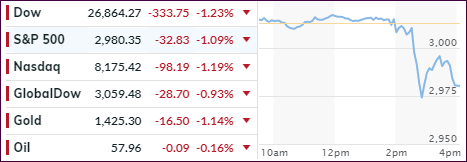
Equities spent most of their day surrounded
by a sea of red, thanks in part to further fallout from the Fed cutting rates by
“only” 0.25%. The bigger impact, however, came from the follow through of tough
language after Trump had announced further tariffs on Chinese goods.
That pushed the markets into bearish mode and
today’s counter punch from the Chinese via words like “temperamental US will
suffer more pain,” did nothing to soothe the raw nerves. This aggravated Wall
Street traders/algos and down we went again recording the worst week of 2019.
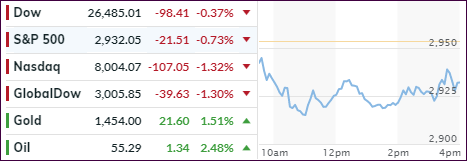
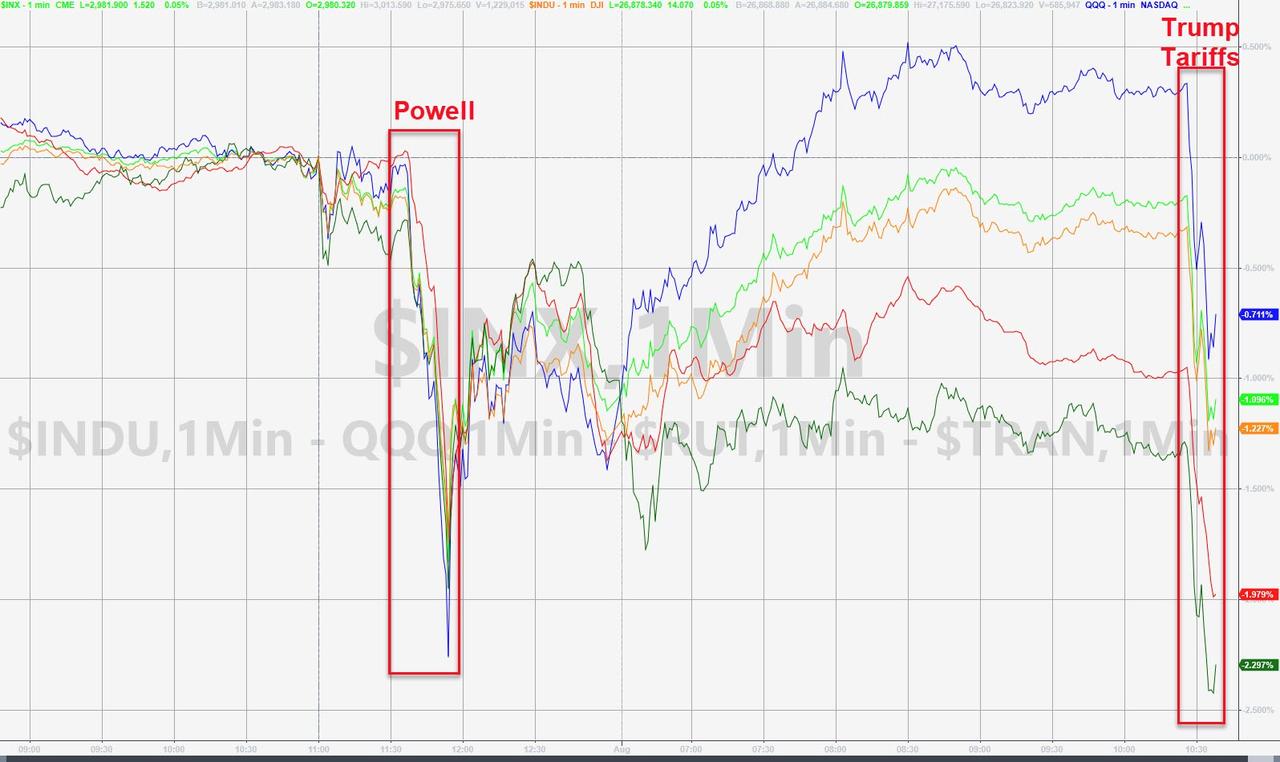
As the chart above shows, the outcome could have
been a lot worse, but thanks to buyers stepping in at mid-day, the losses were
sharply reduced, but we still closed in the red. This was the S&P 500’s 5th
successive drop in a row.
Today’s payroll report did not contain any surprises
with 164k jobs added, which was just about the expected number. This decent
headline was weakened by the fact that substantial historical downward revisions
pulled employment gains for May and June down by 41,000 from what was previously
reported.
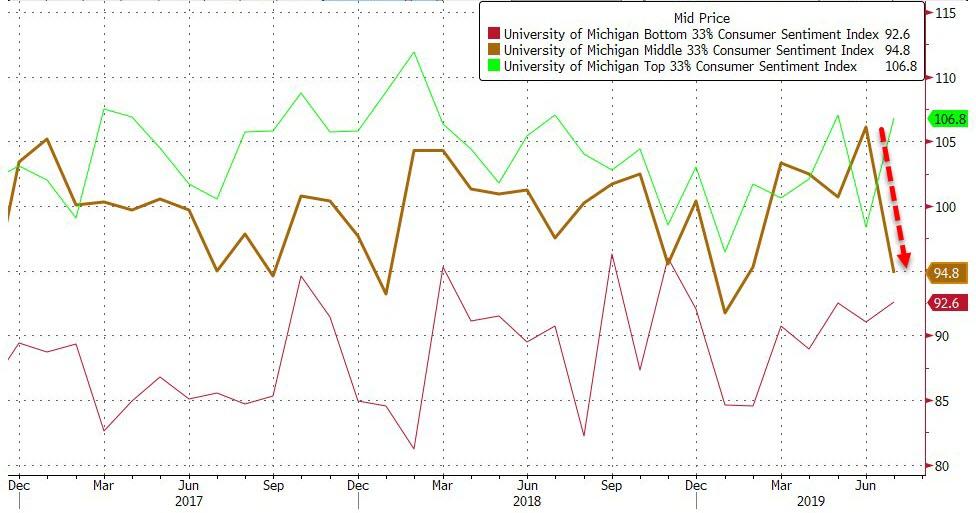
On the economic front, the dire news continues
with Consumer Confidence dropping to 5-month lows, but only in the arena considered
to be the middle-income
Americans, while the bottom and top numbers improved.
Factory orders contracted for the 2nd
month in a row due to a reduction in war-spending, which is a good thing…
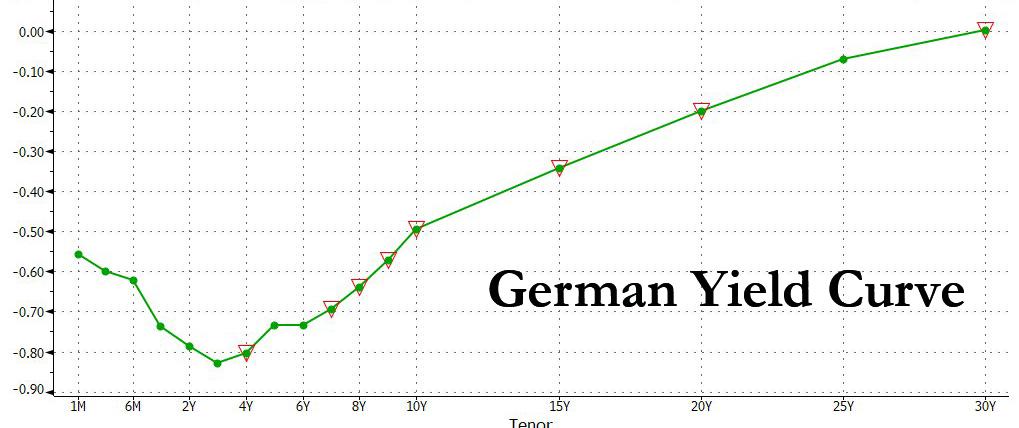
Looking towards Europe, we learned that the entire
yield
curve of economic powerhouse Germany dropped below zero for the first time ever.
What that means is that the idiocy continues in bond land, where every bond you
want to buy has now a negative return. Yes, even the 30-year dropped into minus
territory by a tad.
It’s a race to the bottom, with now some $14
trillion in global bonds now yielding less than zero. I am afraid, it’s just a
matter of time that the US will follow suit.
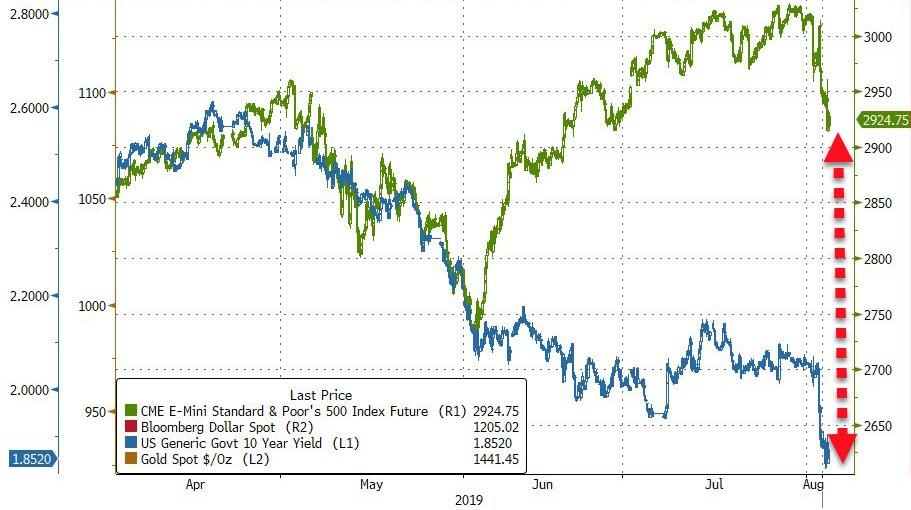
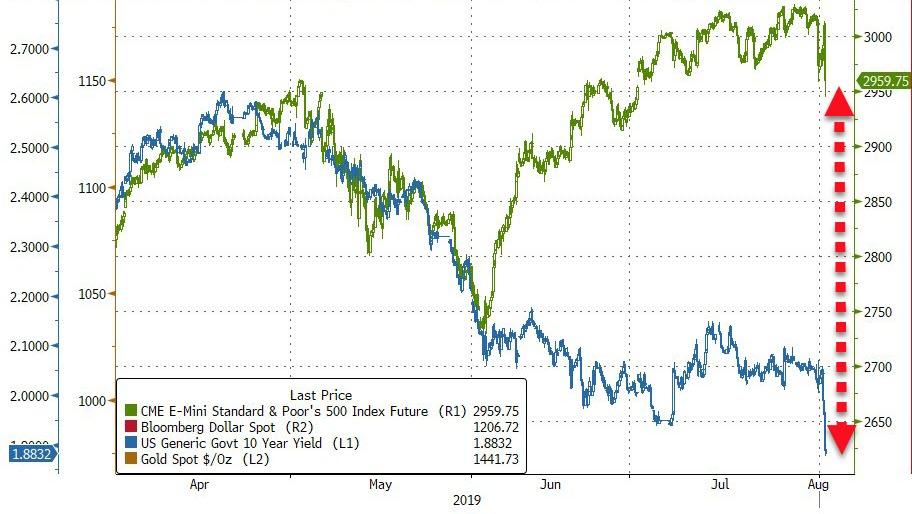
As ZH pointed out, despite this week’s carnage,
bonds and stocks remain dramatically decoupled,
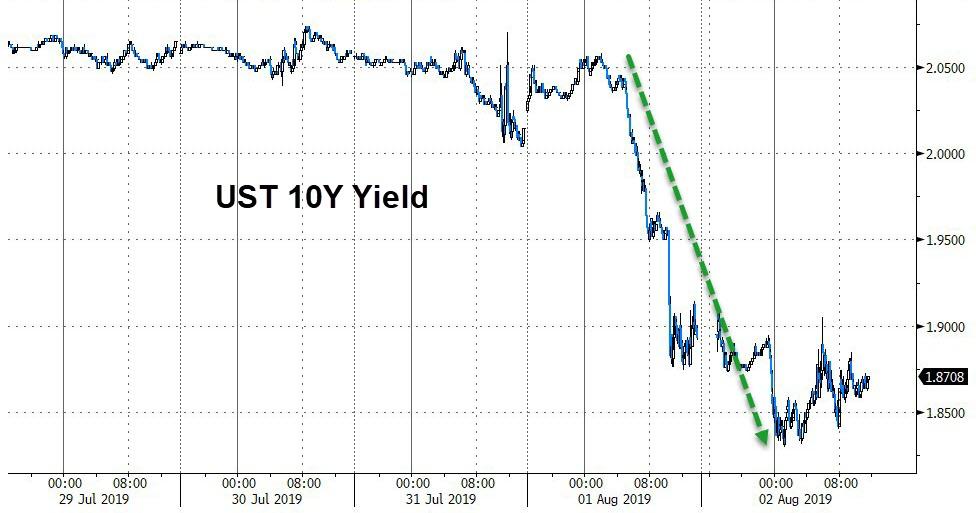
as the 10-year yield experienced its biggest
drop in a week, since the end of 2014.
If the last few days are an indication of what we can expect in the markets, it promises to be an August to be remembered.
1. From the universe of over 1,800 ETFs, I have selected only those with a
trading volume of over $5 million per day (HV ETFs), so that liquidity and a
small bid/ask spread are assured.
2. Trend Tracking Indexes (TTIs)
Buy or Sell decisions for Domestic and International ETFs (section 1 and
2), are made based on the respective TTI and its position either above or below
its long-term M/A (Moving Average). A crossing of the trend line from below
accompanied by some staying power above constitutes a “Buy” signal. Conversely,
a clear break below the line constitutes a “Sell” signal. Additionally, I use a
7.5% trailing stop loss on all positions in these categories to control
downside risk.
3. All other investment arenas do not have a TTI and should be traded
based on the position of the individual
ETF relative to its own respective trend line (%M/A). That’s why those signals
are referred to as a “Selective Buy.” In other words, if an ETF crosses its own
trendline to the upside, a “Buy” signal is generated. Since these areas tend to
be more volatile, I recommend a wider trailing sell stop of 7.5% -10% depending
on your risk tolerance.
If you are unfamiliar with some of the terminology, please see Glossary of Termsand new subscriber information in section 9.
1. DOMESTIC EQUITY ETFs: BUY
— since 02/13/2019
Click on chart to enlarge
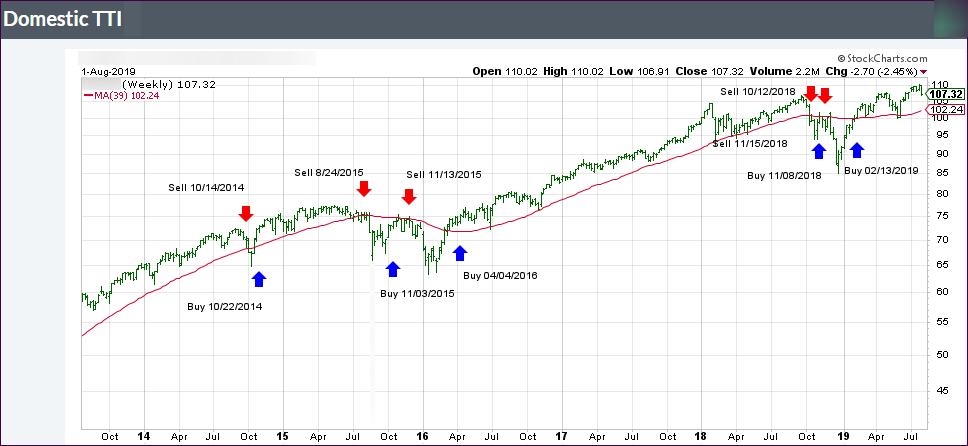
Our main directional indicator, the Domestic Trend Tracking Index (TTI-green line in the above chart) is now positioned above its long-term trend line (red) by +5.20% after having generated a new Domestic “Buy” signal effective 2/13/19 as posted.
Sometimes you just have to laugh
out load. Today was such a day, as data showing that US Manufacturing dropped
to its weakest in 10 years, or more specifically since September 2009. One analyst
suggested that the goods producing sector is “on course to act as a significant
drag on the economy in the third quarter.”
That is truly terrible news,
but it was greeted on Wall Street as “terrific” with the major indexes staging
a huge rebound, after yesterday’s drubbing, with the Dow being up at one
point over 300 points.
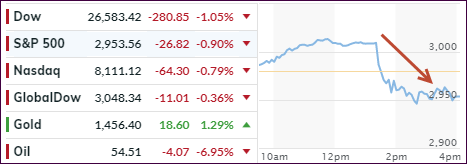
Then came unexpected “bad
news 2.0” in the form of Trump’s announcement that he will add a 10% tariff on
the remaining $300 billion of Chinese imports starting in September.
That caused an instant trend
reversal, and the major indexes dove south with the Dow at one point being down
over 300 points. All gains evaporated
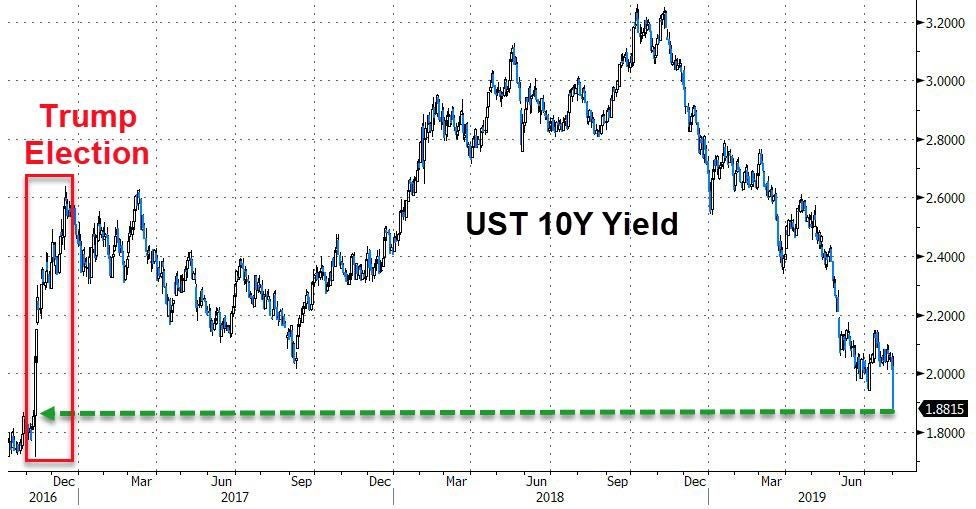
within minutes, while the 10-year bond yield also did its best swan dive
imitation by reaching a yield that is now below the Trump
election lows.
That caused the “jaws
of death,” as ZH termed it, first to widen and then to narrow. In case you missed
it, they simply represent a divergence between the 10-year yield and the
S&P 500, which sooner or later will have to “normalize.” The question remains
whether it will be via a crash in the S&P or a hike in bond yields or a
combination of both.
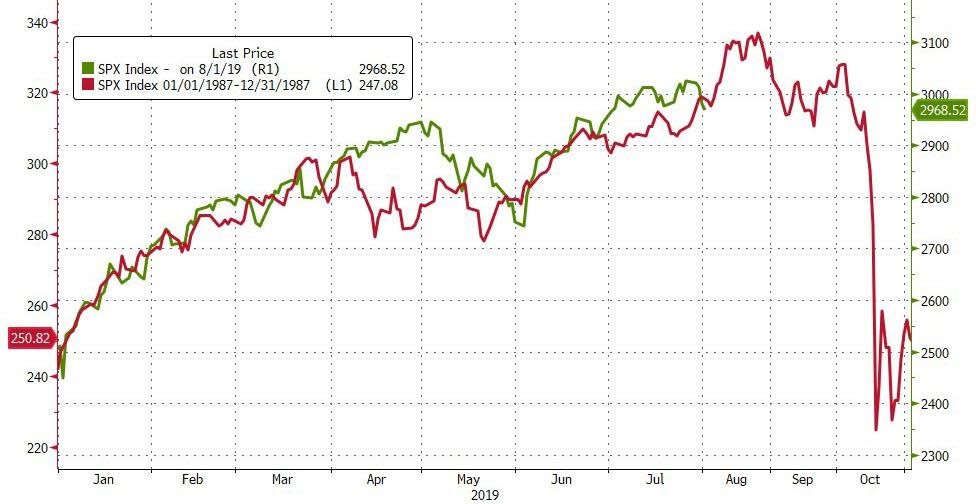
Will history repeat itself as this chart comparison to 1987 seems to indicate? Only time will tell, but it’s good to have an exit strategy; just in case.
The Fed did what was expected by cutting interest rates
by 0.25% for the first time in 11 years. Of course, on Wall Street,
expectations don’t mean much, unless you beat them. The Fed failed to do that,
and the markets tanked with the Dow at one point being down some 400 points.
What created most of the damage was Fed head Powell’s
press conference, during which he appeared dazed and confused, after a barrage
of questions forced him to explain his reasoning. He said that the US economy
is doing great, confidence is rebounding, while the 0.25% was an “insurance”
cut.
Then he revealed that today’s rate reduction was just a “mid-cycle”
adjustment and not the start of a “long series of rate cuts.” That shook and stunned
the markets, as several more cuts were assumed to be forthcoming. One analyst
summarized it like this:
“The market was fine with the statement, but
as seems to be the case, the press conference reveals details that do not sit
well with the market. The response that this is a mid-cycle adjustment and not
part of a longer-term accommodative stance has raised concerns. The market has
really talked itself into a need for lower rates. Obviously the FOMC still
feels strongly the economy is resilient.”
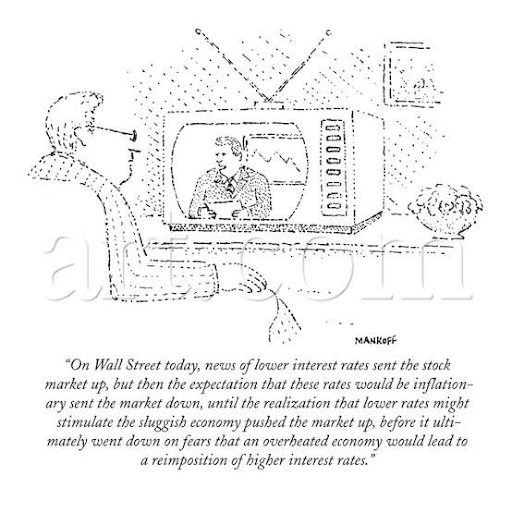
That means the widely anticipated easing cycle over the next
six months will not happen, which this
cartoon sums up perfectly. Powell now holds the dubious record of having
held 12 press conference, of which 10 of them were followed by stocks tanking.
Still, while volatility returned with a vengeance today,
for the month, the major indexes gained, led by the Nasdaq, while SmallCaps
fared the worst.
It will be interesting to see if the markets will adjust
to the “Powell theme,” or if there is more fallout to come over the next week
or so.
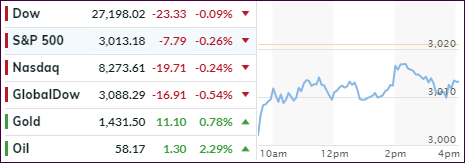
While the major indexes recovered
form an early session dump, they pretty much repeated yesterday’s theme by slipping
and sliding below the unchanged line without much directional conviction.
A mixed earnings picture today,
along with some negative tweets from Trump regarding a possible China deal,
added to today’s uncertainty and kept equities in a tight range.
As a I posted before, tomorrow
will be the most important trading day of the year, as the Fed is scheduled to
release its verdict on interest rates. Opinions as to its market effect and
whether they should or shouldn’t cut rates have been all over the place.
ZH offered a comparison to
the events of 1987 via this
chart posing the question: Is the Fed rate-cut enough to make new highs in
stock…just like we did in 1987?
We should know the answer to
that in the very near future.