Injecting Bullish Sentiment

Ulli Market Commentary Contact

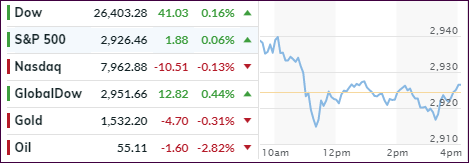
[Chart courtesy of MarketWatch.com]
  1. Moving the markets

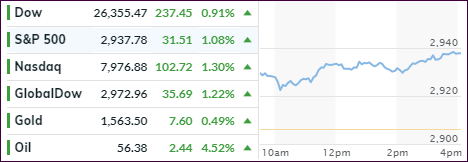
The major indexes staged a turnaround, after yesterday’s pullback, encouraged by an apparent ease in Hongkong tensions. Chief executive Carrie Lam announced that she would withdraw the controversial extradition bill that has sparked months of violent protests, which were feared to eventually hurt the business climate and global financial markets.

While this bill meets only one of five demands from the protesters, at least it’s a step in the right direction, which put the computer algos into a buying frenzy and spreading a sea of green in equities.

Also helping the bullish mood were reports that the People’s Bank of China will soon implement cuts in reserve requirements for Chinese banks, a move that is expected to boost growth and shows willingness by the government to battle the effects of higher US tariffs on Chinese imports.

This readiness by the Chinese to engage in some sort of stimulus eased fears, at least for the moment, that the US economy might slide into a recession in part due to the endless US-China tariff conflict, which has been a contributing factor to not just a worldwide disruption of supply chains but too a slowdown of global economies.

Likewise giving an assist to the bullish cause was more dovish encouragement from a variety of Fed speakers that rate cuts are on the menu. ZH summed them up as follows:

Williams (Dovish): “Ready to act as appropriate”, July cut was right move, economy mixed (admitted consumer spending not a leading indicator), international news matters, low inflation biggest problem.

Kaplan (Dovish): “Monetary policy a potent force”, worried about yield curve inversion, economy mixed (factories weak due to trade, consumer strong), watching for “psychological effects” on consumers, “if you wait for consumer weakness, it might be too late.”

Kashkari (Dovish): Tariffs, “trade war are really concerning business”, job market not overheating, slower global growth will impact US, most concerned about inverted yield curve. Fed’s policy is “moderately contractionary.”

Bullard/Bowman (Looked Dovish): Took part in “Fed Listens” conference but made no comment on policy but then again when has Jim Bullard ever not been dovish.

Beige Book (Mixed): Moderate expansion but trade fears are mounting, but optimism remains, despite what Kashkari says: “although concerns regarding tariffs and trade policy uncertainty continued, the majority of businesses remained optimistic about the near-term outlook”

Evans (Dovish): Trade policy increases uncertainty and immigration restrictions lower trend growth to 1.5%, Auto industry especially challenged

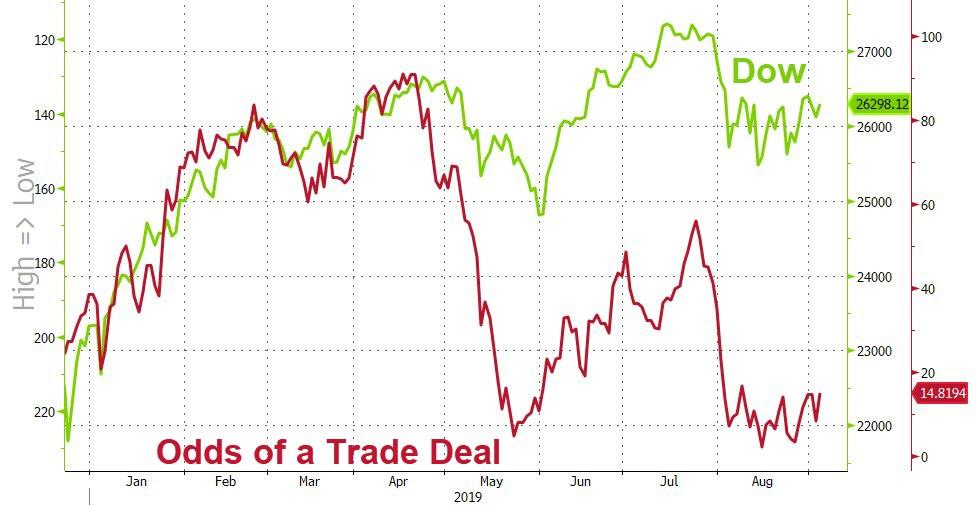
As a result, the markets have now ‘priced in’ an astonishing 124 bps (1.24%) of rate cuts through the end of 2020. Tip of the hat goes to ZH for this chart. On the other hand, a trade deal is now almost entirely ‘priced out,’ which means that the only ‘big dog’ left to support equities is none other than the Fed and its policies.

Read More
Markets Resemble A Deer In The Headlight

Ulli Market Commentary Contact

[Chart courtesy of MarketWatch.com]
  1. Moving the markets

Last week’s rally was based on nothing more than rekindled optimism that the ever-accelerating trade war with China may be “again” on another verge of the warring parties agreeing to a ceasefire.

On the other hand, how many times can you cry “wolf” before it’s being ignored.

Apparently, we have not reached that moment in time yet, as on Sunday morning, against all wishful thinking, the US slapped tariffs on $112 billion in Chinese imports. It only took 1 minute for China to retaliate via higher tariffs on some $75 billion of US goods.

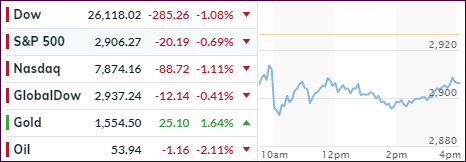
That killed the “trade deal is imminent” proposition, and it became clear that Tuesday’s market reaction would be a negative one, and that’s exactly what happened.

Assisting the sour mood of traders and algos alike was a report showing that US manufacturing is the weakest in 10 years, and the headline manufacturing number plunged into contraction.

At its lowest point, the Dow was down over 300 points, and the S&P 500 almost closed the breakaway gap I mentioned last Thursday, while the index seems to be heading towards the lower band of the 5-week trading range.

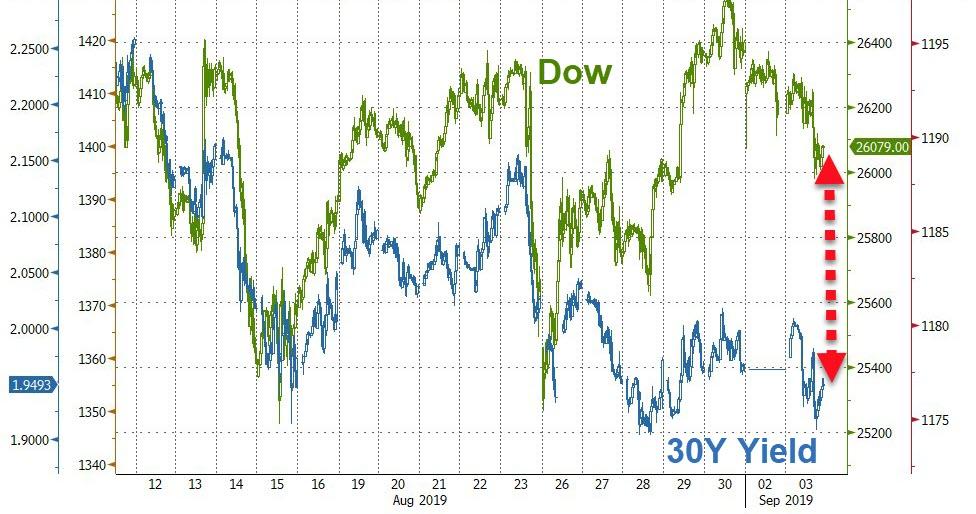
With the slippage of the markets, it appears that there may be some recoupling of stocks and bond yields in the near future, as the jaw of death has closed slightly—and not in favor of stocks.

We will find out soon enough if that tendency continues.

Read More

ETFs On The Cutline – Updated Through 08/30/2019

Ulli ETFs on the Cutline Contact

Below, please find the latest High-Volume ETF Cutline report, which shows how far above or below their respective long-term trend lines (39-week SMA) my currently tracked ETFs are positioned.

This report covers the HV ETF Master List from Thursday’s StatSheet and includes 322 High Volume ETFs, defined as those with an average daily volume of more than $5 million, of which currently 211 (last week 157) are hovering in bullish territory. The yellow line separates those ETFs that are positioned above their trend line (%M/A) from those that have dropped below it.

Take a look:                                                                   

The HV ETF Master Cutline Report

In case you are not familiar with some of the terminology used in the reports, please read the Glossary of Terms. If you missed the original post about the Cutline approach, you can read it here.      

ETF Tracker Newsletter For August 30, 2019

Ulli ETF Tracker Contact

ETF Tracker StatSheet          

You can view the latest version here.

TRADE WORRIES CONTINUE TO DISSIPATE; S&P 500 UP FOR DAY BUT DOWN FOR THE MONTH

[Chart courtesy of MarketWatch.com]
  1. Moving the markets

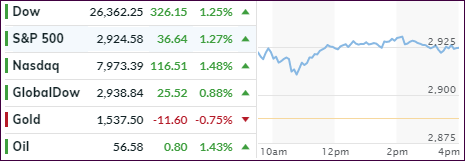
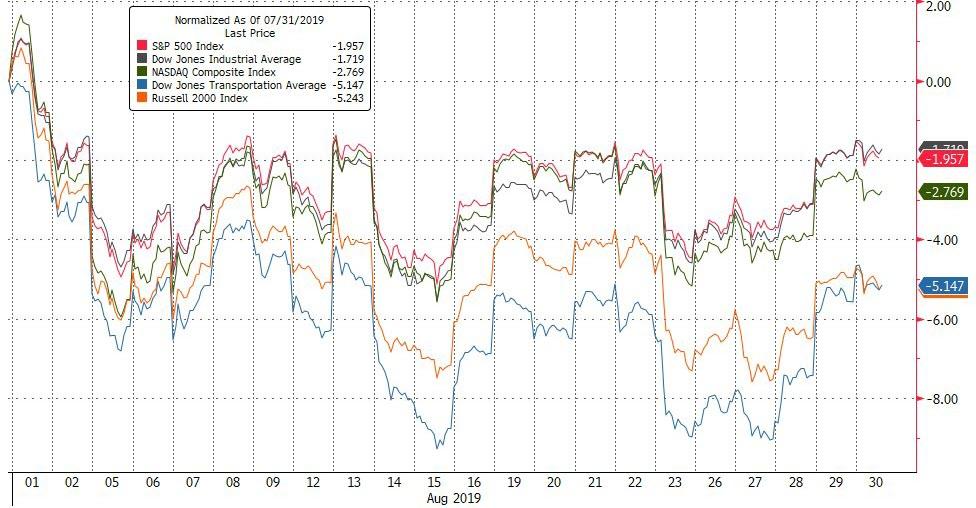
An early rally bit the dust with the major indexes losing upside momentum, dipping into the red and bouncing around their respective trend lines throughout most of the session. A last hour push helped the Dow and S&P back into the green, but the Nasdaq fell just short and closed down a tad. For the month, Transportation and SmallCaps fared the worst, while the Dow and S&P lost the least.

Helping this week’s comeback was the proper dangling of the trade carrot, which helped the markets climb out of last Friday’s deep hole, while recovering some of the losses sustained in this volatile month of August.

It sure paid to be invested in the less volatile SPLV, which gained +2.14% vs. the S&P 500’s loss of -1.8%. Since our Domestic ‘Buy’ cycle in February, SPLV has gained 11.69% vs. the SPY’s +6.35%.

With the US-China trade talks, or rather lack thereof, having taken centerstage, one analyst described the impasse as follows:

“Despite U.S. tariffs on $300 billion worth of Chinese goods set to be raised beginning Sept. 1, another round of trade talks could take place in the month ahead. Such a possibility allows markets to continue clinging on to hope that a resolution to this protracted impasse is not dead in the water, with traders using this as an excuse to push further into risk-on territory at any given opportunity.”

And there you have it. It’s either US-China words of hope for any improvement in trade relations or dovish jawboning from the Fed, with either one of those events being the drivers of equities; fundamentals be damned.

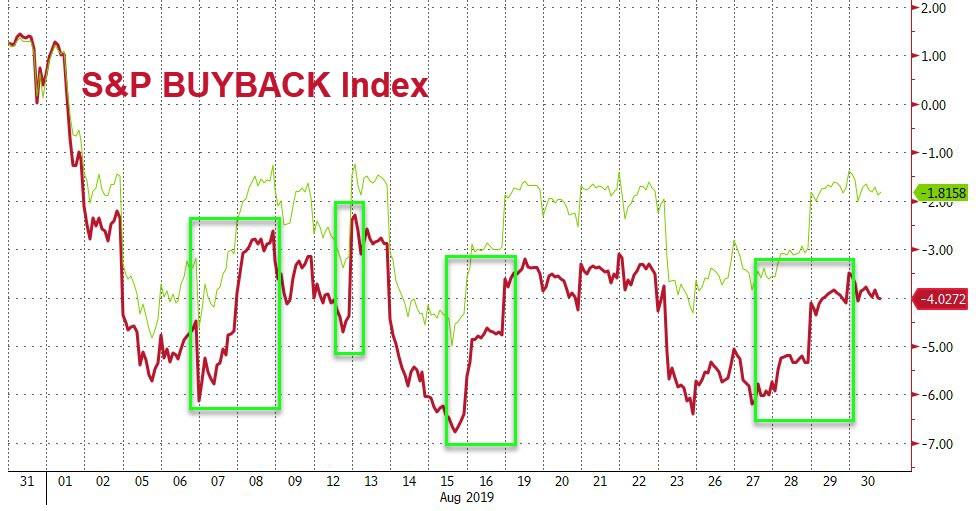
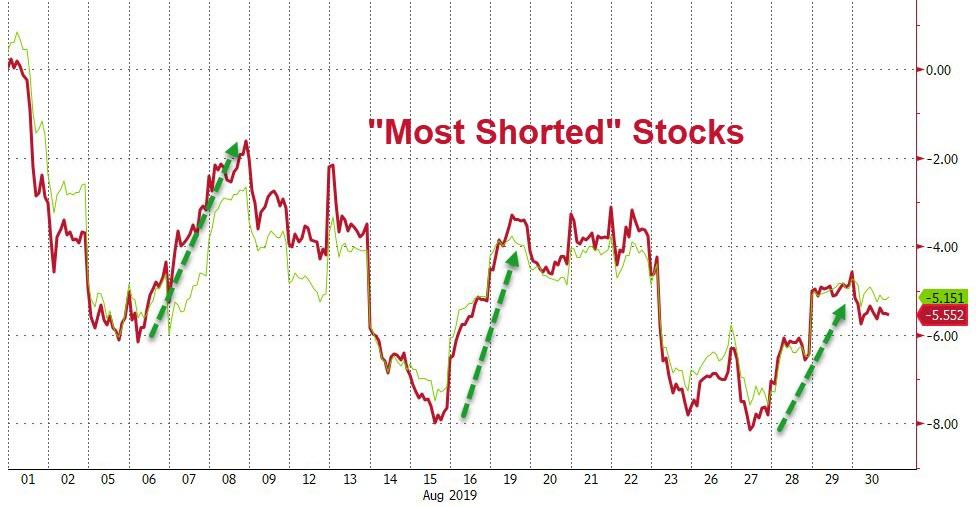
Buybacks gave an assist to the markets on several occasions, as this chart by ZH clearly shows. Selected short squeezes also had an impact, as you can see here, although they weakened towards the end of the month.

We’re now staring the always volatile September in the face, and I’m sure it won’t be smoothing sailing. Our trailing sell stops are ready to be executed, should the need arise.  

Read More

Weekly StatSheet For The ETF Tracker Newsletter – Updated Through 08/29/2019

Ulli ETF StatSheet Contact

ETF Data updated through Thursday, August 29, 2019

Methodology/Use of this StatSheet:

1. From the universe of over 1,800 ETFs, I have selected only those with a trading volume of over $5 million per day (HV ETFs), so that liquidity and a small bid/ask spread are assured.

2. Trend Tracking Indexes (TTIs)

Buy or Sell decisions for Domestic and International ETFs (section 1 and 2), are made based on the respective TTI and its position either above or below its long-term M/A (Moving Average). A crossing of the trend line from below accompanied by some staying power above constitutes a “Buy” signal. Conversely, a clear break below the line constitutes a “Sell” signal. Additionally, I use a 7.5% trailing stop loss on all positions in these categories to control downside risk.

3. All other investment arenas do not have a TTI and should be traded based on  the position of the individual ETF relative to its own respective trend line (%M/A). That’s why those signals are referred to as a “Selective Buy.” In other words, if an ETF crosses its own trendline to the upside, a “Buy” signal is generated. Since these areas tend to be more volatile, I recommend a wider trailing sell stop of 7.5% -10% depending on your risk tolerance.

If you are unfamiliar with some of the terminology, please see Glossary of Terms and new subscriber information in section 9.     

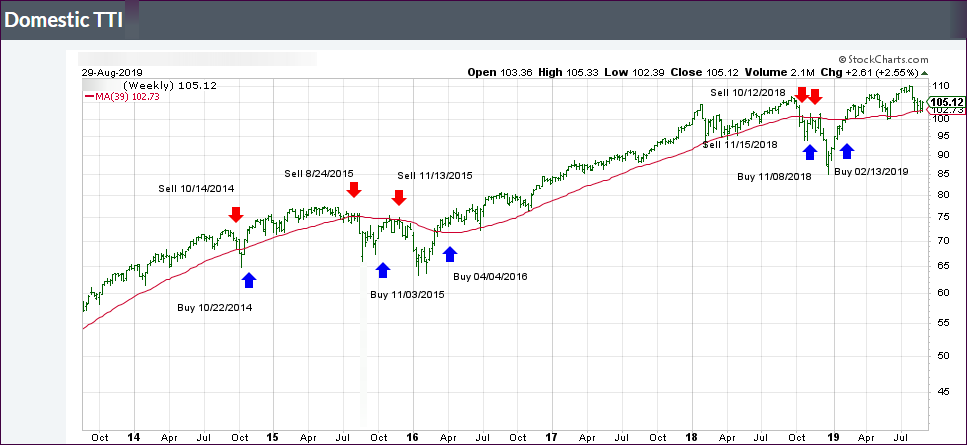
1. DOMESTIC EQUITY ETFs: BUY — since 02/13/2019

Click on chart to enlarge

Our main directional indicator, the Domestic Trend Tracking Index (TTI-green line in the above chart) is now positioned above its long-term trend line (red) by +2.45% after having generated a new Domestic “Buy” signal effective 2/13/19 as posted.

Read More

Easing Trade War Fears Fuel Markets

Ulli Market Commentary Contact

[Chart courtesy of MarketWatch.com]
  1. Moving the markets

When all else fails, a few well-chosen words seem to be enough these days to put a sagging market back into bullish mode. Such was the case today, when China indicated that they were in no rush to respond to the latest round of tariffs announced by Washington.

In the process, this week’s rebound has sharply reduced the month-to-date losses for the major indexes. In the case of the S&P 500, the index is now only down -1.85%, while at its worst point, on August 14th, we saw a loss of -4.66%. With tomorrow being the last trading day of the month, we could see another move higher, should positive trade jawboning continue.

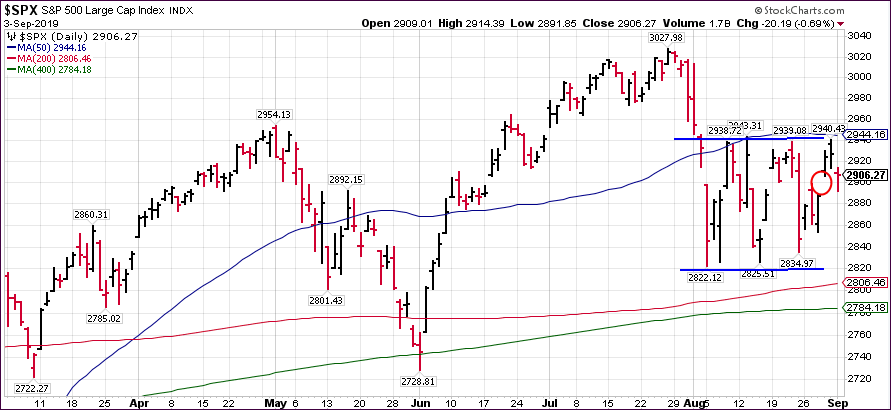
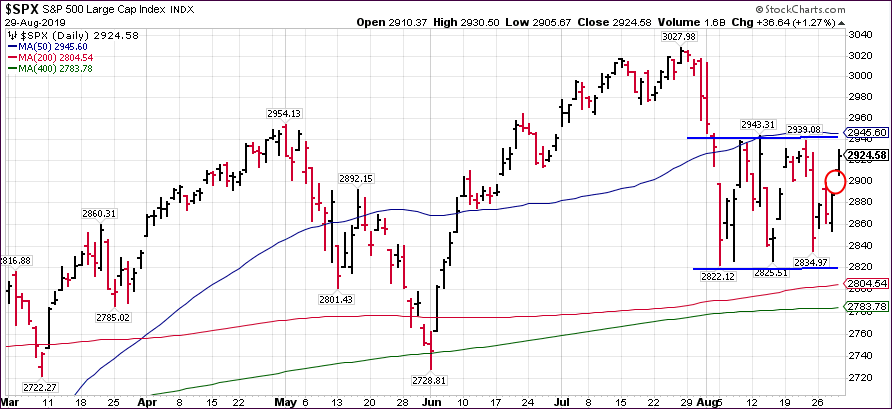
However, today’s jump caused an opening gap in the S&P 500 chart (red circle), which eventually must be closed, meaning that the index will retreat to cover that gap. It always happens, it’s just a question of when.

At the same time, the S&P 500 is closing in on the upper range of its current trading band, as I posted yesterday. The above chart shows that level (blue line) at around the 2,945. If pierced, we may very well see an assault of the July highs.

If recent history is an indication, we could bounce off that “glass ceiling” and head back down to the support line, which lies at the 2,820 level. If that is shattered to the downside, a break of the 200-day M/A (red) will come into play, which might have dire consequences in that it would not only bring the June lows into play but also end this current bullish cycle.

Read More