Below, please find the latest High-Volume ETF Cutline
report, which shows how far above or below their respective long-term trend
lines (39-week SMA) my currently tracked ETFs are positioned.
This report covers the HV ETF Master List from Thursday’s
StatSheet and includes 322 High Volume ETFs, defined as those with an average
daily volume of more than $5 million, of which currently 288 (last week 291)
are hovering in bullish territory. The yellow line separates those ETFs that
are positioned above their trend line (%M/A) from those that have dropped below
it.
In case you are not familiar
with some of the terminology used in the reports, please read the Glossary of Terms.
If you missed the original
post about the Cutline approach, you can read it here.
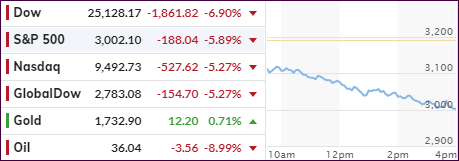
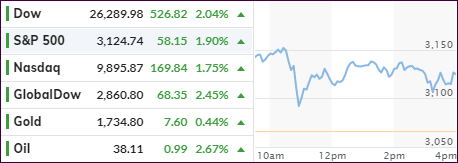
Despite
the Dow touching the 29k level intra-day for the first time, there simply was
not enough upward momentum left to keep the major indexes in the green, and all
three of them ended up with modest losses.
However,
for the week, the S&P managed to eke out an almost 1% gain, which is quite impressive
given the flare up in Middle East tensions over the past weekend and into
Monday.
Not
helping matters today was the Labor Department’s report showing that job and wage
growth was weaker than expected in December, but it did not keep the major
indexes from setting new intra-day highs before slipping into the close.
The
jobs report missed, as only 145k new jobs were created missing expectations of
160k, which was 111k lower than downward revised 256k last month. Manufacturing
took the biggest hit, down -12k, which is its biggest drop since the summer of
2016, according to ZH.
While
disappointing, many analysts believe that today’s payroll miss is unlikely to
change the general economic outlook, as it’s well known that the economy is
merely chugging along at a comfortable pace, while being far from overheating.
Meanwhile,
all eyes are on the arrival of the Chinese delegation on Monday to complete the
Phase 1 trade agreement with the U.S. While the outcome is a foregone conclusion,
given history, you can never be sure, however, until all documents have actually
been signed.
ETF Data
updated through Thursday, January 9, 2020
Methodology/Use of this StatSheet:
1. From the universe of over 1,800 ETFs, I have selected only those with a
trading volume of over $5 million per day (HV ETFs), so that liquidity and a
small bid/ask spread are assured.
2. Trend Tracking Indexes (TTIs)
Buy or Sell decisions for Domestic and International ETFs (section 1 and
2), are made based on the respective TTI and its position either above or below
its long-term M/A (Moving Average). A crossing of the trend line from below
accompanied by some staying power above constitutes a “Buy” signal. Conversely,
a clear break below the line constitutes a “Sell” signal. Additionally, I use a
7.5% trailing stop loss on all positions in these categories to control
downside risk.
3. All other investment arenas do not have a TTI and should be traded
based on the position of the individual
ETF relative to its own respective trend line (%M/A). That’s why those signals
are referred to as a “Selective Buy.” In other words, if an ETF crosses its own
trendline to the upside, a “Buy” signal is generated. Since these areas tend to
be more volatile, I recommend a wider trailing sell stop of 7.5% -10% depending
on your risk tolerance.
If you are unfamiliar with some of the terminology, please see Glossary of Termsand new subscriber information in section 9.
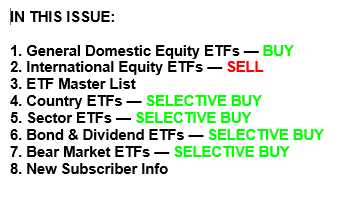
1. DOMESTIC EQUITY ETFs: BUY — since 02/13/2019
Click on chart to enlarge
Our main directional indicator, the Domestic Trend Tracking Index (TTI-green line in the above chart) is now positioned above its long-term trend line (red) by +8.00% after having generated a new Domestic “Buy” signal effective 2/13/19 as posted.
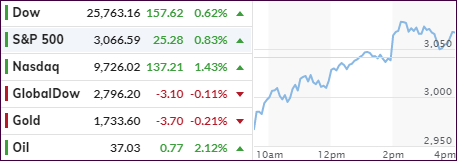
After the opening bell, the major indexes continued their
attack into record territory, as the attention moved from Iran to the latest in
the U.S.-China trade agreement.
It appeared that the tensions in the Middle East eased somewhat,
as the war rhetoric seemed to have slowed down, or at least has been put on the
back burner for the time being. Trump’s comments yesterday that he wasn’t pushing
for an all-out war with Iran, was a relief for traders and resulted in a continuation
of the rebound.
The trade deal now took front and center again with China’s
Vice Premier He scheduled to lead a delegation to Washington next week to sign
the Phase 1 agreement, which supported the current bullish market mood.
In the meantime, the Fed’s vice chairman Clarida announced
that the economy “was on solid ground,” but emphasized that the Fed’s
interest rate policy may be changed at any meeting. Surprisingly, this statement
did not have a negative market moving effect.
In the end, the major indexes melted up again with the
S&P’s forward PE now at 18.5x, which is its highest since the dotcom bust,
according to ZH.
It simply confirms that fundamental evaluations no longer
matter, until one day, they do. Until then, what matters are the coordinated efforts
by the Central Banks to maintain low to negative interest rates and making sure
an abundance of liquidity, AKA the #1 market driver, is always available.
Despite a sharp sell-off overnight in the futures market,
which pulled the Dow down some 400 points, the negative mood had completely
changed by the time regular session bell rang.
We opened slightly higher with upward momentum gaining
steam, after remarks by Trump suggested that the U.S. and the Iranian were refraining
from further military action.
He further minimized Tuesday’s attack by elaborating that
no U.S. casualties were sustained, and only “minimal’ damage was done to U.S.
military facilities in Iraq.
In the end, the market’s initial “risk-off” reaction
reversed in no time sending the S&P 500 and Nasdaq into record territory, although
both indexes came off their highs and slipped into the close. On the downside, crude
oil was hammered, as the de-escalation theme ruled the day.
On the economic front we learned that private sector employment
data from ADP showed that 202,000 new jobs were added in December, which was
above the expected number of 157,000. We’ll have to wait and see if Friday’s employment
report supports that trend as well.
AS ZH posted, “from WW3 to record highs in 12 hours,
as missiles flew and so did tweets and now all is well again.”
I am sure there will be more to this story, as time goes
on.
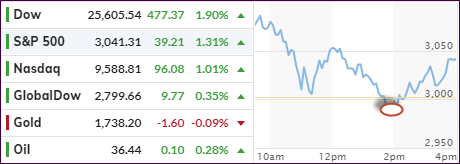
The major indexes opened lower and bobbed and weaved below
their respective unchanged lines through the entire session, with only the Nasdaq
spending some time above it, but it did not manage to hold on to early gains.
For sure, the ongoing concerns about a potential war in the
Middle East have kept markets in check, but the selloffs have been minor, with dip
buyers lurking on deck ready to pick up assets at lower prices.
Some MSM headlines have been screaming WW III for the past
week and, while I am sure the tit for tat will continue, it’s unlikely that it
will turn into a full-blown war, that is, if history is any indication. Over the
past 200 years, Iranians have never started a war, although they have defended
themselves on numerous occasions. I don’t see this changing, but you can never be
certain.
During the recent moderate pullbacks, it has become clear
that low volatility ETFs, like SPLV, which we own, have held up poorly. Case in
point was today, when SPY gave back -0.28% while SPLV dropped -0.59%, or more
than twice as much.
That has been a recurring and disturbing theme lately,
which is why in my advisor practice we have lightened up considerably on its
holdings and may shed even more. Something is simply wrong when an ETF does not
live up to its functionality, namely showing improved resistance to sell-offs.
For sure, SPLV has lost the luster shown during the first 9 months of 2019.
With earnings season not too far away, I am curious to
see if a better 2020, as priced in last year, can become reality. If not, the
savior for the bulls can always be Global Liquidity, as this chart
shows.