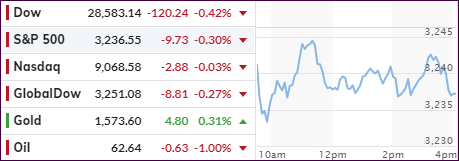
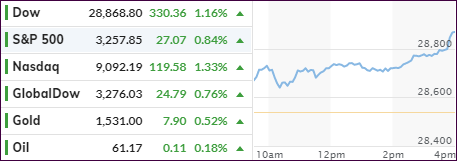
The major indexes opened lower and bobbed and weaved below
their respective unchanged lines through the entire session, with only the Nasdaq
spending some time above it, but it did not manage to hold on to early gains.
For sure, the ongoing concerns about a potential war in the
Middle East have kept markets in check, but the selloffs have been minor, with dip
buyers lurking on deck ready to pick up assets at lower prices.
Some MSM headlines have been screaming WW III for the past
week and, while I am sure the tit for tat will continue, it’s unlikely that it
will turn into a full-blown war, that is, if history is any indication. Over the
past 200 years, Iranians have never started a war, although they have defended
themselves on numerous occasions. I don’t see this changing, but you can never be
certain.
During the recent moderate pullbacks, it has become clear
that low volatility ETFs, like SPLV, which we own, have held up poorly. Case in
point was today, when SPY gave back -0.28% while SPLV dropped -0.59%, or more
than twice as much.
That has been a recurring and disturbing theme lately,
which is why in my advisor practice we have lightened up considerably on its
holdings and may shed even more. Something is simply wrong when an ETF does not
live up to its functionality, namely showing improved resistance to sell-offs.
For sure, SPLV has lost the luster shown during the first 9 months of 2019.
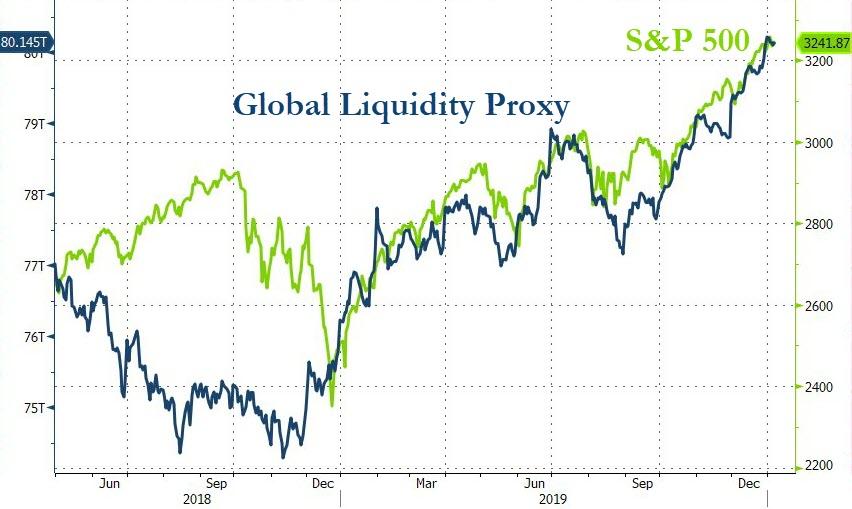
With earnings season not too far away, I am curious to
see if a better 2020, as priced in last year, can become reality. If not, the
savior for the bulls can always be Global Liquidity, as this chart
shows.
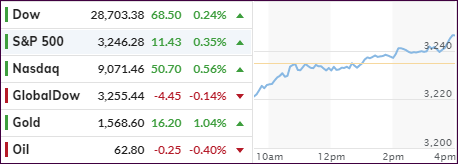
Despite the escalating tensions in the Middle East, the
markets appeared to be looking past the beating of the war drums and dug
themselves out of an early hole. The initial dump did not hold, and a slow but
steady ascent towards the unchanged line was followed by a late burst to assure
a green close for the major indexes.
The appetite for stocks had been somewhat tempered over
the past few trading days due to the unknown implications of the death of the Iranian
general last week. This uncertainty was supported by higher oil prices and fears
what the global fallout might be, should the Iranians close the Straits of
Hormuz.
However, overriding these issues is the fact that the
assumed to be all powerful Fed will continue their accommodative monetary
policy in 2020, despite the US being almost certain to get the Phase-1 trade deal
with China signed, which is to be finalized by January 15.
Despite likely occasional market sell-offs, the general environment
for equities leading up to the election looks positive, that is, until a Black
Swan event causes the major market trend to change from bullish to bearish, which
then will be the time to apply our exit strategy and head for the safety of the
sidelines.
Below, please find the latest High-Volume ETF Cutline
report, which shows how far above or below their respective long-term trend
lines (39-week SMA) my currently tracked ETFs are positioned.
This report covers the HV ETF Master List from Thursday’s
StatSheet and includes 322 High Volume ETFs, defined as those with an average
daily volume of more than $5 million, of which currently 291 (last week 284)
are hovering in bullish territory. The yellow line separates those ETFs that
are positioned above their trend line (%M/A) from those that have dropped below
it.
In case you are not familiar
with some of the terminology used in the reports, please read the Glossary of Terms.
If you missed the original
post about the Cutline approach, you can read it here.
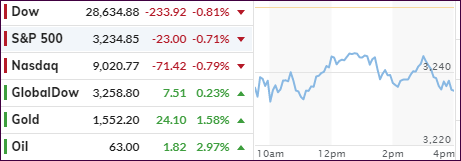
The
markets pulled back today as a result of the US counterstrike in Iran, which focused
on taking out a high-ranking military commander. Obviously, that escalated
Middle East tensions with threats like “hard revenge awaits criminals,” that
made headlines around the world.
Sure,
the prospect of an Iranian retaliation could keep stocks hanging in limbo for a
while, as traders are somewhat unnerved and concerned about a possible fallout,
which would occur if the Straits of Hormuz were to be closed.
That
potential threat was already acknowledged by oil rallying almost 3%, while the
other two safety havens, namely gold and bond yields, were bid higher, an event
that always happens when geopolitical tensions heat up.
We
will have to wait and see what develops over the weekend and next week to judge
if this will be just a temporary interruption of bullish momentum, of if it
develops into something more.
One
other event that is sure to influence markets is the Fed’s planned liquidity
drain next week. As ZH points out correctly, if the Fed’s balance sheet goes up,
so does the S&P 500, and vice versa. This chart
clearly demonstrates this correlation. You can see that the Fed’s balance sheet
rose 11 of 12 weeks and declined in just 1 of 12, and if my magic, so did the
S&P.
However,
the Fed pointed out its “expectations to gradually transition away from active
repo operations (in 2020) as T-Bill purchase supply a larger base of reserves.”
What that simply means is that maturing term repos will not be rolled over, which
translates to an upcoming drain in liquidity:
$25 billion leaves the market on Monday,
$28.8 billion on Tuesday,
$18 billion next Friday, etc.
Hmm,
markets have been reacting positively to increases in liquidity, which makes
me wonder how they will react to decreases in liquidity.
For
sure, the next couple of weeks promise to be anything but boring.
ETF Data
updated through Thursday, January 2, 2020
Methodology/Use of this StatSheet:
1. From the universe of over 1,800 ETFs, I have selected only those with a
trading volume of over $5 million per day (HV ETFs), so that liquidity and a
small bid/ask spread are assured.
2. Trend Tracking Indexes (TTIs)
Buy or Sell decisions for Domestic and International ETFs (section 1 and
2), are made based on the respective TTI and its position either above or below
its long-term M/A (Moving Average). A crossing of the trend line from below
accompanied by some staying power above constitutes a “Buy” signal. Conversely,
a clear break below the line constitutes a “Sell” signal. Additionally, I use a
7.5% trailing stop loss on all positions in these categories to control
downside risk.
3. All other investment arenas do not have a TTI and should be traded
based on the position of the individual
ETF relative to its own respective trend line (%M/A). That’s why those signals
are referred to as a “Selective Buy.” In other words, if an ETF crosses its own
trendline to the upside, a “Buy” signal is generated. Since these areas tend to
be more volatile, I recommend a wider trailing sell stop of 7.5% -10% depending
on your risk tolerance.
If you are unfamiliar with some of the terminology, please see Glossary of Termsand new subscriber information in section 9.
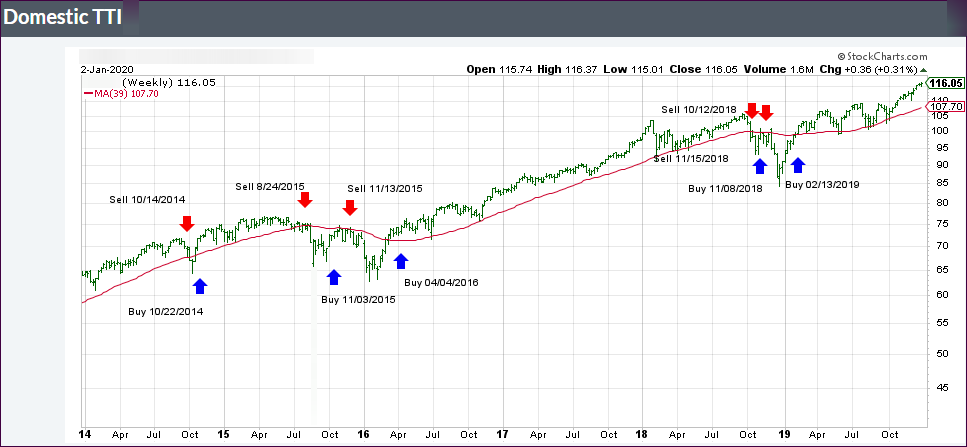
1. DOMESTIC EQUITY ETFs: BUY
— since 02/13/2019
Click on chart to enlarge
Our main
directional indicator, the Domestic Trend Tracking Index (TTI-green line in the
above chart) is now positioned above its long-term trend line (red) by +8.01%
after having generated a new Domestic “Buy” signal effective 2/13/19 as posted.
The link
below shows all High Volume (HV) Domestic Equity ETFs. The sorting order is by
M-Index ranking. Prices in all linked tables below are updated through 01/02/2020,
unless otherwise noted. Price data not yet available at publication is
indicated with 00.00% or -100.00%. Please note that distributions are not
included in the current momentum numbers.
Whenever the
TTI is above the trend line, and therefore in “Buy” mode, you can either use
the tables in the link below to make your selections or choose from the 10 ETFs
in the Spotlight, which are featured daily as part of the market commentary:
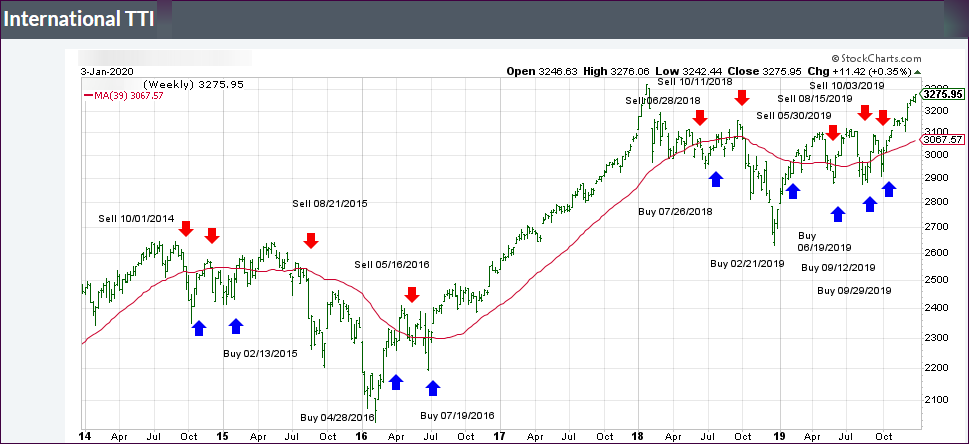
The
International Trend Tracking Index (green) has now moved +6.97% above its
long-term trend line (red) after having generated a new ‘Buy’ signal effective 10/29/2019.
It’s been on a wild rollercoaster ride all year, since international markets
showed far more uncertainty and volatility than the US environment.
The listings
in the link below represent the High Volume (HV) International ETFs I track to
be used during a Buy cycle. They are sorted by M-Index ranking:
This ETF
Master list shows the total of all ETFs listed, which allows you to get a quick
overview of leaders and laggards. The sorting order is by M-Index. Momentum
figures for all ETFs are not adjusted for dividends.
The link below
contains a list of HV ETFs for countries/regions, which I am tracking weekly.
Please note that data in this table does not include adjustments due to
distributions.
Country
funds, especially over the past few years, have been volatile. So, the use of a
trailing stop loss (I use 10%) is imperative to protect your portfolio from
severe downside moves.
5. SECTOR ETFs: SELECTIVE
BUY
To diversify
our portfolios, we always need to look for different opportunities to invest
our money. The table of HV Sector ETF listings in the following link covers a
broad spectrum of possibilities. The sorting order is by M-Index:
Here too, I
recommend the use of a 10% trailing stop loss to minimize the risk.
6. BOND & DIVIDEND ETFs: SELECTIVE BUY
If you
prefer using ETFs for the generation of income, here’s a list of bond and
dividend paying ETFs. It’s important to first look at how these instruments
have held up in terms of momentum figures. Then you should visit your favorite
financial web site to examine yield and other details.
Please note
that data in this table does not include adjustments due to distributions.
Please note
that some of the above funds try to outperform the index they are tied to by
the percentage stated. While this can enhance your returns, it can certainly
accelerate your losses as well. No matter which way you choose, be sure to work
with a trailing sell stop (I suggest 10%) and be aware that volatility will be
your constant companion.
8. NEW SUBSCRIBER INFORMATION
To get a
head start on more successful investing, please click on:
In case you
missed it, you can download my latest e-book “How to beat the S&P 500…with
the S&P 500,” here. If you are
investing your 401k and must use mutual funds, I suggest you primarily stick
with the S&P 500 as described in my book. Of course, you can always use the
above tables to find sector or country ETFs to your liking and use the
equivalent mutual funds as offered by your custodian.
Disclosure:
I
am obliged to inform you that I, as well as my advisory clients, own some of
the ETFs listed in the above table. Furthermore, they do not represent a
specific investment recommendation for you, they merely show which ETFs from
the universe I track are falling within the guidelines specified.
The major indexes continued where they left off on the
last day of 2019 and roared into 2020 with utter abundance, with all three of
them gaining solidly. The entire session was supported by the bullish theme of
last year, and we ended up accelerating into the close, although SmallCaps underperformed.
A big assist came from the Chinese Central Bank when it announced
that it would reduce reserve requirement for commercial banks, thereby creating
a stimulus effect for the country’s economy. That seemed to confirm the general
view of all Central Banks, who for now appear to be in sync with their loose monetary
policies.
The goodwill mood created by the Phase-1 trade agreement,
which is scheduled to be signed on January 15, continues to lend support to
stocks in general, even as some economic data points painted a mixed picture.
For right now, the major directional trend remains up
and, in my advisor practice, I will adjust portfolio holdings accordingly.