Jolting Bullish Sentiment

Ulli Market Commentary Contact

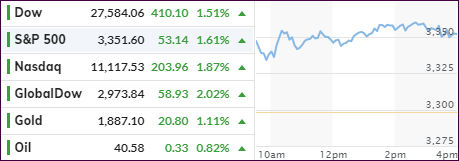
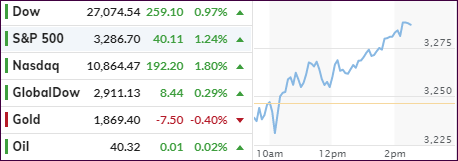
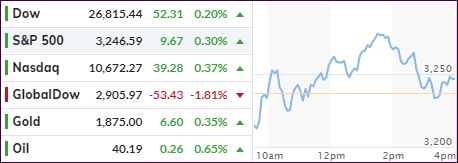
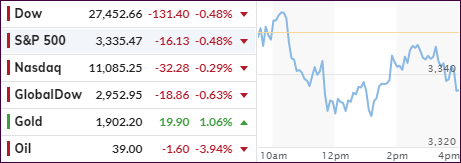
[Chart courtesy of MarketWatch.com]

  1. Moving the markets

Bullish sentiment got an early boost this morning after Gilead Sciences reported that a government clinical trial, designed to evaluate its experimental drug remdesivir in Covid-19 patients, had met the study’s main goal. Hopes were high for progress towards a successful treatment.

That news was good for an initial 350-point jump in the Dow and clearly overrode the potential bearish impact from horrific economic numbers:

Consumer spending fell -7.6% in the first quarter.

Pending Home Sales plummeted by a record in March to the lowest level since 2011.

Quarter 1 GDP plunges -4.8%, its biggest drop since the financial crises 10 years ago

Boeing burns through a record $4.7 billion in cash, revenue crashes 26%, 10% of workforce will be laid off

None of this mattered, as the bullish path had been set with Fed chief Powell committing to take strong action in order to support the economy and the markets by exuding an aura of confidence in the face of many unknowns.

After Powell’s initial announcement, stocks, the dollar and bonds dropped but managed to regain traction into the close. During his press conference he uttered the words I never thought I would hear:

“The debt is growing faster than the economy. This is not the time to act upon those concerns”

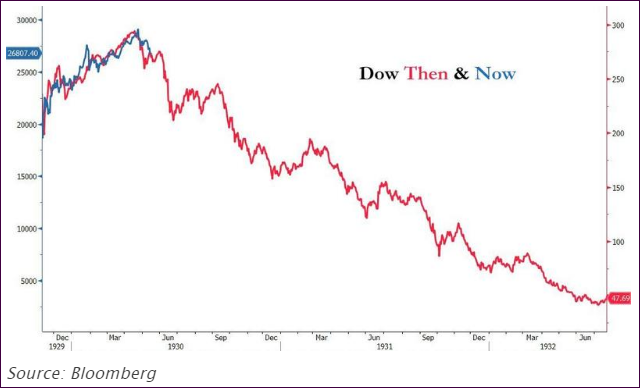
Huh? Just as was pondering as to what moment in time we should be concerned about the excessive debt creation, ZeroHedge had already managed to come up with several possible answers via this chart.

Although stocks have staged an amazing Fed assisted recovery since the lows in March, the Dow remains down some 15% YTD, but there is still one trading day left.

Some of the big hedge fund investors think the market rally in April has gone to extremes, while a survey showed that 16% are still saying the latest move was a bear market rally and further downside was ahead.

Rounding out the discussion was ZeroHedge with this observation:

“Of course, you don’t need to be a wealthy UBS client to understand there is a deep disconnect between the market and the real economy. Main street America has been wiped out, with approximately 30 million job losses in the past 6 weeks alone. And a new shocking report on Monday showed perhaps 50 million people have lost their jobs in the pandemic. Nevertheless, the Fed and Trump admin continue pumping record amounts of stimulus and bailout money to revive corporate America and Wall Street speculators.

If the economy doesn’t improve, meaning a V-shaped recovery is not seen and more of a U-shaped or L-shaped, it would suggest stocks have a long way to drop, likely resulting in the Fed panic buying stocks.”

In the meantime, our Trend Tracking Indexes (section 3) have improved greatly and, if the month of May does not follow the adage “sell in May and go away,” we might be seeing a new domestic “Buy” signal in the not too distant future.

Read More

An Early 400-Point Dow Rally Dumps Into The Red

Ulli Market Commentary Contact

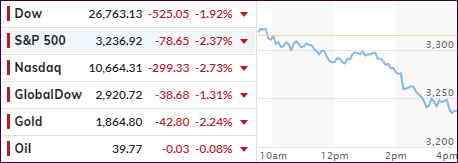
[Chart courtesy of MarketWatch.com]
  1. Moving the markets

The current discussion amongst Wall Street strategists involves the question as to whether a test of the March lows is coming, or if investor FOMO (Fear Of Missing Out) is strong enough to keep driving the markets to ever higher levels.

With the country starting to reopen slowly, traders apparently have no sense in how this process will shake out in the weeks, months and years to come with the primary, and in my opinion erroneous, assumption being that we can turn on a switch and watch in awe how a V-shape type of recovery materializes.  

Far from it, it will be a slow process, and I am pondering how many businesses have the wherewithal to remain shut until that moment in time arrives where their re-opening is “permitted.”

With the major indexes heading for their best monthly gain in many years, thanks to reckless monetary manipulation, I am still astounded by the lack of understanding by investors about the challenges involved to restart the US economy.

Commented Wolfe Research Analysts:

Our sense is that the liquidity-driven ‘melt-up’ could persist over the near term. Ultimately, however, extremely weak fundamentals should matter. Along this vein, we expect the state reopening process to be much slower than what’s currently baked into stock prices.

Today, we saw reality kick in, as the Dow gave up an early 400-point gain and closed in the red, as did all major indexes, with the loser of the day being the Nasdaq.

The early tumble came from a report that Boeing faces a criminal and civil probe over the 737MAX production, which was followed by more bad news, like Dr. Fauci’s grim assessment of the Covid-19 dilemma:

So, it’s not going to disappear from the planet, which means as we get into next season, in my mind it’s inevitable that we will have a return of the virus or maybe it never even went away. When it does, how we handle it will determine our fate,” Fauci commented overnight, adding that he was “almost certain” the virus will return in the winter.

That caused the early short-squeeze to run out of steam, and the markets were forced to take the path of least resistance—down.

The Fed is on deck and scheduled to talk about interest rates and the economy tomorrow. For sure, it will be market moving, but which way?

Read More

Crude Oil Dumps And Equities Pump

Ulli Market Commentary Contact

[Chart courtesy of MarketWatch.com]

  1. Moving the markets

Despite weakness in the futures markets, the computer algos went to work this morning by pushing the major indexes to another green close with the S&P 500 gaining around +1.4%, while crude oil dumped -23%.

We saw two assists supporting equities.

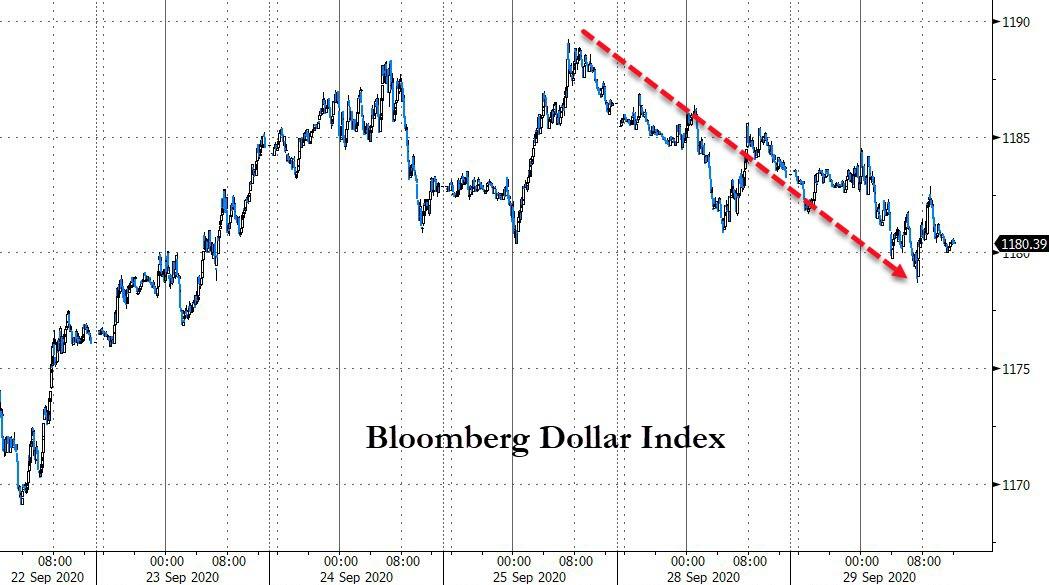
One came from a giant short squeeze causing US stocks to surge, as Bloomberg’s chart shows. The other one, of a more global nature, came from BoJ’s promise to buy more assets, which pumped global markets, with especially the Nikkei being on fire.

This wiped out last week’s losses, as traders’ optimism about loosening restrictions took center stage, despite the usual warnings that such early moves could be premature and backfire.

The busiest week of the earnings season has started with negative news being widely expected, which is another reason why markets are in rally mode confirming once again that bad news can be good news. But for how long?

Guggenheim’s CIO Scott Minerd chimed in by saying:

“The central bank will never be able to get back to normal. The Fed’s balance sheet has expanded from $4.5 trillion to $6.6 trillion in just about a month, and it is likely on its way to over $9 trillion soon.”

With ZeroHedge concluding:

“And there you have it: the US is now (and has been for the past decade) just a more dignified form of USSR-style central planning, one where prices are set by decree and a decline in asset levels is prohibited for one simple reason: with financial assets over 6x global GDP, any crash in markets would result in a depression that would promptly spiral in social collapse.”

Words of wisdom indeed. In case you were wondering, this is exactly why markets are totally disconnected from any reality. Even the real economy, as demonstrated by crude oil, is disintegrating at the same time as earnings expectations are dumping, and not just in the US but globally as well.

This week is loaded with a variety of events, any of which could force the markets in either direction.   

Read More

ETFs On The Cutline – Updated Through 04/24/2020

Ulli ETFs on the Cutline Contact

Below, please find the latest High-Volume ETF Cutline report, which shows how far above or below their respective long-term trend lines (39-week SMA) my currently tracked ETFs are positioned.

This report covers the HV ETF Master List from Thursday’s StatSheet and includes 322 High Volume ETFs, defined as those with an average daily volume of more than $5 million, of which currently 66 (last week 66) are hovering in bullish territory. The yellow line separates those ETFs that are positioned above their trend line (%M/A) from those that have dropped below it.

Take a look:                                                                   

The HV ETF Master Cutline Report

In case you are not familiar with some of the terminology used in the reports, please read the Glossary of Terms. If you missed the original post about the Cutline approach, you can read it here.      

ETF Tracker Newsletter For April 24, 2020

Ulli ETF Tracker Contact

ETF Tracker StatSheet          

You can view the latest version here.

UP FOR THE DAY—DOWN FOR THE WEEK

[Chart courtesy of MarketWatch.com]
  1. Moving the markets

Despite a late-day pump to wipe out some of this week’s losses, the major indexes managed a green close for the session but ended down for the week, with the S&P 500 surrendering a modest -1.3%.

Yes, bad economic news turned out to be good news for the markets. Even crashing Consumer Sentiment (the most terrible ever) and home buying conditions being he worst in 37 years, along with crumbling Durable Goods orders, could not stem the bullish theme and prevent a green close.

As I have noted ad nauseum, equity markets are in no way connected to economic realities, and today was no exception. The fact that global economic data also collapsed by the most on record this week, was of no concern to anyone. Even Monday’s oil debacle now only seems like a distant spot in the rear-view mirror.

However, gold rallied this week, and we added to our existing holdings in anticipation of continued reckless money creation by the Fed, with the eventual destruction of the dollar and a jump in inflation being a logical consequence—over time.

Next week will be a big one with an upcoming Fed meeting, a look at post-shutdown economic growth numbers, and earnings from over 20% of the S&P 500 companies. And, traders will be observing the progress, or lack thereof, of the reopening of some states and the resulting pick up in business activity.

It promises to be another week of unknowns, but the Fed most certainly will attempt to calm the markets and instill some confidence.

Read More

Weekly StatSheet For The ETF Tracker Newsletter – Updated Through 04/23/2020

Ulli ETF StatSheet Contact

ETF Data updated through Thursday, April 23, 2020

Methodology/Use of this StatSheet:

1. From the universe of over 1,800 ETFs, I have selected only those with a trading volume of over $5 million per day (HV ETFs), so that liquidity and a small bid/ask spread are assured.

2. Trend Tracking Indexes (TTIs)

Buy or Sell decisions for Domestic and International ETFs (section 1 and 2), are made based on the respective TTI and its position either above or below its long-term M/A (Moving Average). A crossing of the trend line from below accompanied by some staying power above constitutes a “Buy” signal. Conversely, a clear break below the line constitutes a “Sell” signal. Additionally, I use a 7.5% trailing stop loss on all positions in these categories to control downside risk.

3. All other investment arenas do not have a TTI and should be traded based on  the position of the individual ETF relative to its own respective trend line (%M/A). That’s why those signals are referred to as a “Selective Buy.” In other words, if an ETF crosses its own trendline to the upside, a “Buy” signal is generated. Since these areas tend to be more volatile, I recommend a wider trailing sell stop of 7.5% -10% depending on your risk tolerance.

If you are unfamiliar with some of the terminology, please see Glossary of Terms and new subscriber information in section 9.     

1. DOMESTIC EQUITY ETFs: SELL — since 02/27/2020

Click on chart to enlarge

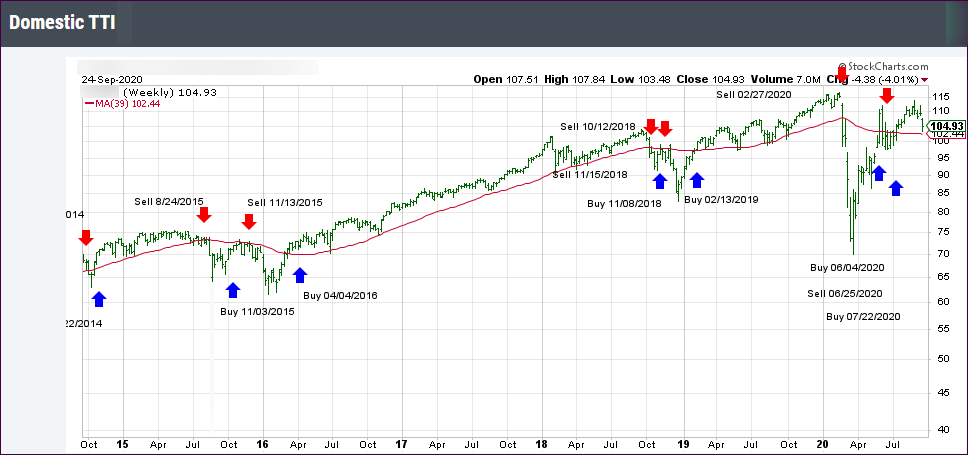
Our main directional indicator, the Domestic Trend Tracking Index (TTI-green line in the above chart) is now positioned below its long-term trend line (red) by -14.65% after having generated a new Domestic “Sell” signal effective 2/27/20 as posted.

Read More