Weekly StatSheet For The ETF Tracker Newsletter – Updated Through 03/05/2020

Ulli ETF StatSheet Contact

ETF Data updated through Thursday, March 5, 2020
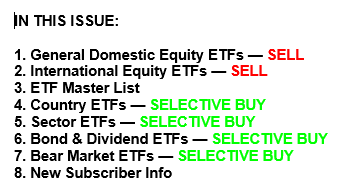
Methodology/Use of this StatSheet:

1. From the universe of over 1,800 ETFs, I have selected only those with a trading volume of over $5 million per day (HV ETFs), so that liquidity and a small bid/ask spread are assured.

2. Trend Tracking Indexes (TTIs)

Buy or Sell decisions for Domestic and International ETFs (section 1 and 2), are made based on the respective TTI and its position either above or below its long-term M/A (Moving Average). A crossing of the trend line from below accompanied by some staying power above constitutes a “Buy” signal. Conversely, a clear break below the line constitutes a “Sell” signal. Additionally, I use a 7.5% trailing stop loss on all positions in these categories to control downside risk.

3. All other investment arenas do not have a TTI and should be traded based on  the position of the individual ETF relative to its own respective trend line (%M/A). That’s why those signals are referred to as a “Selective Buy.” In other words, if an ETF crosses its own trendline to the upside, a “Buy” signal is generated. Since these areas tend to be more volatile, I recommend a wider trailing sell stop of 7.5% -10% depending on your risk tolerance.

If you are unfamiliar with some of the terminology, please see Glossary of Terms and new subscriber information in section 9.     

1. DOMESTIC EQUITY ETFs: SELL — since 02/27/2020
Click on chart to enlarge

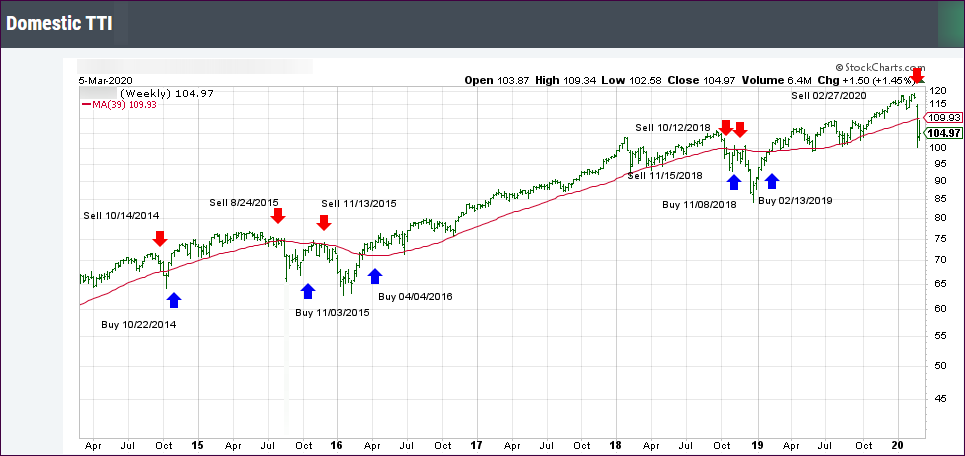
Our main directional indicator, the Domestic Trend Tracking Index (TTI-green line in the above chart) is now positioned below its long-term trend line (red) by -4.49% after having generated a new Domestic “Sell” signal effective 2/27/20 as posted.

Read More
Down The Rollercoaster We Go; Bond Yields Collapse

Ulli Market Commentary Contact

[Chart courtesy of MarketWatch.com]
  1. Moving the markets

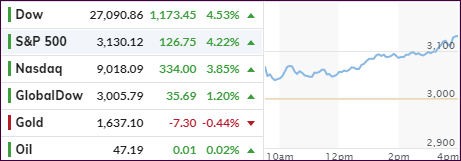
If you thought current market behavior is simply nuts with each rally being followed by a collapse, you are correct. Despite a slightly rising tendency, the major trend direction is anything but clear and can change on a dime the next day.

Today was no different, as the economic picture and the effects of the corona virus have clouded the markets by bouncing them around aimlessly like a rubber ball in a trampoline factory.

On a day-to-day basis, the tug-of-war in the markets has been, and will continue to be, headwinds vs. tailwinds with the former coming out ahead on negative virus news, while the latter will gain strength on any global stimulus reports.  

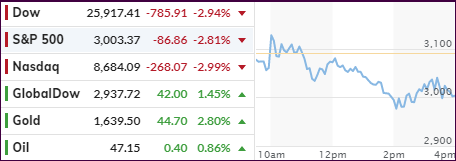
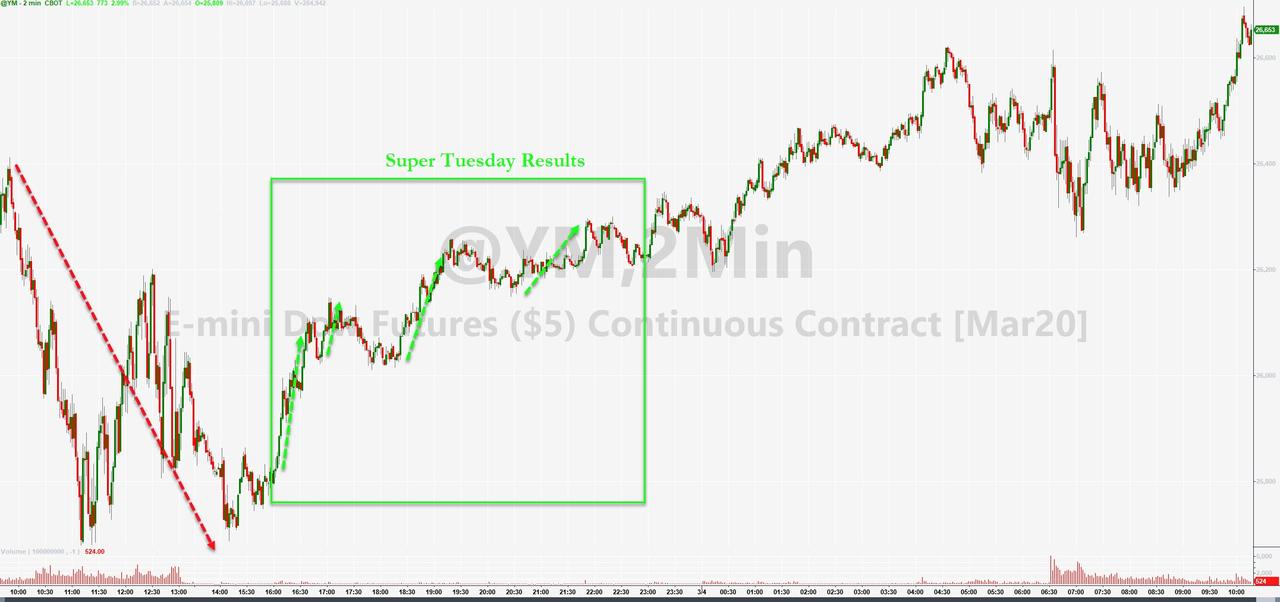
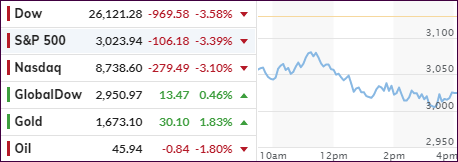
Some of this market action has been referred to as a super-puke with the Dow plunging about 1,000 points and bond yields collapsing to record lows. Demands for more Fed intervention exploded due the continuously worsening conditions in the overnight repo market.

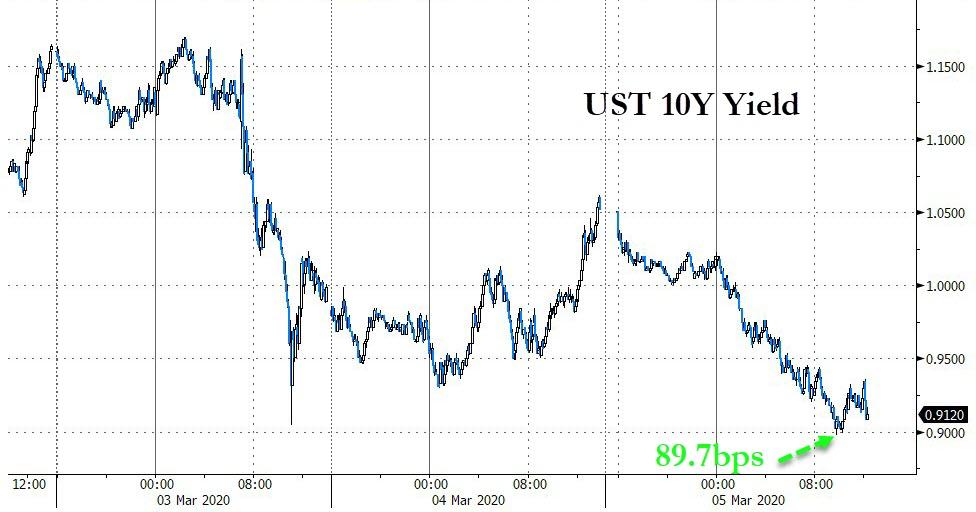
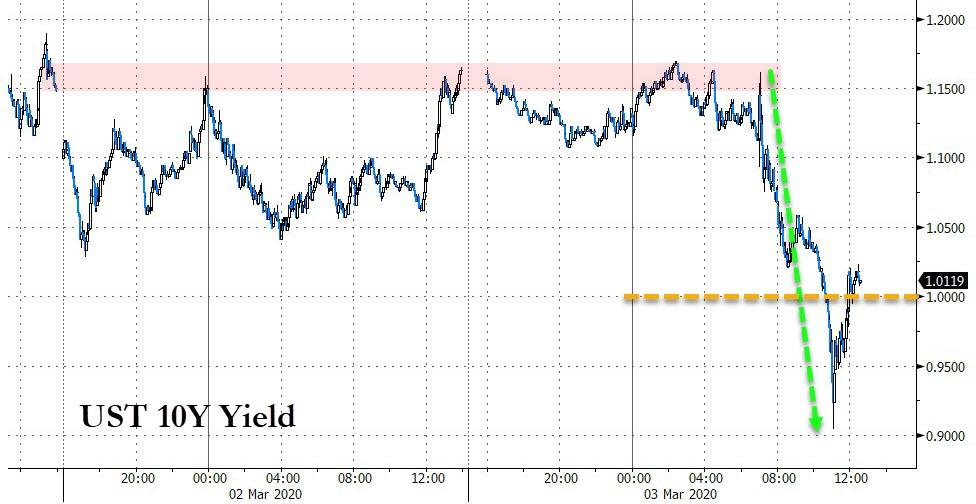
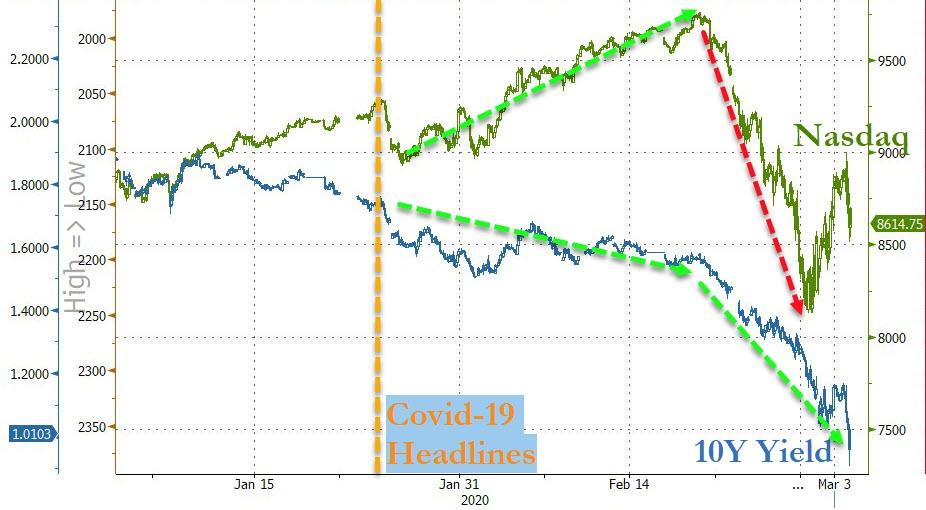
With equities seemingly panicking, another 0.5% rate cut in March is not only expected but also priced in, just to keep things afloat. As a result, the widely watched 10-year bond yield touched new record lows at 0.897% but rallied to close the first time ever below 1% (0.9120%).

Major trend direction is questionable at best, which is why we remain on the sidelines for the time being.

Read More

Shifting In Reverse; A New Rally Emerges

Ulli Market Commentary Contact

[Chart courtesy of MarketWatch.com]
  1. Moving the markets

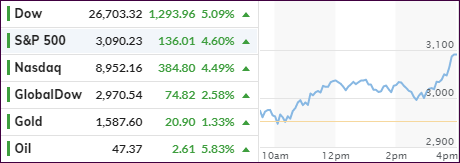
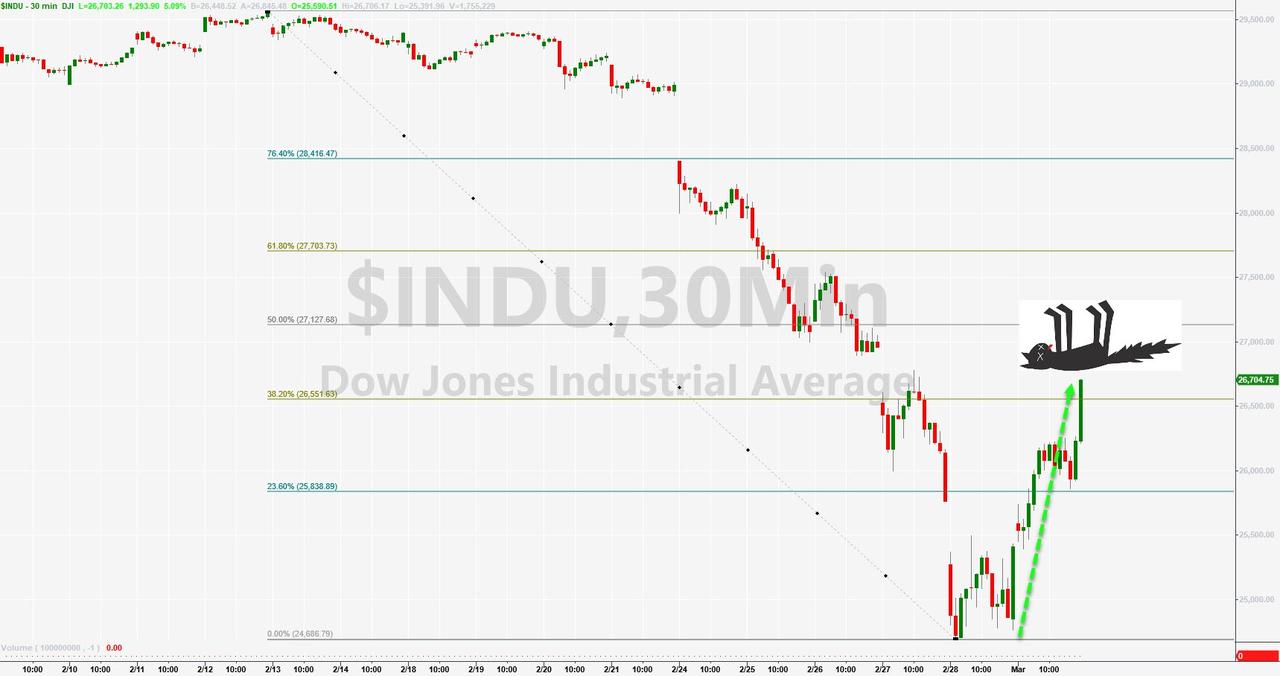
Despite the markets tanking yesterday, after the Fed surprise 0.5% interest rate cut, today we saw another bounce back, which in part may have been contributed by last night’s outcome of the Democratic primary vote.

Or, as one analyst quipped, maybe, just maybe, Biden’s gains mean Trump more likely to win…and that sent stocks higher?

Who knows, it also may have taken traders a day to warm up to the Fed’s surprise cut with today’s rebound more than recouping yesterday’s losses.

The bond market had another wild session with the 10-year yield predominantly trading below the 1% marker, before a late rally pushed the yield up by 4 basis points to close at 1.047%. However, at this point it appears that yields will be heading way below the 1% level.

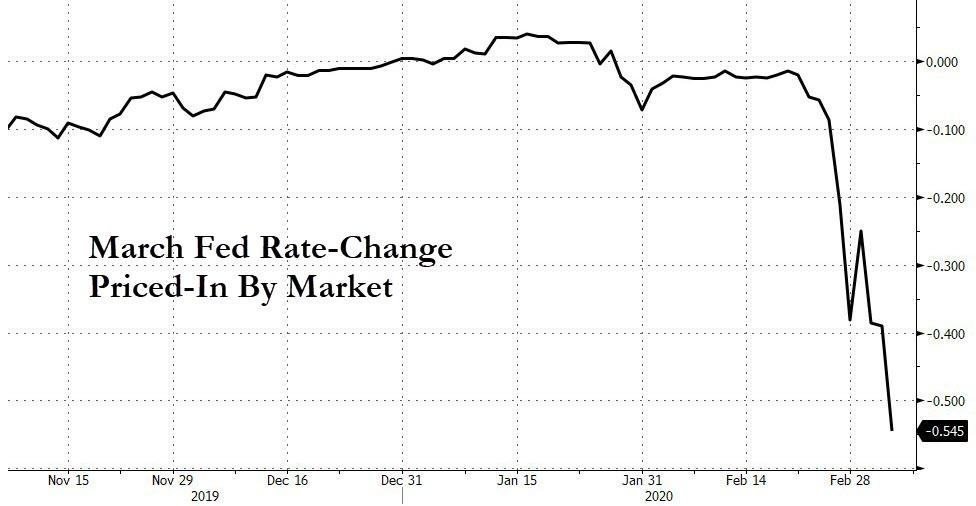
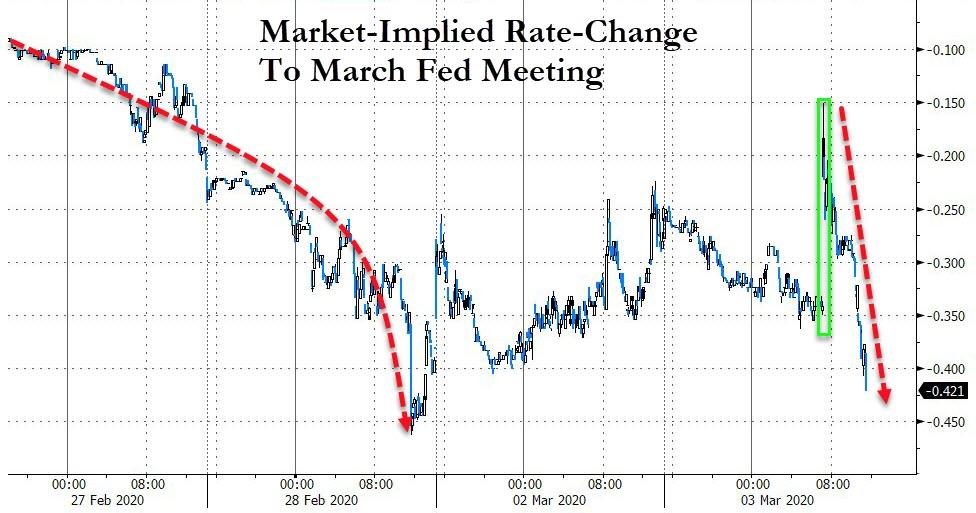
But, traders are never satisfied when it comes to the level of interest rates, which means the market is now “demanding” almost 2 more rate-cuts, before the end of March, as this chart by Bloomberg shows.

Today’s move has pushed our main directional indicator, the Domestic Trend Tracking Index (TTI) back to within striking distance of a new “Buy” signal. Currently, we are only -0.95% away from the crossing of our long-term trend line into bullish territory.

Obviously, such a move would need to be accompanied by some staying power, before I will pull the trigger and ease back into domestic equity ETFs. The International TTI is lagging and about -3.20% away from turning bullish.

Stay tuned.

Read More

Fed Cuts Rates—Equities And Bond Yields Plunge

Ulli Market Commentary Contact

[Chart courtesy of MarketWatch.com]
  1. Moving the markets

Despite the Fed’s attempt to please the markets by cutting interest rates a surprising 0.50%, an initial spike reversed and down we went, with the major indexes giving back a large chunk of yesterday’s gains.

Bond yields skidded with the widely followed 10-year touching a 0-handle intra-day for the first time ever but closing slightly above at 1.007%.

The Fed’s reasoning for this emergency cut was that “we saw risk to the outlook for the economy and chose to act. I don’t think anybody knows how long it will be. I do know that the U.S. economy is strong.”

Of course, opinion vary widely as to the above wisdom and the view that the Fed is beholden to the markets. Here are some comments:

  • Did the Fed just swing from omnipotence to impotence?
  • The Fed cut rates, and the market dropped.
  • What do they know?
  • Did the Fed get an early glimpse of this week’s payroll data?

In the end, it appears that the Fed’s shock and awe rate reduction caused more turmoil than the intended reaction, namely calmness.

ZH pointed out that today’s cut was the largest since the fall of 2008 and just the ninth emergency rate cut in history. Despite all this, the markets still have priced in almost two more rate-cuts in March!

Does that mean that stocks will finally catch down to the reality of bonds?

It promises to be an interesting yet nerve wrecking time, and a good one to observe future developments from safety of the sidelines.

Read More

Intervention Hopes Power Markets

Ulli Market Commentary Contact

[Chart courtesy of MarketWatch.com]
  1. Moving the markets

It comes as no surprise that after last week’s market drubbing, a rebound of some sort was in order. One analyst quipped by posting the question: Can a cat with a coronavirus bounce?

At least for right now, it seems that way, as the major indexes, motivated and supported by the Bank of Japan’s (BoJ) massive buying of almost $1 billion US dollars in stock ETFs, designed to stabilize markets, helped to create an overall positive sentiment to start the week.

So far, the Fed has been quietly absent and may have second thoughts about intervening in the markets, other than jawboning last Friday that “the coronavirus poses evolving risks to economic activity. The Federal Reserve is closely monitoring developments and their implications for the economic outlook. We will use our tools and act as appropriate to support the economy.”

Of course, expectations keep growing that Central Bankers will act in unison to attempt to stem the economic fallout from the virus. Still, traders are anxiously watching to see for how long not only supply chains, but also future corporate earnings will be affected.

I found analyst’s Mike Whitney’s summary most appropriate:

“Well, next week the Fed will announce that it is slashing rates by 50 basis points and that it’s coordinating its action with its fellow central banks, the BoE, the BoJ, and the ECB.

The Fed might also announce an additional liquidity program aimed at banks and financial institutions that suddenly find they themselves unable to borrow at the Fed’s discount rate.

The announcement could ignite a relief rally, but the surge is not likely to last long since it will not have any material effect on either the virus or the disruptions to supply-lines. The Fed’s easy money will not create the Chinese-made components that laptop manufacturers need to sell their products.

They won’t put skittish workers back in the factories or passengers back on airplanes or consumers back in the retail stores. The Fed’s low rates are designed to stimulate demand, but they do nothing to mitigate a “supply shock”. Regrettably, the problem is on the supply side not the demand side.”

Right now, the markets are looking to stop last week’s bleeding. It will take a little more than a one-day reflex rally, based on intervention hopes, to re-establish the bullish trend.

Read More

ETFs On The Cutline – Updated Through 02/28/2020

Ulli ETFs on the Cutline Contact

Below, please find the latest High-Volume ETF Cutline report, which shows how far above or below their respective long-term trend lines (39-week SMA) my currently tracked ETFs are positioned.

This report covers the HV ETF Master List from Thursday’s StatSheet and includes 322 High Volume ETFs, defined as those with an average daily volume of more than $5 million, of which currently 73 (last week 272) are hovering in bullish territory. The yellow line separates those ETFs that are positioned above their trend line (%M/A) from those that have dropped below it.

Take a look:                                                                   

The HV ETF Master Cutline Report

In case you are not familiar with some of the terminology used in the reports, please read the Glossary of Terms. If you missed the original post about the Cutline approach, you can read it here.