Earnings Give A Bullish Assist

Ulli Market Commentary Contact

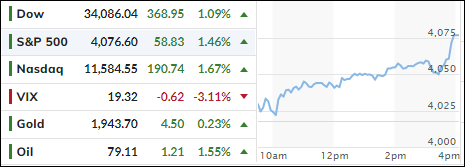
[Chart courtesy of MarketWatch.com]

  1. Moving the markets

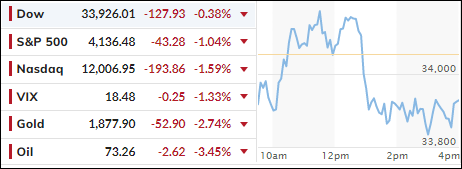
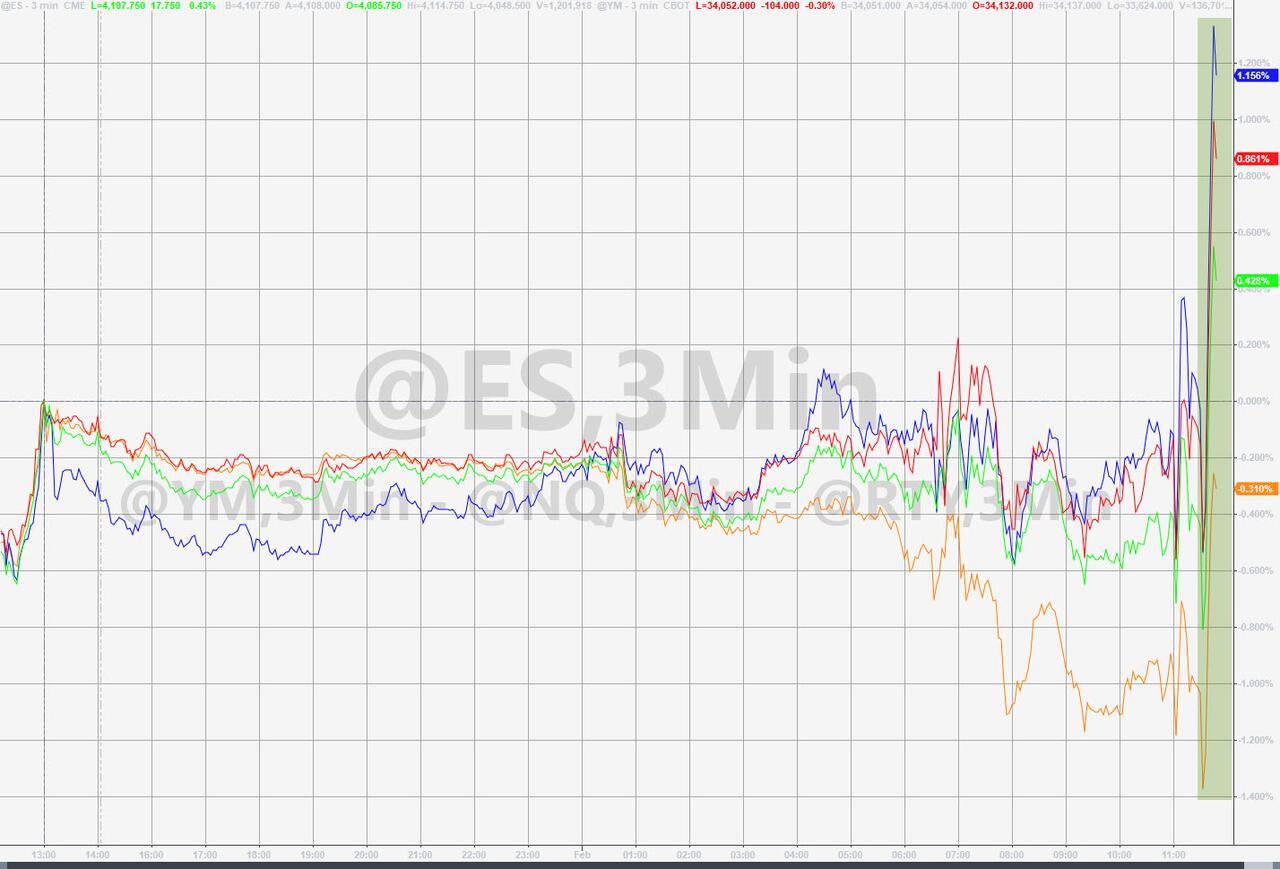
Despite an early 500-point jump in the Dow, supported by strong earnings reports (Goldman Sachs, Lockheed Martin), volatility set in with the major indexes tumbling off their lofty levels. The cause was Apple reporting that it will be cutting iPhone 14 production less than 2 weeks after its debut.

Added ZeroHedge:

The news that there is just not enough demand for the trinkets and beads of the world’s largest company makes one wonder if the consumer is really as strong as the talking heads would like everyone to believe.

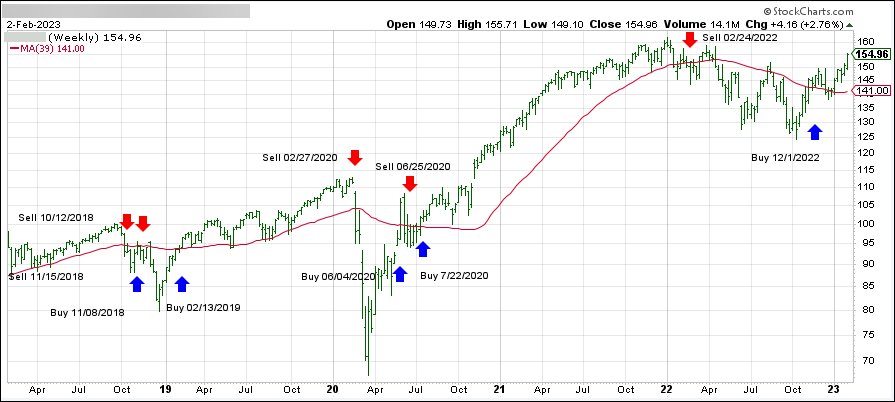
Uncertainty reigned and trading was choppy, as many investors seem to lack conviction that this rally has legs. According to my count, we have seen 5 occurrences when, after a rebound, the indexes dumped to make lower lows each time, which is a hallmark of bear market behavior.

This SPY chart demonstrates what the bulls had to put up with in 2022:

Will this current rebound be different?

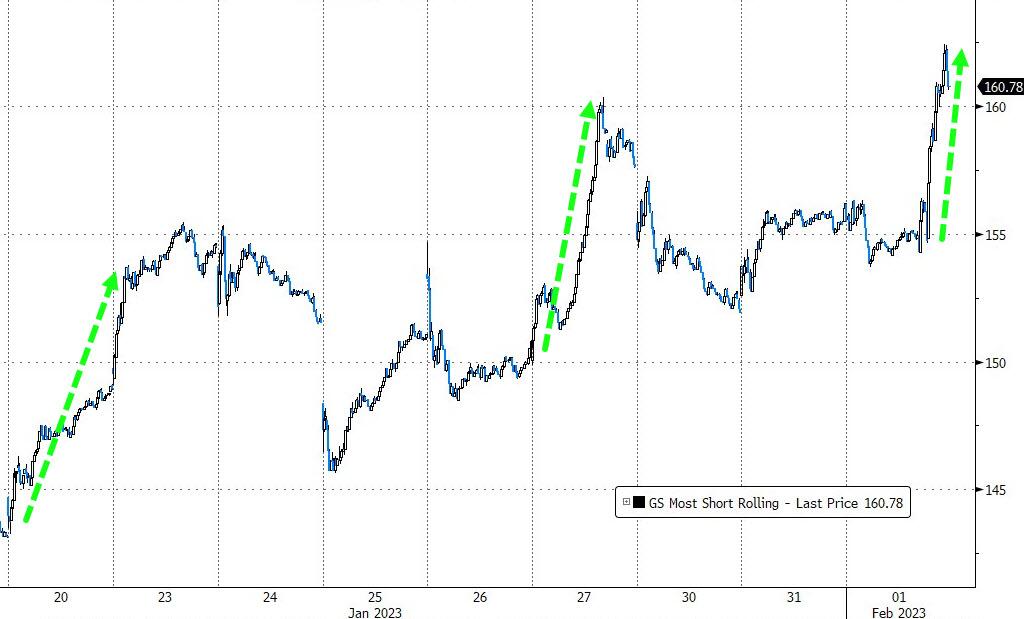
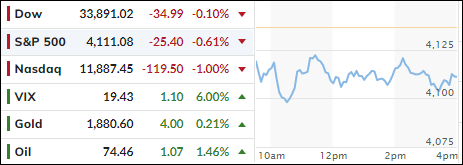
Today, another short squeeze helped the bullish cause with the major indexes closing in the green. Bond yields chopped around and ended slightly lower with the 10-year losing its 4% level by closing at 3.99%.

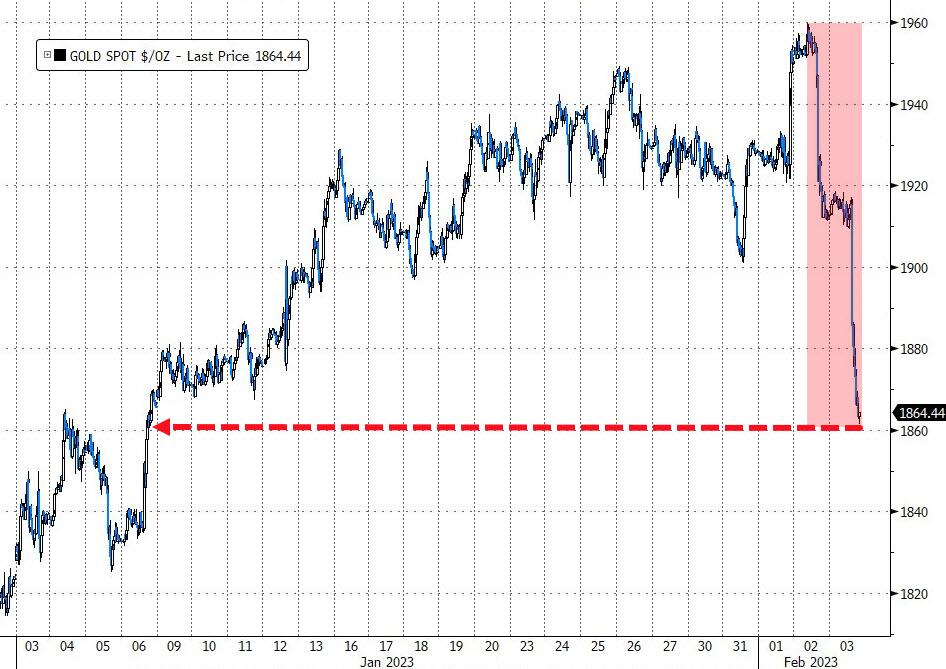
Gold retreated a tad, but Crude Oil stumbled and is threatening to break the $80 barrier to the downside. With the current administration’s plan to announce more SPR releases to lower the price of gasoline at the pump, and a weakening economy, we could see the black gold take a dump into $70s.

Read More

The Pendulum Swings The Other Way

Ulli Market Commentary Contact

[Chart courtesy of MarketWatch.com]

  1. Moving the markets

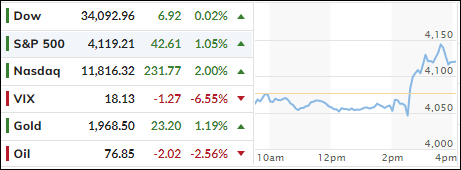
A relief rally held its ground with the major indexes remaining steady above their respective unchanged lines, as strong bank earnings by Bank of America and Bank of Mellon provided the fuel to sustain the rebound.

Of course, stocks have been in deeply oversold territory, and are hovering near year lows of the year, with the S&P 500 having declined in four of the past five weeks. We have witnessed big moves in both directions, as apprehension has spread through Wall Street causing this roller-coaster type of swings.

Today, the pendulum swung back in favor of the bulls, which also found some encouragement by the markets now moving into the seasonally strong part of the year.

Whether that is enough to propel the rally further remains to be seen and will be impacted by the upcoming earnings season, as well as companies’ outlooks and/or revisions, along with the Fed’s policies in the face of persistently high inflation and an economic slowdown.  

As ZeroHedge pointed out, “Friday’s bloodbath was dominated by hedge fund shorting, which set up the market for a major squeeze higher…yet again.” And that is exactly what happened, as the most shorted stocks got squeezed early on, but that was it—no follow through, which could indicate that all of the ammo has been used up.

Bond yields presented a mixed picture with the 10-year rallying back above 4% and closing at 4.02%, while the 30-year followed suit. Yields have now risen for 11 straight weeks, the longest such streak since 1978, as ZeroHedge added.

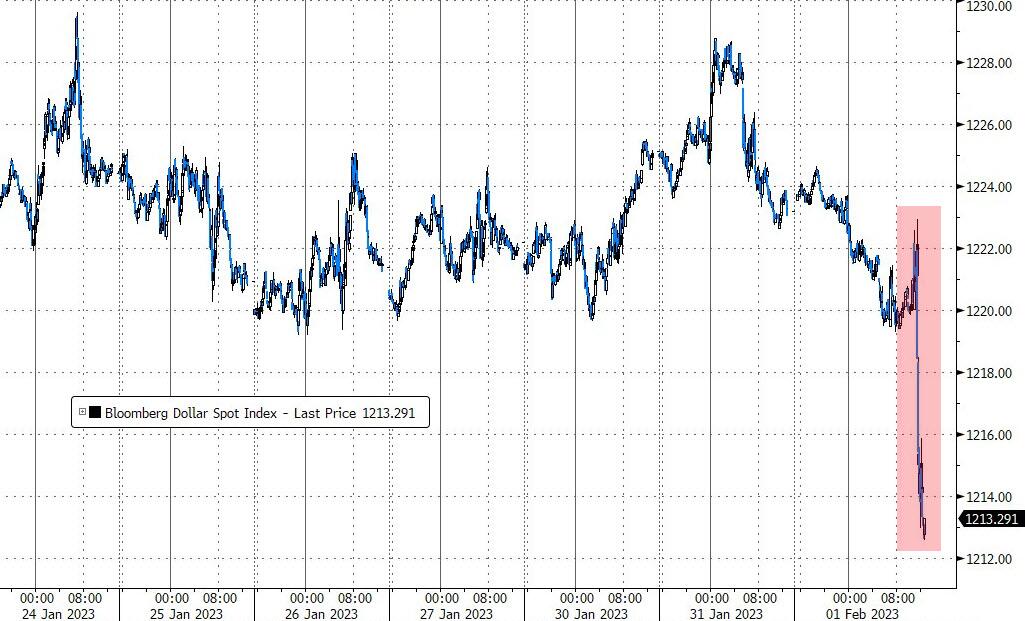
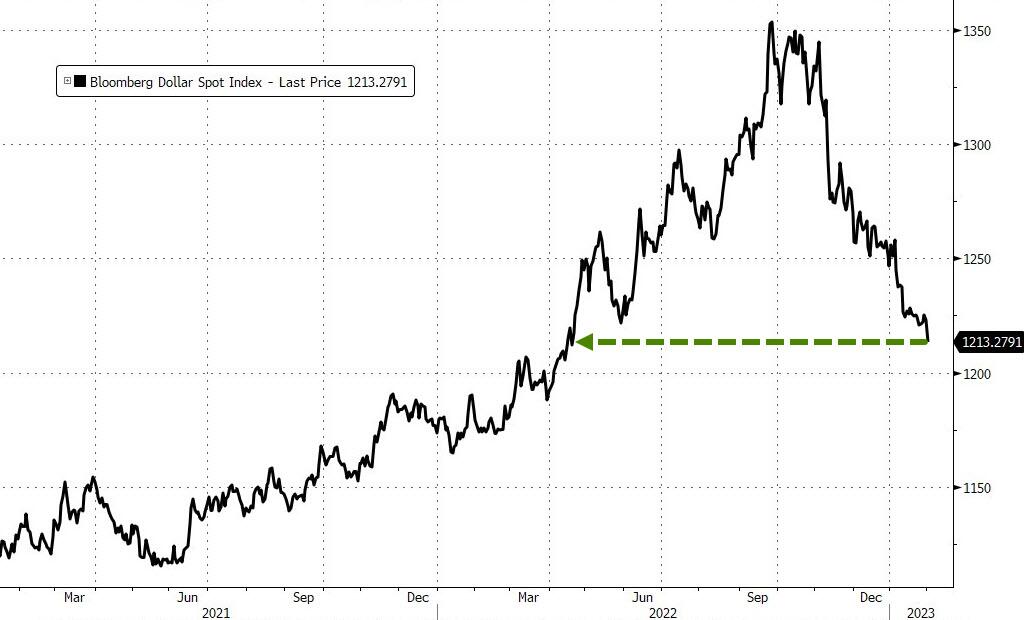
The US Dollar was in diving mode today, which helped Gold to rally, but the precious metal could not sustain the early gains but closed in the green.    

Can this bounce be prolonged? ZeroHedge concluded that it can—at least until the November FOMC meeting—that is if the 2008-2009 analog holds true.

Read More

ETFs On The Cutline – Updated Through 10/14/2022

Ulli ETFs on the Cutline Contact

Below, please find the latest High-Volume ETF Cutline report, which shows how far above or below their respective long-term trend lines (39-week SMA) my currently tracked ETFs are positioned.

This report covers the HV ETF Master List from Thursday’s StatSheet and includes 312 High Volume ETFs, defined as those with an average daily volume of more than $5 million, of which currently 16 (last week 19) are hovering in bullish territory. The yellow line separates those ETFs that are positioned above their trend line (%M/A) from those that have dropped below it.

Take a look:                                                                   

The HV ETF Master Cutline Report

In case you are not familiar with some of the terminology used in the reports, please read the Glossary of Terms. If you missed the original post about the Cutline approach, you can read it here.      

ETF Tracker Newsletter For October 14, 2022

Ulli ETF Tracker Contact

ETF Tracker StatSheet          

You can view the latest version here.

PUMPED, THEN DUMPED

[Chart courtesy of MarketWatch.com]

  1. Moving the markets

Yesterday’s market reversal, that saw Dow swing from a minus 500 points to a plus 800 points, marked the fifth largest in history. The worse than expected CPI report (+8.2% YoY), with the core number surging to 40-year highs, slammed the markets, but a sudden turnaround created a massive rally with the major indexes ending the session solidly in the green.

From my vantage point there was more involved than meets the eye, and I suspect that the Plunge Protection Team (PPP) stepped in to avoid a total market meltdown and pushed the indexes higher, after which the enormous number of shorts were forced to liquidate thereby creating a massive short squeeze and turning bad news into a good outcome for the markets.

As is the case with engineered market direction, the outcome very often results in nothing more than a dead-cat-bounce. And that is exactly what was confirmed today, as the bears took charge and installed some realism by knocking the indexes off yesterday’s level. The S&P 500’s gain of +2.6% was pretty much wiped out by today’s -2.37% loss, which put the index right back to where it started the month.

Contributing to today’s weakness was a consumer survey by the University of Michigan showing that inflation expectations were increasing, a sentiment that is watched closely by the Fed and may influence their future actions.

Not helping the bullish theme were reports of a brewing banking crisis. Last week, it was the BoE, which had to step in to save its bonds from crashing and by extension, their pension funds from collapsing.

Then, a few days ago, we learned that the Fed quietly wired some $3 billion to Switzerland, which was followed today by another $6.3 billion. Judging by recent reports, there is a dollar funding shortage very likely connected with the latest news about the Credit Suisse bank having “issues.”

ZeroHedge summed it up like this:

And speaking of the coming crisis, recall what we said at the start of September: the coming Fed pivot will have nothing to do with whether the Fed hits or doesn’t hit its inflation target, and everything to do with the devastation unleashed by the soaring dollar (a record margin call to the tune of some $20 trillion) on the rest of the world.

Here is the US, bond yields rallied with the 10-year finally conquering its 4% glass ceiling and closing above it at 4.02%. The US Dollar swung wildly but rallied for a second straight week, which crashed the Japanese Yen to its weakest since 1990! Ouch.  

After another wild week, which should have finally made it clear that the best spot to watch this carnage from is sitting in cash on the sidelines, the analog to 2008-2009 remains disconcertingly on track.

Read More
Weekly StatSheet For The ETF Tracker Newsletter – Updated Through 10/13/2022

Ulli ETF StatSheet Contact

ETF Data updated through Thursday, October 13, 2022

Methodology/Use of this StatSheet:

1. From the universe of over 1,800 ETFs, I have selected only those with a trading volume of over $5 million per day (HV ETFs), so that liquidity and a small bid/ask spread are assured.

2. Trend Tracking Indexes (TTIs)

Buy or Sell decisions for Domestic and International ETFs (section 1 and 2), are made based on the respective TTI and its position either above or below its long-term M/A (Moving Average). A crossing of the trend line from below accompanied by some staying power above constitutes a “Buy” signal. Conversely, a clear break below the line constitutes a “Sell” signal. Additionally, I use a 12% trailing stop loss on all positions in these categories to control downside risk.

3. All other investment arenas do not have a TTI and should be traded based on the position of the individual ETF relative to its own respective trend line (%M/A). That’s why those signals are referred to as a “Selective Buy.” In other words, if an ETF crosses its own trendline to the upside, a “Buy” signal is generated. Here too, I recommend trailing sell stop of 12%, or less, depending on your risk tolerance.

If you are unfamiliar with some of the terminology, please see Glossary of Terms and new subscriber information in section 9.     

1. DOMESTIC EQUITY ETFs: SELL — since 02/24/2022

Click on chart to enlarge

Our main directional indicator, the Domestic Trend Tracking Index (TTI-green line in the above chart) has broken below its long-term trend line (red) by -9.78% and remains in “SELL” mode.  

Read More
Stuck In Limbo

Ulli Market Commentary Contact

[Chart courtesy of MarketWatch.com]
  1. Moving the markets

Today’s Producer Price Index (PPI) was a mixed bag and turned out to be a yawner for the stock market. While the PPI climbed 0.4% in September, which was twice the forecast of 0.2%, year over year, however, it rose 8.5%, which was an improvement from August’s 8.7% increase.

The major indexes interpreted that as inconclusive and spent the session chopping around their respective unchanged lines with not much gained or lost. The S&P 500 was the worst performer sporting a negative -0.33% and notched its 6th day of losses.

The Fed’s September meeting notes were released, as MarketWatch reported:

The minutes showed that the central bank expects to keep hiking interest rates and keep them high until inflation shows signs of cooling off.

On the other hand, one comment in the minutes led to optimism that the Fed might slow its tightening campaign or even walk it back if there was more financial market turbulence.

Of course, traders are always looking for optimism in Fed Statements, but today that hope was dampened somewhat when Chicago Fed President Charles Evans suggested that job losses were an acceptable circumstance:

If unemployment goes up, that’s unfortunate. If it goes up a lot, that’s really very difficult. But price stability makes the future better.

Bond yields slipped, the US Dollar dipped, while Crude Oil dropped for the 3rd straight session to end at $87. Gold gained moderately but has a way to go to reclaim its $1,700 level.  

Right now, nothing is more on traders’ minds than tomorrows CPI report. As JP Morgan pointed out, consensus expects to see inflation increase 8.1% from a year ago in September. Anything above the prior reading of 8.3% could put the stock market at risk of a quick 5% tumble.

It promises to be an interesting day, but I think whatever magnitude the initial market reaction may be, it likely will be limited in duration.

Read More