Play The Calls

Ulli Uncategorized Contact

I have been playing tennis for over 40 years and, by the mere exposure to many opponents, had my share of disagreements over line calls.

While we’ve never reached the level of outbursts of John McEnroe in the 70s, it’s been an issue from time to time, especially when playing with people whose personality makes it difficult to accept losing a point or a match.

To avoid those potential disagreements, we instigated a simple rule to just “play the calls.”

I was reminded of that during several recent discussions about investing. Some callers analyzed and projected why a certain sector should do well in the next year because of certain fundamentals, which then should warrant an investment in that area.

I hate to burst your bubble, but whatever fundamental arguments you might have, they are already discounted in the current price, which is the inherent problem with fundamental analysis.

You’re better off looking at the long-term trend, forget fundamental analysis, and only jump aboard if the trend warrants such action. In other words, to use my tennis adage from above “just play the calls” and don’t sweat the other stuff.

If you combine that with my recommended trailing sell stop discipline, you will find that your decision making process becomes much easier and less time consuming, and so will your investment life.

Who knows, you may even find the time to pick up the game of tennis.

No Load Fund/ETF Tracker updated through 10/1/2009

Ulli Uncategorized Contact

My latest No Load Fund/ETF Tracker has been posted at:

http://www.successful-investment.com/newsletter-archive.php

Weak economic data, along with lofty market levels, pulled the major indexes down another 2%.

Our Trend Tracking Index (TTI) for domestic funds/ETFs has now crossed its trend line (red) to the upside by +7.43% keeping the current buy signal intact. The effective date was June 3, 2009.


The international index has now broken above its long-term trend line by +12.53%. A Buy signal was triggered effective May 11, 2009. We are holding our positions subject to a trailing stop loss.


[Click on charts to enlarge]

For more details, and the latest market commentary, as well as the updated No load Fund/ETF StatSheet, please see the above link.

Rebounding From The Lows

Ulli Uncategorized Contact

Yesterday, the markets repeated the behavior of the past few months which, a couple of days ago, I referred to as “back to normal.”

After a sharp sell off at the opening, the bulls stepped in and slowly but surely pulled the major indexes out of the doldrums and, for a short period, into positive territory. The gains did not hold, but the losses were minor compared to what could have been.

It was a volatile day to close out a quarter, which featured the S&P; 500 gaining 15%, its best quarterly performance since the end of 1998. Despite this impressive run, there is still a lot of making up to be done to overcome last year’s disaster when the markets collapsed and the S&P; 500 ended up losing 17% just in October 2008.

From current prices, the S&P; 500 still needs to gain another 19.8% just to get to the level we sold at on 6/23/08. Whether we will get there remains to be seen, but at least we made it through September with flying colors.

Of course, now we have October in front of us, a month which has also been known to wreak havoc with the markets. There is no need to become complacent; keep an eye on your trailing stop loss points, and be ready to act should this trend suddenly come to an end.

The Worst ETF Of 2008

Ulli Uncategorized Contact


The Natural Gas ETF UNG has to go down in history as one of the worst performers in 2008 and possibly 2009.

The downtrend, which started in June of 2008, still has not come to an end and those investors holding on for dear life may have hard time making up their losses.

Why bring it up now?

If an investor had followed the major trend such as I advocate, there would have been two opportunities to get out of this ETF with minimal losses or even profits, depending on the entry point:

1. The use of a trailing sell stop would have triggered a sell about 10% off the high (upper arrow) or

2. The breaking of the long-term trend line to the down side (lower arrow) would have been the final confirmation that a major trend change is about to occur; or is at least very likely.

Since you never know beforehand if one of your holdings is about to turn south in a big way, these simple techniques can make sure that your portfolio survives turbulent times in the market.

Disclosure: We currently have no positions in the ETF discussed.

Back To “Normal”

Ulli Uncategorized Contact


After the modest sell-off last week, M&A; was yesterday’s buzzword, and the markets rallied higher in “normal” fashion. These days, that can be interpreted that a slight pullback is always followed by a rally sufficient to make up the small losses; that is until it no longer works and the trend ends.

Some readers have commented that they exited the market as weakness surfaced last week. Again, my mode of operation is not to make emotional decisions but let the market tell me when it’s time to get out.

There is no harm in taking profits early, and your comfort level should determine if you have reached this point. There is no sense in following any strategy if you don’t have the stomach for it.

As a point of reference, last week’s drop pulled some of our holdings only 2.5% off their highs. In other words, more downside action is needed before our trailing sell stops kick in.

We’ll sit tight and let the stops be our guide as to when to exit knowing that a trend reversal appears to be likely at that time.

Tips For TIPS

Ulli Uncategorized Contact

The WSJ reports that “Investors Seek Inflation Haven in TIPS Funds.” Here are some highlights:

Rising fears of inflation are fueling an investor rush into mutual funds and exchange-traded funds holding Treasury inflation-protected securities.

So far this year, more than $17 billion has poured into funds that invest in TIPS, government-issued bonds whose principal grows with rising inflation, according to estimates from research firm Morningstar Inc. That compares with estimated net cash inflows of almost $10 billion for 2008.

Their popularity reflects worries that massive U.S. government spending will eventually lead to high inflation, which could erode the value of stocks and ordinary bonds. But if inflation stays at current low levels longer than some investors expect, TIPS may not add much juice to a portfolio—and could even drop in value.

Sure, common sense dictates current government policies will lead to inflation–eventually. However, as I have pointed out before, all industrialized nations more or less are following the same inflationary policies, which makes me wonder what the ultimate effects will be. In the past, only isolated countries have inflated their currencies with the effect that they lost in value relative to all others.

This time around, everyone is trying to inflate to get out from under the deflationary forces. I think we are in unchartered territory with the outcome being a total unknown.

That said, many investors aren’t in it for the yields, but for the protection they hope the bonds will provide if inflation suddenly surges. For now, TIPS buyers are brushing aside the prospect that the bonds won’t do well if that much-feared inflation doesn’t materialize. Indeed, many TIPS have been bid up to prices exceeding their face value.
….
But inflation alone doesn’t determine how well TIPS perform. Supply and demand also play a role. And demand for TIPS is driven by inflation expectations, rather than actual inflation. Such expectations could drive TIPS prices higher, thereby shrinking yields, since price and yield move inversely.

“There has been a ton of money flowing into TIPS year to date, yet there’s no inflation,” says Lawrence Glazer, managing partner at Mayflower Advisors in Boston.

Instead, money keeps pouring into the investments based on the expectation that inflation is ahead.

If the break-even rate widens, that would imply investors foresee higher inflation. But once the Federal Reserve begins to address inflation, it will raise short-term interest rates, and that would push down the value of existing bonds.

In that case, there would be two counterforces acting on TIPS: rising inflation or expectations of inflation pushing up demand and thereby pushing up prices; and rising short-term rates driving down prices. If the Fed pushes rates up faster than inflation rises or raises rates before inflation picks up, TIPS could rack up losses for their owners. They could also decline if inflation turns out milder than investors’ original expectations.

I agree that supply and demand plays a major role. In fact, it may have been that imbalance of more investors “expecting” inflation that has caused TIP to break out above its long-term trend line. Take a look at a 2-year chart:
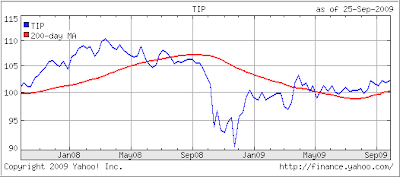


If this inflation expectation is not met, we could very well see a drop below the trend line again. If you own TIP in your portfolio, be sure to use the trailing sell stop discipline here as well; just in case the future does not turn out the way many investors expect.

Disclosure: My clients currently have holdings in the ETF discussed above.
