No Load Fund/ETF Tracker updated through 10/8/2009

Ulli Uncategorized Contact

My latest No Load Fund/ETF Tracker has been posted at:

http://www.successful-investment.com/newsletter-archive.php

The major indexes recouped two weeks of losses as the Bull run continued.

Our Trend Tracking Index (TTI) for domestic funds/ETFs has now crossed its trend line (red) to the upside by +8.81% keeping the current buy signal intact. The effective date was June 3, 2009.


The international index has now broken above its long-term trend line by +15.28%. A Buy signal was triggered effective May 11, 2009. We are holding our positions subject to a trailing stop loss.


[Click on charts to enlarge]

For more details, and the latest market commentary, as well as the updated No load Fund/ETF StatSheet, please see the above link.

Exiting The Market: Sell Stop Vs. Trend Line Break

Ulli Uncategorized Contact

Reader Tom had the following question in regards to exiting the market:

I had some time to kill so I did a spread sheet on my brokerage results and found something interesting that raised a question.

Assuming the TTI tells us to hold, but we have a trailing 7 percent Stop Loss set…..would we be better off holding until the TTI signals a sell…or letting the Stop Loss get us out BEFORE the TTI indicates is time to bail out?

If you look at the spread sheet you can see that the July positions I was in stopped out but the TTI said “hold”….I would have been better off ignoring the Stop as you can see from today’s price points on the ETFs that were sold.

That’s a very good question. The reason for the trailing sell stop is that the TTI can move substantially above its long term trend line. Right now, it is positioned 9.07% above it. The TTI by nature is a slow moving indicator whether the market is rallying or retreating.

If you were to wait until the TTI breaks through its long-term trend line on the way down, you would give up too much profit until the sell signal kicks in. Even worse, by waiting that long, you could possibly turn a winning position into a losing one.

The alternative to avoiding that scenario is the use of the trailing sell stop. It will from time to time, as you have experienced, give you a whip-saw signal, which will cause you to have to find a new entry point if the markets head back up.

There is no way that this can be avoided (unless you buy and hold), so look at whip-saws as simply insurance, which will protect your portfolio from possible market disaster.

Making Up Losses

Ulli Uncategorized Contact


The markets rallied for 2 straight days and made up the losses of the entire last week, which puts us now back within striking distance of the psychological Dow 10,000 barrier.

Gold hit a record yesterday as the dollar weakened. The widely held GLD gained 2.46% on the day. As I posted about last week, we are participating in the metals and some currencies in a more conservative fashion via PRPFX, which gained a more modest 1.09% but is up over 9% since we bought it in early June.

Some mutual funds/ETFs are simply better suited for trend tracking than others. They tend to have less erratic swings by moving somewhat slower to the upside, but they also don’t crash to the downside. These slower moves avoid whip-saws and let us stay aboard a lot longer than we would with more volatile funds/ETFs.

A good way to avoid fast moving ETFs and mutual funds is to drop down the M-Index rankings when analyzing the weekly StatSheet. If you are an aggressive investor, you can consider selecting some of the top ranked ETFs, but be aware that frequent whip-saws, whenever the markets correct, will be part of your investing life.

If you are more conservative, go further down the list and, while your upside will be more limited, so will be your downside. As I said before, it all depends on your individual risk tolerance.

Reader Q + A: Exit Strategy

Ulli Uncategorized Contact

Reader Bill had this question regarding our sell strategy:

I have my IRA diversified among seven T. Rowe Price funds. Do I apply an exit strategy to each separate fund—or use one fund (i.e: Equity Income)?

Where do you suggest I put the money from the exit strategy in this environment?

Yes, you will have to track the trailing sell stop points for each fund separately, since they obviously fluctuate to different degrees. Some may hold up better than others so each needs to be followed based on its own merit.

While the markets have pulled back recently, no sell stops have been triggered yet. However, if that should occur, I always move to the safety of the money market funds first.

That allows me to observe market behavior unemotionally and evaluate if this was simply a whip-saw or an actual trend reversal. At the same time, I will consult the weekly StatSheet to see if any other area is moving to the upside.

Chances are there will be hardly any, since all world markets are so intertwined that they pretty much move in tandem but to varying degrees.

If the markets head further south, I’m glad I’m out; if they reverse and head up again, I may re-enter using some of my previously held positions (or new ones) once the old highs have been taken out. That confirms to me that the trend is back on track and warrants exposure again.

Keep in mind that this is not an exact science, but merely a focused effort to keep out of harms way should the markets head south again in a big way a la 2008.

Sell Stops And Bond Funds

Ulli Uncategorized Contact

Sell stops were the main topic of the past couple of weeks as readers provided valuable feedback and asked for clarification.

Here are a couple more comments:

I learned from you that the trailing stop loss is usually 7% I do hold TIP (ETF). Does the same 7% hold for bond funds as well or should it be a lesser amount?

With bond funds being (in general) less volatile than stock funds, you can adjust the trailing top loss to some degree, maybe to the 4%-5% level; if you are more comfortable with that.

Personally, I have not held bond funds long enough to see if that makes much of a difference. The key is to have some exit point in place just in case this arena goes haywire.

One reader disagrees and had this to say:

I consider TIPs to be held and not sold under any condition for a retiree’s portfolio. I hold both the ETF and individual bonds.

While you certainly can hold individual bonds for their duration, I don’t recommend that for any bond funds. In times of turmoil, bond funds can drop sharply as we’ve seen last year. Take a look at the chart for TIP:
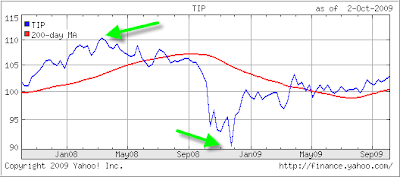


From peak to trough, the drop was about 18%. Of course, with the benefit of hindsight, it does not seem such a big deal. But, while the price of TIP was approaching the $90 level in November of 2008, I’m sure that many investors were worried about further deterioration.

Unfortunately, we are living in an environment were anything can happen as far as investments is concerned. Last year should have taught everyone that lesson.

As the reader above stated “I consider TIPs to be held and not sold under any condition for a retiree’s portfolio,” I disagree and will have to take the opposite stance by saying that “there is no investment which should be held without an exit strategy.”

Where Are We Now?

Ulli Uncategorized Contact


[Click on chart to enlarge]

In the past, I have published this chart from time to time featuring some of the worst bear markets in history, and how they compare to each other in severity and duration.

Thanks to Doug Short for constantly updating and publishing these Mega-Bears.

You can clearly see how the S&P; 500 (blue) has fared since the 2000 peak along with the rebound from March 09. It now remains to be seen whether this stimulus induced rebound can continue, or if we eventually follow the way of the Dow from 1929 to 1949 (gray). I have indicated a possible directional change with the red arrow and question mark.

Given the current economic landscape, I believe the odds are higher that we are following the 1929 scenario than continuing higher and taking out the 2007 highs.

Of course, this is nothing but an educated guess on my part, but the point is that you must be prepared for the possibility of a downturn via my recommended trailing sell stop strategy.

If the market shows a similar future performance of any of these 3 scenarios, simply buying and holding any investments will destroy your portfolio.

Follow the trends, keep your sell stops tight, and you will have increased your odds of better dealing with the unknown.