No Load Fund/ETF Tracker updated through 1/20/2011

Ulli Uncategorized Contact

My latest No Load Fund/ETF Tracker has been posted at:

http://www.successful-investment.com/newsletter-archive.php

A minor pullback pulled the Nasdaq and the S&P; 500 lower by moderate percentages. However, the markets have not been able to overcome overhead resistance.

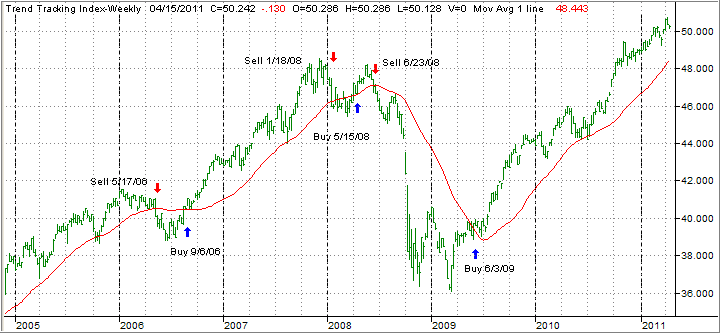
Our Trend Tracking Index (TTI) for domestic funds/ETFs has moved above its trend line (red) by +4.58 % (last week +5.60%) and remains in bullish mode.


The international index has broken above its long-term trend line by +8.37% (last week +9.25%). A new Buy signal was triggered effective 9/7/10. If you decided to participate, be sure to use my recommended sell stop discipline.


[Click on charts to enlarge]

For more details, and the latest market commentary, as well as the updated No Load Fund/ETF Tracker StatSheet, please see the above link.

Losing Steam

Ulli Uncategorized Contact


So far, the 1,300 level of the S&P; 500 has been a formidable opponent for the bullish crowd, as the markets sold off yesterday after coming within striking distance of breaking through that milestone.

Despite the positive earnings from IBM and Apple on Tuesday, it was a reversal on Wednesday as the financials and technology shares were a drag on the markets.

Housing starts in 2010 were absolutely atrocious and came in as the second lowest number since record keeping started in 1959. It just simply is a confirmation that housing is still in the doldrums and will not improve until prices will have found a level that not only creates genuine demand but also is in line with median incomes for any given area. You can stimulate all you want but nothing permanent will come from it until these two conditions are met.

Oh yes, and it would help to have a major improvement in the employment picture; after all, most home owners make their home purchases with monies received from earned income.

Talk has increased that the markets have become increasingly ripe for a pullback. While yesterday’s 1% retraction in the S&P; was fairly mild, it pays to be prepared should this turn into more than just a temporary bearish phase.

While the major domestic and international trends remain up, there is always the possibility of more short term reversals. There is nothing to do at this point except knowing where your potential exit points should be.

Nibbling At The 1,300 Level

Ulli Uncategorized Contact


Resiliency was the word of the day, as disappointing earnings from Citigroup and concerns about Apple were offset by upbeat manufacturing data.

As we have seen so often lately, even a sliver of a silver lining gets the bulls going, and yesterday was no exception. The Dow lead the way higher and dragged the S&P; 500 and Nasdaq slightly above their respective unchanged lines.

Nevertheless, momentum was not sufficient enough to pierce the S&P;’s 1,300 level, but after hours impressive earnings from Apple and IBM may provide the markets with the impetus needed to break through that milestone.

Despite a busy economic calendar, corporate earnings will share the center stage, and we have to wait and see if the bulls can continue their current dominance.

Muni Issues

Ulli Uncategorized Contact


I have been opposed to municipal fund investing for a couple of years now ever since the market crash of 2008. Initially, my reasons were only fundamental in nature but in November 2010, the technical aspects turned bearish as well.

Let’s first look at The WSJ’s updated report in “New Hit To Strapped States:”

With the market for municipal bonds tumbling, cities, hospitals, schools and other public borrowers are scrambling to refinance tens of billions of dollars of debt this year, another sign that the once-safe market is under duress.

The muni bond market was hit with the latest wave of bad news Thursday, prompting a selloff that sent the market to its lowest level since the financial crisis. A New Jersey agency was forced to cut the size of a bond issue by about 40% because of mediocre demand, and pay a higher rate than expected. And mutual fund giant Vanguard Group shelved plans for three new muni bond funds, citing market turmoil.

“We believe that this delay is prudent given the high level of volatility in the municipal bond market,” said Rebecca Katz, spokeswoman for the nation’s biggest fund company.

The market has fallen every day this week, and investors have been net sellers of their holdings in municipal-bond mutual funds for nine straight weeks, according to fund tracker Lipper FMI.

Yields on 30-year triple-A rated general obligation bonds shot higher to 5.01% on Thursday, reflecting a spike in perceived risk, according to Thomson Reuters Municipal Market Data. The last time those bonds yielded 5% was Jan. 30, 2009, during the financial crisis.

Amid the selloff, public borrowers such as states and utilities face a wave of refinancing stemming from deals cut mostly during the crisis. The deals involved letters of credit from banks that were designed to keep financing costs down for government entities in need of cash.

Though the financing deals can be meant to last decades, the letters of credit underpinning them are expiring sooner. That could force the borrowers in many cases to pay higher interest rates or seek guarantees at higher costs. For the weakest borrowers, new guarantees may not be available and refinancing too costly. There are about $109 billion worth of letters of credit and similar backstops expiring this year, according to Bank of America Merrill Lynch. Some $53 billion in letters of credit alone is expiring this year, according to Thomson Reuters.

“Municipalities may be hard-pressed to come up with this money or refinance this debt,” said Eric Friedland, a municipal analyst at Fitch Ratings. The ratings firm is scouring to identify risks among weaker municipalities that are seeking to renew these deals, and says it could downgrade some.

The short-term squeeze is unusual in the $2.9 trillion municipal bond market. Most debt is paid back over decades. And state and local governments generally don’t need to borrow money to fund their daily operations. The long-term nature of the market is a key reason why most experts don’t see the problems with state and local government debt spiraling into another financial crisis. Analysts say that many large states and cities with good credit ratings have been able to roll over deals well ahead of their expiration.

But there are parts of the market where short-term cash crunches could emerge, leading municipalities to potentially default on their debts. The risks could spill over to banks that backed bonds with the letters of credit.

The biggest concerns, analysts say, are smaller muni borrowers such as hospitals and schools that have subpar credit.

Municipalities borrowed $122 billion of variable-rate demand debt in 2008, roughly twice the amount of these types of loans borrowed the year before, according to Thomson Reuters.

Rollover crunches were a major part of the financial crisis, as banks that had relied on short-term debt couldn’t borrow and became insolvent. More recently, rollover issues contributed to Greece’s financial crisis.

Banks are reluctant to renew the letters of credit in part because of impending rules that restrict the amount of risk they can take.

Besides banks, one provider of muni letters of credit is the giant California pension fund, the California Public Employees’ Retirement System, which has back-stopped $2.5 billion of adjustable-rate bonds.

Calpers’ chief investment officer, Joe Dear, said in an interview that the pension fund partly uses the letters to make it easier for local California entities to borrow money, but it has no plans to ramp up its involvement in such deals.

“We, like a lot of people, are watching the muni market, and it is not getting any healthier,” said Mr. Dear.

While there is a lot of analysis being done and forecasts abound as to the magnitude of the muni problem, there is an easy way to see where the muni market is at. I am, of course, talking about simply look at the trend.

The 2-year chart above shows PZA, which tracks the Long-Term Core Plus Municipal Securities Index, which normally invests 80% of its assets in insured muni securities.

As you can see, the trend line was broken to the upside in April of 2009, generating a buy, and did not drop below it until November 2010. That break below coincided with PZA coming off its high by 5%, which triggered our trailing sell stop. While we only had limited holdings, we liquidated them at that time.

Since then, it’s been straight down into bear market territory. If you like investing in munis, I suggest you wait until the price breaks the trend line to the upside again until establishing positions.

Don’t try to be a hero by attempting to bottom fish now; it’s very easy to do something very stupid as no one can tell when we really have hit bottom.

With the markets being closed on Monday, I will return on Wednesday morning with Tuesday’s market report.

Sunday Musings: Predictions For The ETF Industry

Ulli Uncategorized Contact

Seeking Alpha featured some interesting thoughts and upcoming changes for the ETF industry. Let’s listen in to “11 Predictions for the ETF Industry in 2011:”

Last year was a very interesting one for the ETF industry, a stretch filled with both ups and downs. The industry suffered from numerous attacks that concerned investors about the possibility of an ETF collapsing and the role that these securities played in the Flash Crash. Yet many dismissed these claims as fear-mongering, and shrewd investors continued to pile into ETFs as a way to reduce expenses, achieve more diversified exposure, and enhance the overall tax efficiency of their portfolios. In fact, ETF assets recently surged to the $1 trillion level, while the number of fund choices continued to expand as well, hitting the 1,100 mark.

The past year was no doubt one of the most important in the industry’s short history, as the products continued to gain market share in new markets around the world. With 2011 well underway, the new year figures to be full of exciting developments for the industry as well. Below, we highlight several predictions for the ETF industry in 2011, our thoughts on what headlines might shape the next phase of the ETF boom.

1. VWO Surpasses EEM in Assets Under Management (AUM)

Okay, so this is an easy one. The two most popular emerging market investments continue to thoroughly dominate the Emerging Market ETFdb category, combining to account for more than $90 billion of the $110 billion or so in total. Both of the funds track the MSCI Emerging Markets Index, and as a result are largely similar in terms of composition and individual weightings. The most significant difference between the funds – besides the issuer name – is that VWO charges an expense ratio that is roughly one-third that of EEM. As a result, cost conscious investors have been piling into Vanguard’s VWO instead of iShares’ EEM…

This development will underscore the importance of low fees to ETF investors, and perhaps inspire other firms to slash their expense ratios in an effort to gain market share. There are several match-ups where cost differentials could be critical to future growth, including the head-to-head gold ETF match-up as well as a variety of country-specific ETFs.

2. New Country ETFs Debut

This past year saw the release of several country ETFs targeting once hard-to-reach international markets; countries that are now available in ETF form include the Philippines (EPHE), New Zealand (ENZL), and Egypt (EGPT), just to name a few. Moreover, a number of additional products appeared in other markets such as India and Brazil, targeting unique aspects of their respective economies…

3. Volatility ETNs – But Not the Traditional VIX

Last year saw a surge in the number of products offering exposure to volatility, an asset class that was previously beyond the reach of many investors. While all of the VIX ETPs currently on the market are linked to indexes based on the volatility of the S&P; 500, there seems to be an opportunity in harnessing the volatility of other equity benchmarks and even other asset classes. Currently, there are VIX levels for oil, gold, and a variety of other commodities and indexes as well. Given the popularity of the current crop of VIX ETNs, it is rather odd that no one has thought of this yet, especially considering the often significant volatility of gold and oil…

4. Small-Cap Europe ETFs

IndexIQ, the firm perhaps best known for its hedge fund replication ETFs, has been one of the few firms to offer investors quality exposure to small caps in foreign markets. Their four core small cap funds, which target the small cap securities in Australia (KROO), Canada (CNDA), Taiwan (TWON), and South Korea (SKOR), have been slow to build assets despite the fact that they arguably offer more “pure play” exposure to the local economies and tend to not be as prone to heavy exposure in oil and banking firms as their large-cap peers…

5. At Least 50 ETFs Close

While there will almost certainly be a net gain of funds in the ETF world this year, it is undeniable that many ETFs are money losers for their issuers. More than 450 ETFs finished 2010 with less than $50 million in assets, a common rule-of-thumb breakeven point in the ETF industry. Although many of these funds are relatively new products that are still hitting the sweet spot on their growth curve, many of them have been around for quite a while and are unlikely to suddenly see a surge in assets. As issuers look to cut the fat from their product lineups, look for at least 50 ETFs to close down this year.

6. 2011: Year Of the Non-BRIC Emerging Market ETF

If 2010 was the year of the commodity ETF, 2011 will be the year of the non-BRIC Emerging Market ETF. After billions of dollars flowed into BRIC-focused ETFs last year, expect investors to look towards smaller or lesser-known emerging markets in 2011 as an option to move away from U.S. exposure and identify markets poised to deliver solid long-term results…

7. More Online Brokerages Jump on the ETF Bandwagon (I’m Looking at You, E-Trade)

As further evidence of the growing importance and recognition of ETFs, numerous brokerage houses announced plans to offer many ETFs commission-free to their clients, a development that may accelerate the shift from mutual funds to ETFs among individual investors. With the recent proposal of a revived FocusShares, it appears that Scottrade will likely join the growing chorus of online brokerages to offer commission-free trading on a number of products to their clients…

8. India ETFs Catch Up to China ETFs

While China may still be an emerging market, its ETF lineup is highly developed; currently over 150 ETFs offer at least some exposure to the country, with 16 putting a majority of their assets in Chinese stocks. This number increases even more if investors add in auxiliary China exposure in the form of Hong Kong securities or those from Taiwan. This is in sharp contrast to the situation in India, where just 43 funds offer exposure to the country and just five have more than half of their assets in the sub-continent. In fact, more funds offer exposure to either Peru or South Africa than India, the world’s most populous democracy…

9. Active ETF Push Continues

With ETF assets hitting $1 trillion in late December, the vast majority of assets continue to be in “plain-vanilla” funds tracking standard indexes such as the S&P; 500 or the Russell 2000. Active ETFs, once billed as the “next big thing” in the industry, have been slow to catch on with investors. Grail, the San Francisco firm behind one of the first true active ETFs, recently indicated in an SEC filing that it is on the verge of a sale or liquidation. While a handful of active PIMCO bond funds have had some success, assets in active ETFs have generally been disappointing…

10. More Funds in the Underdeveloped Currency and RE Categories

Despite the massive markets that exist in both the foreign currency and real estate worlds, the number of ETF products in these two categories leaves much to be desired. Just 14 funds track the real estate market in the U.S., while just 11 exist in the Global Real Estate ETFdb Category. While the currency ETP lineup is comparatively more robust with 30 funds, it is pretty small when one considers that over $2 trillion trades hands every day in the currency market, suggesting that far more potential exists in this slice of the market as well…

11. VIX ETPs Contraction

The end of 2010 saw the launch of numerous funds targeting the suddenly-popular volatility play in the market. However, these funds are largely similar, tracking various stretches of the S&P; 500 volatility index curve, and are best suited for sophisticated investors making short-term trades or hedges. As a result, we predict that some VIX ETNs will close and that issuers will come to see that this is probably an oversaturated market in its current form…

Interestingly enough, I used to use EEM in my advisor practice, but switched to VWO a long time ago (we currently have positions in it). With performance roughly being equal, the far lower cost made this an easy decision.

Lower costs overall will be the continued benefit for the investing public as the major ETF players juggle for position.

While we sure don’t need another ETF tracking the S&P; 500, new additions of specific country ETFs will be very useful when structuring a portfolio to hopefully include those areas that zig when the domestic market zags.

Any newcomers will have to prove themselves first, as I mentioned in yesterday’s post. At the very minimum, a 9 months price history is essential in order to determine fund direction and changes in momentum over time.

An All-World ETF

Ulli Uncategorized Contact

Would it not be nice to be able to invest in one ETF that covers the entire world? Now you can, as IndexUniverse suggests in “Rydex launches All-World ETF:”

Rydex, the Rockville, Md.-based fund sponsor known for its flagship equal-weight S&P; 500 ETF, has launched a new equally weighted fund designed to measure the equity market performance of both developed and emerging economies.

The Rydex MSCI All Country World Equal Weight ETF (NYSEArca: EWAC) tracks the equal-weighted MSCI All County World Index, which comprises more than 2,400 stocks from 24 developed and 21 emerging market countries, according to the company’s fact sheet. The fund’s components are rebalanced quarterly to maintain the equal weighting.

EWAC’s focus is on large-cap firms; the median market capitalization of companies in the MSCI ACWI Equal Weighted Index is $11.3 billion.

Equal weighting—as opposed to weighting by market capitalization—is an alternative approach to indexing that’s increasingly attracting the attention of both investors and fund sponsors. As of late October, the Rydex S&P; Equal Weight ETF’s (NYSEArca: RSP) year-to-date returns were more than twice as much as its market cap-weighted counterpart, the SPDR S&P; 500 ETF (NYSEArca: SPY).

According to Rydex portfolio strategist Tony Davidow, the quarterly rebalancing provides a quasi-active component to his firm’s equal weighted funds and may be part of the secret of their relative outperformance.

“We’re essentially selling the winners high and buying the underperformers low,” said Davidow.

In addition, Rydex believes equal weighting helps reduce risk.


EWAC has an expense ratio of 0.60 percent. The fund began trading Jan. 12 on the New York Stock Exchange’s Arca platform with a relatively large bid-ask spread of around $0.27. Buyers were prepared to pay $40.12 a share, while sellers were at $40.39, according to data posted on Yahoo finance.

While I like the idea of having the option of investing in an all-world ETF, EWAC is too new to be considered investment material.

As always, I like to first see 9 months of price data to be able to chart a trend, substantial volume increase and much improved bid/ask spreads before I would even consider this new arrival. Nevertheless, it’s a step in the right direction, and I will report on the progress this ETF has made in a few months.