A Bleak Future Is In Store For Europe

Ulli Market Commentary Contact

Only time will tell if the Eurozone will overcome this debt crisis. However, Europe faces a near certain reality of economic stagnation. With the amount of austerity that has been put in place, prospects for growth are dire indeed.

Not only is the economy likely to contract this as suggested by the IMF and others, but forward progress in the years following will be very slow as suggested in a recent interview with hedge fund manager George Soros.

In what he calls an impending “lost decade” for the EU, the recent austerity measures by PIIGS members especially, will put a damper on economic growth and likely keep unemployment high while creating deflationary pressures. In a deflationary environment, the real value of debt increases, creating a vicious cycle where the public and private sectors have additional hurdles to pay off debt.

Given Europe’s declining financial condition, it’s critical to understand the potential ramifications this can have for global markets and your portfolio on a short-term and long-term basis.

When Will This Greek Tragedy End?

Ulli Market Commentary Contact

While the markets appear impervious to the disastrous situation unfolding in Greece, we certainly are not. Although it’s difficult to quantify the impact of an adverse event in Greece on U.S. markets, Greek default is a very realistic scenario that could trigger a negative ripple effect globally.

As Greece is mired in talks with its bondholders over the restructuring terms and the conditions of its new bonds, let’s consider why Greece remaining in the Eurozone is far from a good idea.

The mounting tension has already served to be divisive. Germany’s Merkel wants Greece to cede control of its budgetary decisions and put in that power in the hands of a European official. Considering the ineptitude of the Greek government in complying with bailout conditions or demonstrating that it can severely reduce its deficit, this is a move that could be implemented to ease the European situation, and in effect, markets, but will turn Greece into nothing but a (German?) colony.

Already, the troika (IMF, ECB, and European Commission) have significantly intervened in the recent debt discussions given that Greece has been unable to adequately uphold its financial obligations, putting its approximate $170 billion IMF loan in jeopardy. Whether Greece will receive its next tranche of nearly $20 billion in bailout funding come March is up in the air.

Read More

01-27-2012

Ulli Newsletter Archives Contact

ETF/No Load Fund Tracker Newsletter For Friday, January 27, 2012

ETF/No Load Fund Tracker StatSheet

————————————————————-

THE LINK TO OUR CURRENT ETF/MUTUAL FUND STATSHEET IS:

https://theetfbully.com/2012/01/weekly-statsheet-for-the-etfno-load-fund-tracker-newsletter-updated-through-01262012/

————————————————————

Market Commentary

Friday, January 27, 2012

ETFs END THE WEEK ON AN UNCERTAIN NOTE

In what’s been a bit of an up and down week, the S&P 500 dropped 0.16% today. However, it’s been the 4th straight positive week for the index. With the spate of European downgrade news, European indices saw plenty of red.

Despite continued negativity in the Eurozone, the Euro once more appreciated against the dollar, hitting $1.32/Euro. Nevertheless, investors sought safety in low risk assets as the 10-year Treasury yield fell to 1.90%.

While it’s difficult to point to one indicator to gauge risk, seeing as the VIX has remained low but demand for Treasuries has been high, the outlook for Europe and the U.S. is pessimistic at the moment. To put it succinctly, we are in risk on mode for the long-term.

Today’s lackluster GDP numbers are proof that the U.S. is still a far way off from recovery. GDP growth was 2.8% in the 4th quarter, lower than expected. It is this anemic growth that supports the Fed’s decision to keep rates near zero through 2014, as credit markets have yet to serve as an effective channel to spur growth over the last few years.

Following in line with Standard and Poor’s, Fitch Ratings docked Spain and Italy down two notches. Although borrowing costs for Spain and Italy didn’t rise following the S&P downgrades, we’ll have to see if the investor outlook darkens now that two major ratings agencies have downgraded them.

Already stricken with high yields, Spain is now a caught in a tighter pickle. It needs to reduce its budget deficit through austerity, but with unemployment now at 23%, Spain has to stimulate its economy somehow. Spanish Prime Minister Rajoy is now appealing for laxer Eurozone budget deficit targets. I’m afraid that despite efforts from Merkel and others to impose strict budget standards, the unique circumstances and needs of each Eurozone country will be too much to overcome.

With respect to our Trend Tracking Indexes (TTIs), our Domestic TTI remains above its trend line at +4.27% while the International TTI has inched closer to its trend line at -0.20%. I will be staying out of international ETFs and would only add exposure if there was a confirmed uptrend in progress. Nevertheless, I will post a special update in the blog should an International Buy signal materialize.

A bullish January has lifted markets for sure, but it’s necessary to proceed with caution as we might see a tumultuous February considering developments in Greece. I believe maintaining a solid bond ETF allocation mixed in with a few attractive domestic equity/sector ETF names is the best strategy going forward.

Have a great week.

Ulli…

————————————————————-

READER Q & A FOR THE WEEK

All Reader Q & A’s are listed at our web site!
Check it out at:

http://www.successful-investment.com/q&a.php

A note from reader GEH:

Q: Ulli: In these turbulent markets your ETF News continues to be a great source of information and guidance.

You clarify your Cutline reports with this comment:

“The second report includes only High Volume ETFs. To clarify, High Volume (HV) ETFs are defined as those with an average daily volume of $10 million or higher.

These ETFs are generated from my selected list of some 93 that I use in my advisor practice. It cuts out the “noise,” which simply means it eliminates those ETFs that I would never buy because of their volume limitations. 33 ETFs (last week 21) have managed to hang on in bullish territory after the recent volatility.”

By this, do you mean that you only buy ETFs that are on the High Volume Cutline Report? And if so why?

Do you use a similar guideline for Mutual Funds?

A: GEH: If you personally invest only smaller amounts of money, you can pretty much choose any ETF that appeals to you. As an investment advisor, I move larger amounts of client’s assets into and out of ETFs, so volume becomes a critical factor to me. It allows me to exit, when our sell stops get triggered, without too much slippage in price.

That’s not an issue with most mutual funds, but I still won’t use any with assets of under $50 million.

———————————————————-

WOULD YOU LIKE TO HAVE YOUR INVESTMENTS PROFESSIONALLY MANAGED?

Do you have the time to follow our investment plans yourself? If you are a busy professional who would like to have his portfolio managed using our methodology, please contact me directly or get more details at:

https://theetfbully.com/personal-investment-management/

———————————————————

Back issues of the ETF/No Load Fund Tracker are available on the web at:

https://theetfbully.com/newsletter-archives/

ETF/No Load Fund Tracker Newsletter For Friday, January 27, 2012

Ulli ETF Tracker Contact

ETF/No Load Fund Tracker StatSheet

————————————————————-

THE LINK TO OUR CURRENT ETF/MUTUAL FUND STATSHEET IS:

https://theetfbully.com/2012/01/weekly-statsheet-for-the-etfno-load-fund-tracker-newsletter-updated-through-01262012/

————————————————————

Market Commentary

Friday, January 27, 2012

ETFs END THE WEEK ON AN UNCERTAIN NOTE

In what’s been a bit of an up and down week, the S&P 500 dropped 0.16% today. However, it’s been the 4th straight positive week for the index. With the spate of European downgrade news, European indices saw plenty of red.

Despite continued negativity in the Eurozone, the Euro once more appreciated against the dollar, hitting $1.32/Euro. Nevertheless, investors sought safety in low risk assets as the 10-year Treasury yield fell to 1.90%.

While it’s difficult to point to one indicator to gauge risk, seeing as the VIX has remained low but demand for Treasuries has been high, the outlook for Europe and the U.S. is pessimistic at the moment. To put it succinctly, we are in risk on mode for the long-term.

Today’s lackluster GDP numbers are proof that the U.S. is still a far way off from recovery. GDP growth was 2.8% in the 4th quarter, lower than expected. It is this anemic growth that supports the Fed’s decision to keep rates near zero through 2014, as credit markets have yet to serve as an effective channel to spur growth over the last few years.

Following in line with Standard and Poor’s, Fitch Ratings docked Spain and Italy down two notches. Although borrowing costs for Spain and Italy didn’t rise following the S&P downgrades, we’ll have to see if the investor outlook darkens now that two major ratings agencies have downgraded them.

Read More

Weekly StatSheet For The ETF/No Load Fund Tracker Newsletter – Updated Through 01/26/2012

Ulli ETF StatSheet Contact

ETF/Mutual Fund Data updated through Thursday, January 26, 2012

If you are not familiar with some of the terminology used, please see the Glossary of Terms.


1. DOMESTIC EQUITY MUTUAL FUNDS/ETFs: BUY — since 10/25/2011

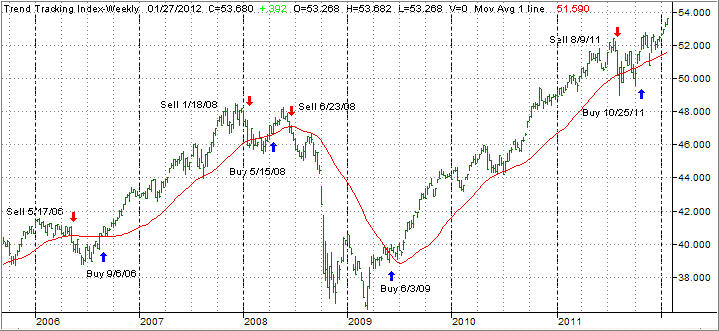
The domestic TTI broke through its long-term trend line generating a Sell for this area effective 8/9/2011. Over the recent past, we’ve seen the TTI hovering slightly below and above this dividing line between bullish and bearish territory. The clear break to the upside occurred on 10/24/11 and, effective 10/25/11, a new Buy signal for domestic equities is in effect.

As of today, our Trend Tracking Index (TTI—green line in above chart) has broken above its long term trend line (red) by +4.15%. Be sure to tune into my blog for the latest updates.

Read More

European Concerns Return As Equity ETFs Fall

Ulli Market Review Contact

Chart courtesy of MarketWatch.com]

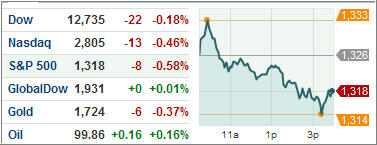
Although today wasn’t a big mover or shaker, the S&P 500 fell 0.57%. However, some European indices such as the DAX and FTSE gained over 1%. Meanwhile, the Euro barely budged against the dollar, remaining at $1.31/Euro.

The 10-year Treasury took another dip today, falling to a yield of 1.93%. Investors just don’t seem to have much consistency in their risk outlook given jumps and drops in the Treasury rate.

The primary focus right now is whether a suitable deal can be hashed out between the Greek government and its bondholders. Not only must they see on the same wavelength, but other Eurozone leaders as well as the ECB and the IMF are having their say. Trying to determine an appropriate haircut as well as a coupon rate for new bonds that is agreeable with all parties involved is going to be a big mess.

Read More