ETFs/Mutual Funds On The Cutline – Updated Through 2/24/2012

Ulli ETFs on the Cutline Contact

Below are the latest ETF Cutline reports, which show how far above or below their respective long-term trend lines (39 week SMA) my currently tracked ETFs/MFs are positioned.

The first report covers the ETF Master List from Thursday’s StatSheet and includes 398 ETFs, of which currently 360 (last week 353) of them are hovering in bullish territory.

The second report includes only High Volume ETFs. To clarify, High Volume (HV) ETFs are defined as those with an average daily volume of $10 million or higher.

These ETFs are generated from my selected list of some 93 that I use in my advisor practice. It cuts out the “noise,” which simply means it eliminates those ETFs that I would never buy because of their volume limitations. 79 ETFs (last week 74) have managed to move into in bullish territory after the recent run up.

The third report covers Mutual Funds on the Cutline. There are currently 815 (last week 808) above the line and 46 below it out of the 861 that I follow.

Take a look:

1. ETF Master Cutline Report

2. ETF High Volume Cutline Report

3. MF Cutline Report

Last Week In Review: ETF News And Blog Posts To 2/26/2012

Ulli Market Review Contact

In case you missed it, here’s a summary of the ETF topics and market reviews I posted to my blog during the week ending on 2/26/2012.

Meandering with an upside bias best describes the trend of the past week. The major indexes have reached a crucial point which, if broken to the upside, could mean further advances and confirmation of the current bull market. The milestones are 1,370 for the S&P 500 and 13,000 for the Dow.

If momentum weakens, and these hurdles are not overcome, the downside could come into play again, which should not be surprising given the fact that we have not seen a decent market pullback this year.

This week, we covered the following:

Read More

Equity Markets Are Witnessing A Rally Now. Is It Driven By Fundamentals?

Ulli Market Review Contact

Markets in the US have touched June highs since 2008, and the Dow is flirting with 13,000. Is the equity market witnessing a bull run, particularly since the start of this year? Or is the market overpriced and a pullback is imminent?

The S&P is up eight percent year-to-date and nearly 25 percent since October 2011 lows. Some of the emerging markets have recovered spectacularly and are up more than 20 percent year-to-date.

If Saira Malik, Head of Global Equity Research at TIAA-CREF, a large teacher’s retirement fund, is to be believed, the Dow is now fairly valued. The recent rally has been caused by a combination of both local and global events such as stronger manufacturing in the US, the ECB’s LTRO initiative, better investor confidence in Germany and better business surveys in China.

However, investors should cut their risk exposures to moderate levels since energy prices have shot up recently. This will affect consumer spending and profitability of companies and it has already reflected in the forward looking earnings estimates of the S&P, which has dipped to 9 percent from 11 percent.

The utilities, which tend to do well during slowdowns, have done well in the last four months. Investors can target them for better dividend yields unless markets turn extremely negative. Currently trading at 14X of forward-earnings, the S&P is fairly valued now since historically it has traded in the 12X to 18X range in the last five years.

The liquidity enhancing measures taken by the Fed in the US, by the ECB in Europe, by the BoE in England, and by the BoJ in Japan, will ensure that the markets remain well funded in near future. You can watch the full interview here.

Whether these measures will have the desired long-term positive effect remains to be seen. I view them merely as desperate band aid approaches, since the real underlying issue of too much debt anywhere you look, has not been addressed.

A Week Of Small Gains For the Major Market ETFs — Lofty Levels May Cause More Volatility

Ulli Market Commentary Contact

Wall Street witnessed another week of volatile trading though US stock indexes made weekly gains on Friday and the S&P 500 Index closed at its highest level since June 2008 after consumer confidence and home sales reports topped expectations.

The earnings season is drawing to a close and markets next week will probably be more macro-economic news driven. So far this week, domestic economic indicators have been by-and-large positive, helping offset concerns on Iran’s nuclear program and rising oil prices with crude futures for April delivery closing at $109.77 a barrel on Friday, the highest since May last.

The market volatility is likely to continue next week with possible positive economic developments and concern over the impact on consumer spending from rising energy prices driving the index movements.

The Dow Jones Industrial Average (DJIA) closed at 12,982.95, up 0.3 percent on the week, while the S&P 500 climbed to 1,365.74, a gain of 0.3 percent from last week’s finish. The NASDAQ Composite ended the week at 2963.75, a weekly gain of 0.4 percent.

Data released by Thomson Reuters show 63 percent of the companies among the 461 S&P 500 firms that have declared Q4 results so far, have managed to beat the (already lowered) street expectations on earnings.

Read More

02-24-2012

Ulli Newsletter Archives Contact

ETF/No Load Fund Tracker Newsletter For Friday, February 24, 2012

ETF/No Load Fund Tracker StatSheet

————————————————————-

THE LINK TO OUR CURRENT ETF/MUTUAL FUND STATSHEET IS:

https://theetfbully.com/2012/02/weekly-statsheet-for-the-etfno-load-fund-tracker-newsletter-updated-through-02232012/

————————————————————

Market Commentary

Friday, February 24, 2012

MAJOR MARKET INDEXES END WEEK HIGHER, ENERGY LINKED ETFS SHINE AS CRUDE PRICES INCH HIGHER

Wall Street stocks ended the week higher on Friday as better-than-expected economic data continued to flow in. The enthusiasm was somewhat tempered, however, as oil prices breached the $109 barrier amid tensions over Iran’s nuclear program.

The University of Michigan Consumer Sentiment Index came in at 75.3 for Feb., topping expectations of 73 for the month. New-home sales number, although higher than last month’s reading, fell short of estimates, indicating that the housing market is not out of the woods yet.

The Dow Jones Industrial Average (DJIA) failed to clear the psychologically important, but technically irrelevant 13,000 level again today. The DJIA lost about two points, or less than 0.1 percent, to end at 12,982.95. The Dow has been trading at its highest level in nearly four years since the start of February.

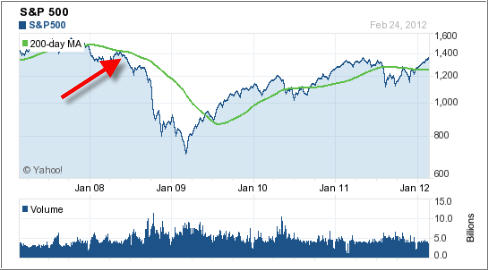
The S&P 500 added 0.2 percent, to close at 1,365.74 for the day. It’s up 0.3 percent on the week, holding just below its June 2008 high. While that sounds great as a news headline, the gains of the last few years have done nothing but erase the devastating losses of the 2008 market crash as the chart shows:
[Chart courtesy of YahooFinance]

Our Domestic Trend Tracking Index (TTI) signaled a ‘Sell’ on 6/23/08. Had you followed it and done nothing since, you’d be at same point as those investors who held their positions through stunning pullbacks and breathtaking rallies. Ah well, the benefit of hindsight…

The Domestic TTI ended the week on the bullish side of the trend line by +5.74%, while the International TTI rallied to +5.19%.

Yields on 10-year Treasury notes fell to a fresh weekly low of 1.98 percent as worries over rising oil prices impacting growth lingered.

The central bank purchased longer-term securities maturing between Feb. 2036 and August 2041 today, a move aimed at replacing $400 billion of shorter-term debt to cap future borrowing costs.

Crude prices hit a nine-month high with oil futures rising $1.94 to $109.77 a barrel on the New York Mercantile Exchange over saber rattling with Iran.

I am sure you’ve noticed the tremendous price change at the pump, however, rising energy prices is proving to be a boon for energy producers. Market Vectors Russia ETF (RSX), a Russia focused equity ETF with nearly 40 percent exposure to producers like Gazprom and Lukoil, rose 4.5 percent today (No holdings).

Also iShares MSCI Europe Financials Index Fund (EUFN) added an impressive 1.5 percent on the week (No holdings). The region’s stability in the near-midterm remains a worry though.

Have a great week.

Ulli…

————————————————————-

READER Q & A FOR THE WEEK

All Reader Q & A’s are listed at our web site!
Check it out at:

http://www.successful-investment.com/q&a.php

A note from reader Chris:

Q: Ulli: I have been tracking your system for a few months now.  I find it very intriguing, and recently started to invest in this manner, to lock in gains, and limit losses.

My question involves how you handle dividends.  I realize that you adjust your trailing stop based on the distribution, however, in your portfolios, do you take a cash distribution, or do you use dividend reinvestment?  How would you handle a new trailing stop with dividend reinvestment, if in fact you use that method?

Any advice would be greatly appreciated.

A: Chris: I always take a cash distribution, which I let accumulate and then, once the sum is meaningful, I re-invest. In taxable accounts, it eliminates tedious cost basis calculations of re-invested dividends.

———————————————————-

WOULD YOU LIKE TO HAVE YOUR INVESTMENTS PROFESSIONALLY MANAGED?

Do you have the time to follow our investment plans yourself? If you are a busy professional who would like to have his portfolio managed using our methodology, please contact me directly or get more details at:

https://theetfbully.com/personal-investment-management/

———————————————————

Back issues of the ETF/No Load Fund Tracker are available on the web at:

https://theetfbully.com/newsletter-archives/