April Jobs Data Disappoints; Time For Another Round Of QE?

Ulli Market Commentary Contact

The Friday US jobs numbers disappointed big time. Does this mean the Fed will initiate another round of Quantitative Easing?

According to Tom Porcelli, Chief US Economist at RBC Capital Markets, this job number alone is unlikely push the Fed to the edge. Ben Bernanke has made it clear that the Fed would prefer not to initiate another round of assets purchase, especially for an economy that’s not gaining momentum.

Post FOMC meeting, Bernanke had said he would expect the economy to add 150,000-200,000 jobs; a pretty modest range. After Friday’s release, the average comes to 135,000, failing to cross an already low barrier.

The manufacturing jobs came in at 16,000, lower than the estimated 22,000. However, manufacturing, which contributes 10 percent to the economy, is unlikely to slow down the recovery alone.

Read More

Taking Stock: PIMCO Does It Again! Now It’s A Global TIPS ETF

Ulli Bond ETFs Contact

The California-based Pacific Investment Management Company, the world’s biggest manager of bond mutual funds, has done it again. Barely two months after the launch of its first exchange traded fund (the Total Return ETF BOND) the fixed-income fund goliath has just launched its second offering. This time PIMCO will help investors protect their investments against inflation through its Global Advantage Inflation-Linked Bond Strategy Fund (ILB).

You should note, however, that this fund cannot and will not use derivative instruments such as forwards, futures, options and swaps to maximize returns, a strategy successfully employed by Bill Gross over the years for his MF products. The fund is an actively managed product that invests in high-quality inflation linked bonds covering both the emerging and the developed worlds.

The only drawback of this investment strategy is that you may have to accept a lower yield for protection against inflation. Since these are sovereign bonds backed by governments, there’s virtually no default risk (hard to believe when looking at Europe), which explains the comparatively lower return. If you are seeking higher returns, and are willing to accept greater risk, this may not be the ideal solution.

Read More

05-05-2012

Ulli Newsletter Archives Contact

The ETF/No Load Fund Tracker—Monthly Review—April 30, 2012

Major Market Indexes Pull Back Slightly

The broad markets closed lower in April for the first time in 2012, with only the Dow Jones Industrial Average gaining a negligible 0.01 percent for the month.

The S&P 500 Index ended 0.8 percent lower after four months of growth in a row while the tech-heavy NASDAQ Composite Index dropped 1.5 percent.

Economic data for the month remained mixed though corporate earnings by and large remained above the much lowered bar, with three-fourth of the S&P companies beating analysts’ expectations.

Weekly jobless claims stayed elevated for two consecutive weeks in a row at the end of April, suggesting the economy may be stagnating.

The first quarter GDP growth reading came in at a lousy 2.2 percent versus 3 percent in the final quarter of 2011. However, the Institute for Supply Management reading expanded unexpectedly in April, suggesting that manufacturing is on the recovery path.

US Commerce Department data showed consumer spending rose slower by 0.3 percent in March while personal income grew by 0.4 percent, improving the savings rate to 3.8 percent versus 3.7 percent in Feb. Consumer spending grew by 2.9 percent in the first quarter of 2012, marking the fastest growth in more than a year.

The Consumer Confidence Index for April slipped to 69.2 in April from 70.2 in the prior month. Inflation rose 0.2 percent in March, pushing the annual index down to 2.1 percent from 2.3 percent in February, if you can believe the official numbers.  Nevertheless, this was in line with the Fed’s target of 2 percent annual inflation rate till 2014.

However, don’t be surprised if the Fed decides to inject further liquidity by undertaking another round of quantitative easing after the current measures end in June. That possibility will definitely come into play, should the markets take a dive to the downside.

US Treasuries continued to rise as safe-haven assets demand grew over an uneven economic recovery. Yield on the benchmark 10-year notes dropped below 2 percent, reflecting concerns over European and global economic environment. 30-year yield also dropped marginally, indicating the Federal Reserve is unlikely to raise record-low interest rates in near future.

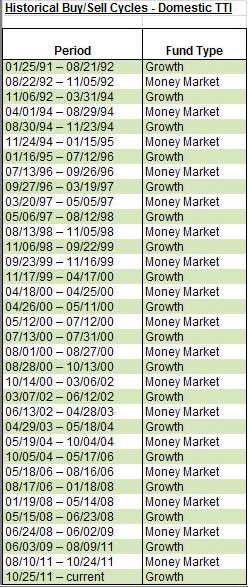
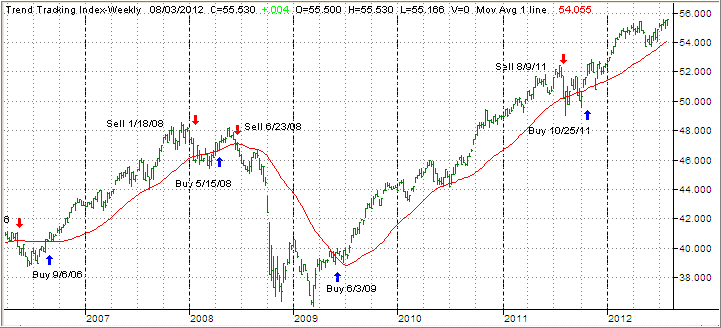
Our Domestic Trend Tracking Index (TTI) inched higher meaning that we’ve ventured deeper into bull market territory for the time being. Here’s the latest chart:

What has pushed the markets to these elevated levels YTD? It certainly has not come from the recent releases of economic data points. In my mind, the primary reason behind this upward momentum is the simple fact that the Fed has established a safety net via the various QE stimulus packages, such as we’ve seen over the past two years.

Wall Street bulls have been smoking “hopium” assuming that, should the markets head south sharply, the Fed will come to the rescue with another QE package and pull the indexes out of the doldrums. Despite the trillions of dollars spent, QE has done nothing to solve current economic woes, but it has supported stock prices. How long that can continue is anyone’s guess.

On the international front, Europe continues to rock the global recovery boat. The Dutch coalition government collapsed towards the end of the month following differences over further spending cuts.

The presidential elections in France added another dimension to the ongoing uncertainties as incumbent President Nicholas Sarkozy lost the first round to Socialist candidate Francois Hollande. There have been enough indications that Hollande is unlikely to continue with austerity measures and frustrate the present EU-wide effort of bringing more fiscal compliance in the eurozone. In other words, the eurozone agreement may very well unravel after the final elections on May 6th.

Adding to the uncertainty this weekend will be the Greek elections, which also can have dire consequences for those supporting the current eurozone circus.

Ratings agency Standard and Poor’s downgraded Spain after Madrid failed to stick to the 2012 budget-deficit target, raising fears that the Iberian nation may be the next country to seek a bailout. To me, it’s not a matter of if but when Spain will be looking for international assistance.

Since we are on the bullish side of the trend line (see chart above), I am predominantly sticking to my ETF Model portfolios #2 and #4, as they offer a good balance of equity vs. bond holdings during these uncertain times where a sudden unexpected event could derail global markets.

For added safety, I have set up my trailing sell stops for all holdings, which will get us out of the markets quickly and effectively, should the need arise.

05-04-2012

Ulli Newsletter Archives Contact

ETF/No Load Fund Tracker Newsletter For Friday, May 4, 2012

ETF/No Load Fund Tracker StatSheet

————————————————————-

THE LINK TO OUR CURRENT ETF/MUTUAL FUND STATSHEET IS:

https://theetfbully.com/2012/05/weekly-statsheet-for-the-etfno-load-fund-tracker-newsletter-updated-through-05032012/

————————————————————

Market Commentary

Friday, May 4, 2012

US EQUITIES SLUMP ON WEAK JOB DATA; VXX SOARS, USO SINKS

A market selloff sent the S&P 500 and the NASDAQ Composite to their lowest level in 2012 today after the US Labor Department report showed employers added fewer jobs in April than estimated.

Markets were further spooked over the upcoming French elections on Sunday, where incumbent president Nicholas Sarkozy faces tough challenge from socialist challenger Francois Hollande.

Treasuries advanced, hitting a fresh three-month high amid speculations that the US Fed would intervene to kick-start a slowing economy. Government debt ended on a high for the seventh week in a row, the longest stretch since 2008.

The Dow Jones Industrial Average (DJIA) dropped 1.3 percent, lower by 1.4 percent for the week. Political uncertainty in Europe added to the market frenzy as Greece goes to polls this weekend. All the 30 components of Dow closed lower for the day.

The S&P 500 Index (SPX) lost to end at 1369.10 with only utilities gaining while energy dropped the most among its 10 business groups. The NASDAQ Composite Index (COMP) sank 2.3 percent, its biggest single-day loss since end November. Apple Inc (AAPL) lost 6.3 percent for the week, while social-networking site LinkedIn Corp. (LNKD) soared 7.2 percent on the day in a negative market after the firm upgraded its forecast for the year.

Yield on 10-year benchmark Treasuries gave back 0.06 percentage points to 1.87 percent, the lowest level early February. 30-year bond yield slipped 0.04 percentage points to 3.07 percent, after the initial jobs report showed US employers added only 115,000 jobs in April against a median forecast of 160,000 by economists at Bloomberg.

ETFs in the news:

During a day when the markets witnessed the biggest fall, the volatility tracking ETF, the S&P 500 VIX Short-Term Futures ETN (VXX) naturally soared.  VXX had a tough year thus far as all the benchmarks performed well this year. This ETF will be an interesting watch in the coming months, if today’s jobs report is any indication of things to come.

Lower jobs data drove the crude futures down on NYMEX by 4 percent, pushing oil related ETFs down. The day’s biggest loser was the United States Oil Fund (USO), losing 3.97 percent. USO witnessed a massive selloff, with the number of shares changing hands at 20 million, 3.5 times its daily average.

Other oil linked funds like the Invesco PowerShares DB Oil Fund (DBO) were also hit, shedding 4.03 percent for the day. Oil’s weakness affected other energy linked equity ETFs with the Vanguard Energy ETF (VDE) also closing down for the week and a loss of 2.20 percent on the day.

Our Trend Tracking Indexes (TTIs) headed south as well, but both remain above the line and in bullish territory, although the international TTI showed the most weakness. Here are this week’s closing numbers:

Domestic TTI: +3.99% (last week +5.38%)

International TTI: +1.53% (last week +4.00%)

Have a great week.

Ulli…

Disclosure: No holdings

————————————————————-

READER Q & A FOR THE WEEK

All Reader Q & A’s are listed at our web site!
Check it out at:

http://www.successful-investment.com/q&a.php

A note from reader May:

Q: Ulli: How far out do you anticipate a sell signal will be given for Domestic Equity Funds?

A: May: There is no way to anticipate the timing of a potential sell signal. It happens when the price line of the domestic TTI crosses its long term trend line to the downside.

However, before that happens, we will have been stopped out already via my recommended trailing sell stop discipline.

———————————————————-

WOULD YOU LIKE TO HAVE YOUR INVESTMENTS PROFESSIONALLY MANAGED?

Do you have the time to follow our investment plans yourself? If you are a busy professional who would like to have his portfolio managed using our methodology, please contact me directly or get more details at:

https://theetfbully.com/personal-investment-management/

———————————————————

Back issues of the ETF/No Load Fund Tracker are available on the web at:

https://theetfbully.com/newsletter-archives/

ETF/No Load Fund Tracker Newsletter For Friday, May 4, 2012

Ulli ETF Tracker Contact

ETF/No Load Fund Tracker StatSheet

————————————————————-

THE LINK TO OUR CURRENT ETF/MUTUAL FUND STATSHEET IS:

https://theetfbully.com/2012/05/weekly-statsheet-for-the-etfno-load-fund-tracker-newsletter-updated-through-05032012/

————————————————————

Market Commentary

Friday, May 4, 2012

US EQUITIES SLUMP ON WEAK JOB DATA; VXX SOARS, USO SINKS

A market selloff sent the S&P 500 and the NASDAQ Composite to their lowest level in 2012 today after the US Labor Department report showed employers added fewer jobs in April than estimated.

Markets were further spooked over the upcoming French elections on Sunday, where incumbent president Nicholas Sarkozy faces tough challenge from socialist challenger Francois Hollande.

Treasuries advanced, hitting a fresh three-month high amid speculations that the US Fed would intervene to kick-start a slowing economy. Government debt ended on a high for the seventh week in a row, the longest stretch since 2008.

The Dow Jones Industrial Average (DJIA) dropped 1.3 percent, lower by 1.4 percent for the week. Political uncertainty in Europe added to the market frenzy as Greece goes to polls this weekend. All the 30 components of Dow closed lower for the day.

Read More

Weekly StatSheet For The ETF/No Load Fund Tracker Newsletter – Updated Through 05/03/2012

Ulli ETF StatSheet Contact

ETF/Mutual Fund Data updated through Thursday, May 3, 2012

If you are not familiar with some of the terminology used, please see the Glossary of Terms.


1. DOMESTIC EQUITY MUTUAL FUNDS/ETFs: BUY — since 10/25/2011

The domestic TTI broke through its long-term trend line generating a Sell for this area effective 8/9/2011. Over the recent past, we’ve seen the TTI hovering slightly below and above this dividing line between bullish and bearish territory. The clear break to the upside occurred on 10/24/11 and, effective 10/25/11, a new Buy signal for domestic equities went into effect.

As of today, our Trend Tracking Index (TTI—green line in above chart) has broken above its long term trend line (red) by +4.73%. Be sure to tune into my blog for the latest updates.

Read More