US Stocks Inch Up On Europe, Housing Data; DBA Pops, VIXY Slips

Ulli Market Commentary Contact

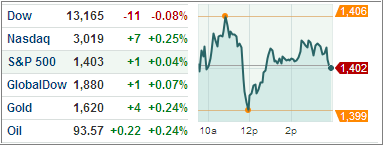
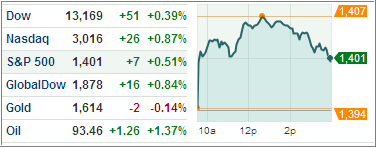
[Chart courtesy of MarketWatch.com]

US stocks finished higher Tuesday as investors turned slightly bullish on signs of improvement in the housing market, although clouds continue to hang over the markets ahead of the EU summit meeting scheduled for Thursday and Friday this week.

Treasuries retreated as risk sentiments improved over speculation that European leaders were progressing over resolving the ongoing sovereign crisis. US Treasury notes pushed ahead, recovering from the day’s lowest level after German Chancellor disapproved proposals for Eurobonds which requires shared responsibility of the region’s liabilities.

The Dow Jones Industrial Average (DJIA) climbed 0.3 percent, after rising more than 74 points and sinking more than 50 points as the indexes turned choppy during the day’s trade. 18 among the Dow’s 30 components closed the day higher.

Read More

Equities Slide Ahead Of Key Brussels Meeting; EGPT Soars, GREK Sinks

Ulli Market Review Contact

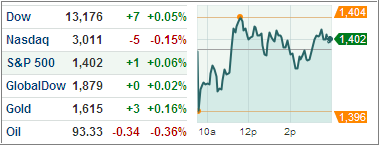
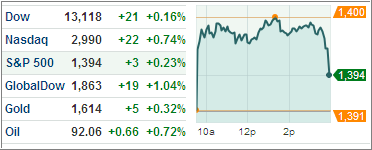
As investors became worried ahead of a key meeting this week in Brussels (rightfully so), and after reports of Greek Finance Minister resigning on health grounds just four days into his job hit the wires, US equities plummeted more than one percent Monday.

Moods were soured further after Cyprus became the fifth nation in the single-currency union to seek money from the region’s lifeboat funds to prop up its struggling banks, citing massive losses from Greek debts.

US Treasuries advanced over news that German Chancellor Angela Markel has turned down proposals for joint euro-area wide bonds and deposit insurance schemes, terming them incorrect and counterproductive. Ms. Merkel argued in favor of a political union and called for stronger oversight mechanism instead, pouring cold water on Spain, Italy and France’s for an early solution to reign-in spiraling borrowing costs.

Read More

ETFs/Mutual Funds On The Cutline – Updated Through 6/22/2012

Ulli ETFs on the Cutline Contact

Below are the latest ETF Cutline reports, which show how far above or below their respective long-term trend lines (39 week SMA) my currently tracked ETFs/MFs are positioned.

The first report covers the ETF Master List from Thursday’s StatSheet and includes 398 ETFs, of which currently 202 (last week 219) of them are hovering in bullish territory.

The second report includes only High Volume ETFs. To clarify, High Volume (HV) ETFs are defined as those with an average daily volume of $10 million or higher.

These ETFs are generated from my selected list of some 93 that I use in my advisor practice. It cuts out the “noise,” which simply means it eliminates those ETFs that I would never buy because of their volume limitations. 34 ETFs (last week 36) have managed to remain in bullish territory after the recent market volatility.

The third report covers Mutual Funds on the Cutline. There are currently 494 (last week 551) above the line and 367 below it out of the 861 that I follow.

Take a look:

1. ETF Master Cutline Report

2. ETF High Volume Cutline Report

3. MF Cutline Report

In case you are not familiar with some of the terminology used in the reports, please read the Glossary of Terms.

Last Week In Review: ETF News And Blog Posts To 6/24/2012

Ulli Market Review Contact

In case you missed it, here’s a summary of the ETF topics and market reviews I posted to my blog during the week ending on 6/24/2012.

Some reality set in as the Fed disappointed the markets by not providing a freshly spiked punchbowl causing the major indexes to slip sharply on Thursday. The damage for the week, however, was only minor as the bulls had shoved the S&P 500 higher leading up to the Fed announcement.

Continued weak domestic economic data, combined with the ever worsening European debt crisis, will make it difficult for the markets to find some solid footing but, as we’ve seen in the past, a few well placed rumors will get the bulls stampeding.

I have doubts if any rebounds will have staying power, as the Eurotanic will take center stage in the weeks and months to come.

This week, we covered the following:

Read More

Europe Needs Central Fiscal Structure: Michael Spence

Ulli Europe Contact

Michael Spence, professor of economics at New York University’s Stern School of Business thinks the risks in Europe needs socialization in the short-term. The Eurozone is going to stand or fall depending on the reforms they undertake in Spain or Italy.

Unfortunately, those reforms will take time to show the results. Borrowing costs however remain the dominant problem right now and to bring the sovereign yields of Spain and Italy down, the intervention of core European institutions and the IMF are required as the reforms are initiated. In order to do that, they would need to keep buying peripheral bonds, which involves socializing the risks involved.

The Federal Reserve’s latest move to extend the Operation Twist through the end of the current year had barely any impact on the markets; it was a non event which basically suggests that central banks are running out of monetary tools that can offer solutions.

Read More

New ETFs On The Block: Global X Permanent ETF (PERM)—Will It Replace PRPFX?

Ulli ETF News Contact

The Global X Permanent ETF (PERM), launched by the New York based fund issuer offers investors exposure to a number of core asset classes. The ETF replicates the Solactive Permanent Index, a benchmark comprised of three major core asset classes; stocks, Treasuries & bonds, and precious metals, thus diversifying holdings for all market conditions.

Each of the categories is further diversified to minimize downside risks. Stocks include both domestic and international sectors, Treasuries portfolio is equally split between long-term bonds and short-term bonds and notes while precious metals seek to invest in both gold and silver.

The diversified portfolio is designed to perform regardless of four broadly classified economic conditions including: increasing growth, decreasing growth, increasing inflation and decreasing inflation based on the “permanent” investment strategy made famous by Harry Browne in his 1998 book Fail-safe Investing.  The book assumes that the economy is always in one of four states: prosperity, inflation, recession and depression. The portfolio doesn’t attempt to forecast economic growth or inflation. Rather it seeks to benefit from low volatility while generating moderate returns.

Read More