7 ETF Model Portfolios You Can Use – Updated through 9/4/2012

Ulli Model ETF Portfolios Contact

Again, tight range riding in the S&P 500 prevailed this past week with the index dropping a scant 4 points.

It’s simply amazing to watch that any sell off, which pulls the indexes off their highs by a meager 0.5%, is met with buying as hope prevails that the Fed will always come to the rescue by throwing an assist should bearish forces gain the upper hand.

Bernanke’s speech came and went and, while leaving some disappointment it was not enough to cause markets to retreat. Why? Because there is another Fed meeting lurking around the corner next week, and maybe, just maybe, we will see the mother of all bazookas finally revealed.

The same game is being played in the European circus where the ECBs main attraction in form of Mario Draghi is now supposed to reveal the big gun he had bragged about, which has contributed to an elevated market for a few weeks now. We’ll soon find out if it’s the real thing or if it turns out that all he’s got is a water pistol—and empty one at that.

In the meantime, here’s the latest ETF model portfolio update:

Read More

08-05-2012

Ulli Newsletter Archives Contact

The ETF/No Load Fund Tracker—Monthly Review—August 31, 2012

Europe Still Wavering; In Search Of Direction From Central Banks

US equity ETFs ended higher despite a quiet and boring August with all three leading indexes gaining for the month.

Not surprising, the QE addicted crowd was left a little disappointed on the last trading day of the month, as Fed Chairman Ben Bernanke skipped any explicit mention of QE3 at the annual economic symposium in Jackson Hole, even though he sounded dovish and said the economy failed to add net new jobs since January and labor market stagnation remained a “grave concern.”

He, however, pointed out that “nontraditional policies” may be explored if the situation warrants, hinting at future Fed intervention if the economy fails to fire.

The Dow Jones Industrial Average (DJIA) finished the month 0.6 percent higher while the S&P 500 (SPX) added 2 percent for August.

Meanwhile, the US economy continued to churn out mixed data, as the August consumer confidence reading came in at 60.6, the lowest in nine months.

European stocks rallied on the month’s final session with the pan-European Stoxx Europe 600 index finishing August 1.9 percent higher even though the unemployment rate hit rate an all-time high of 11.3 percent while inflation paced to 2.6 percent from 2.4 percent in the prior month.

The rally was supported by media reports that quoted Governing Council member Benoit Coeure stating the ECB is working on a way to intervene in the bond market, particularly in the short-maturity segment. Sure, that sounds like another attempt to mask the real problem of solvency by providing more liquidity.

Meanwhile, Germany showed signs of a slowdown in August with unemployment rising. Markets were rattled on Thursday, August 30 after Slovak Prime Minister Robert Fico said chances of the euro breaking up are 50:50.

In a related development, German chancellor Angela Merkel supported Greece’s continuation in the currency union but strongly disapproved of leveraging the region’s emergency lending fund, the European Stability Mechanism, for buying Spanish and Italian bonds from the primary markets to bring borrowing costs down, contending such measures would violate the Maastricht Treaty.

She, however, backed ECB President Mario Draghi’s plan to intervene in the secondary bond market even though media reports suggested German Bundesbank chief Jens Weidmann considered resigning several times due to his opposition to Draghi’s plan. Draghi had favored “exceptional measures” in an article in the German newspaper Die Zeit citing price stability. Weidmann said decisions to fund governments by printing money should be taken up by parliaments instead of central banks and warned such measures may prove addictive “like a drug” for profligate states.

As far as the major domestic trend is concerned, our Domestic Trend Tracking Index (TTI) closed out the month hovering +3.06% above its long term trend line, as the chart below shows:
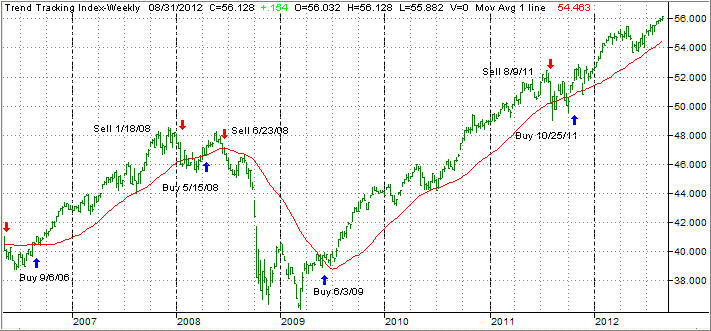
That means we remain clearly on the bullish side, and I have added some more exposure for new accounts to the conservative and dividend yielding ETF DVY (current yield is 3.4%), which has proven itself this year to add some stability to our portfolios as opposed to the Total Stock Market Index (VTI), which we had very limited holdings in.

With markets reacting no longer to bad or good news, but only to rumors as to what the Fed will do next, less volatile holdings are the way to go, especially in view of the fact that the economies not only in Europe but globally as well are worsening by the week.

With all eyes being focused on the Fed, or in Europe’s case on the latest word from the ECB, trends can easily reverse all of a sudden if one of these central planners disappoints or surprises.

This happened on the international side, as our International Trend Tracking Index (TTI) confirms:
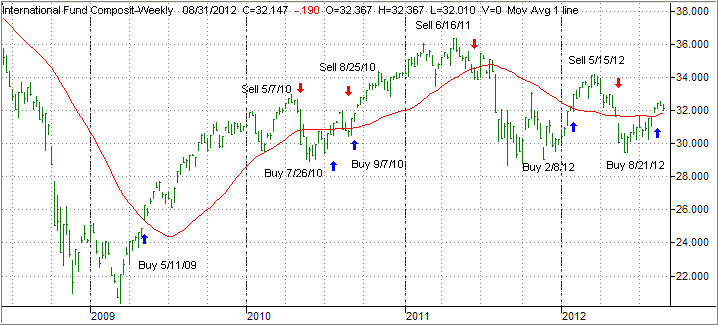
Our latest Buy signal lasted from 2/8/12 until 5/15/12; then a reversal kicked in and a new ‘Buy’ was generated on 8/21/12. It is clear that short-term signals like these confirm the uncertainty in the rest of the world, which is why I sidestepped this one so far.

Remember, with Europe slowly falling apart, the United States is still the cleanest shirt in the global dirty laundry basket, which means, when things go bad, capital flight at this point will be into the U.S. supporting bond holdings and to some degree equities.

How long that will last is anyone’s guess. With politicians and central banks on both sides of the Atlantic being convinced that the underlying problem of too much debt can be resolved by issuing more debt, it’s only a matter of time until unforeseen consequences will affect market forces.

The timing of it is the big unknown, but I believe that there is a limit to the fine art of can kicking, so we are prepared to liquidate, should all of sudden the trend reverse so that we make it through the exit doors before they become too crowded.

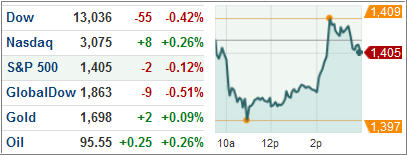
US Indexes Trim Losses While Europe Tumbles Ahead Of ECB Meeting

Ulli Market Commentary Contact

[Chart courtesy of MarketWatch.com]

US equity indexes started September on a weak note as investors’ concern that the economy was slowing over weak manufacturing data was somewhat tempered by hopes the European Central Bank will intervene to tame the continent’s debt crisis. Here we go again. We will find out soon if Mario Draghi’s promise to deliver a European solution actually has meaning.

The US ISM manufacturing index dropped to 49.6 in August from 49.8 a month earlier, falling short of economists’ forecast of 50. A separate report over the weekend showed China’s manufacturing shrank the fastest in August since March 2009, stoking fears of another global slowdown.

The Dow Jones Industrial Average (DJIA) closed 55 points lower, after sinking as much as 114 points earlier. Decliners outnumbered gainers 19-to-11 as breadth within the 30-stock blue-chip index turned negative.

Read More

ETFs/Mutual Funds On The Cutline – Updated Through 8/31/2012

Ulli ETFs on the Cutline Contact

Below are the latest ETF Cutline reports, which show how far above or below their respective long-term trend lines (39 week SMA) my currently tracked ETFs/MFs are positioned.

The first report covers the ETF Master List from Thursday’s StatSheet and includes 398 ETFs, of which currently 317 (last week 330) of them are hovering in bullish territory.

The second report includes only High Volume ETFs. To clarify, High Volume (HV) ETFs are defined as those with an average daily volume of $10 million or higher.

These ETFs are generated from my selected list of some 93 that I use in my advisor practice. It cuts out the “noise,” which simply means it eliminates those ETFs that I would never buy because of their volume limitations. 64 ETFs (last week 67) have managed to remain in bullish territory after the recent market volatility.

The third report covers Mutual Funds on the Cutline. There are currently 781 (last week 788) above the line and 80 below it out of the 861 that I follow.

Take a look:

1. ETF Master Cutline Report

2. ETF High Volume Cutline Report

3. MF Cutline Report

In case you are not familiar with some of the terminology used in the reports, please read the Glossary of Terms.

Last Week In Review: ETF News And Blog Posts To 9/2/2012

Ulli Market Review Contact

In case you missed it, here’s a summary of the ETF topics and market reviews I posted to my blog during the week ending on 9/2/2012.

The big speech from Bernanke at J-Hole came and went and, as I suspected, no earth shattering announcement was made other than the usual jawboning that “we stand ready to act…, etc.”

Amazingly enough, the markets have become so totally dependent on what the Fed might or might not do that the mere uttering of potential QE still being a possibility is apparently enough to put a floor under any dramatic 0.5% pullback of the major indexes.

How great is that?

The Fed no longer needs to actually act but only offer the possibility that they might, and the QE addicted crowd happily pushes the major indexes higher? As if there were no longer fundamentals to consider or negative news events to be acted upon; nothing seems to matter; only Bernanke’s word is the gospel which determines market direction.

A pretty sad state of affairs, which will work until the day it doesn’t when unintended consequences make an appearance all of a sudden and rock the boat in a big way.

Over past week, we covered the following:

Read More

Should Bernanke Maintain The Status Quo?

Ulli Market Review Contact

The sluggishness in the jobs market is neither a fiscal responsibility nor a monetary responsibility of the Federal Reserve, rather it’s about responsibility in the short run versus responsibility in the long run, says Edward Lazear, former economic adviser to President George W. Bush and a professor at the Stanford University.

The best policies to grow jobs are not the ones that are going to work in the next month or two, he noted, adding earlier measures (like quantitative easing) to grow jobs have not been particularly effective. In order to grow job, the economy needs to get back on the growth path as there’s nothing special about the job market right now.

The problem is that the recovery has not been strong enough and if we look at past data, growth has been about 2.2 percent annually since the economy came out of recession in the spring of 2009, he said. Looking at the number of jobs created since then, it becomes clear that the job market has done reasonably well, and we are close to historical averages. It’s not that jobs are not growing or the labor market is stuck, but the real problem is that the economy is stuck.

Read More