Weekly StatSheet For The ETF/No Load Fund Tracker Newsletter – Updated Through 02/07/2013

Ulli ETF StatSheet Contact

ETF/Mutual Fund Data updated through Thursday, February 7, 2013

Table of Content082312

If you are not familiar with some of the terminology used, please see the Glossary of Terms.


1. DOMESTIC EQUITY MUTUAL FUNDS/ETFs: BUY — since 10/25/2011

TTI

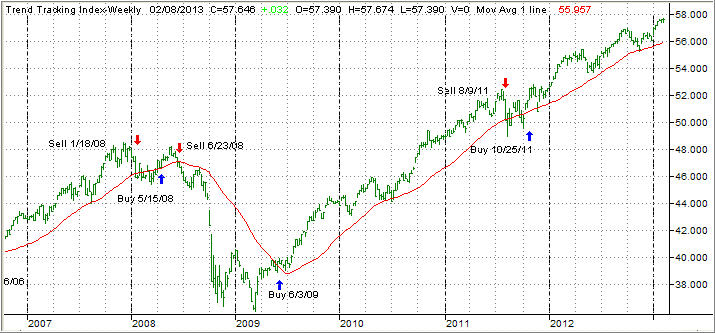
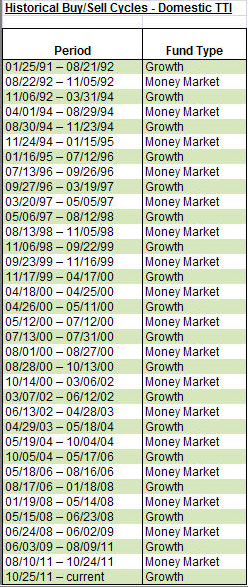
The domestic TTI broke through its long-term trend line generating a Sell for this area effective 8/9/2011. Over the recent past, we’ve seen the TTI hovering slightly below and above this dividing line between bullish and bearish territory. The clear break to the upside occurred on 10/24/11 and, effective 10/25/11, a new Buy signal for domestic equities went into effect.

As of today, our Trend Tracking Index (TTI—green line in above chart) has bounced off its long term trend line (red) by +3.16% as part of the post election rebound.

To avoid a potential whip-saw, a Sell signal to move out of all domestic equity positions will be generated once we have clearly pierced the line to the downside. Be sure to tune into my blog for the latest updates.

Read More

Stock Indexes Lose Steam; Europe Drifts Lower On Draghi

Ulli Market Commentary Contact

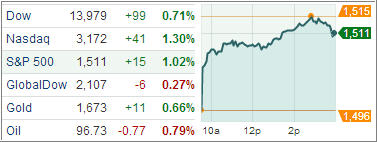
Thur pic

[Chart courtesy of MarketWatch.com]

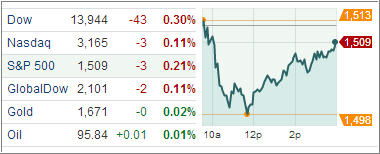
After a two-day advance, US stock indexes drifted lower today as investors lost risk appetite following the release of mixed economic reports, and European policy makers warned a strong euro could hamper the region’s recovery.

On the economic front, applications for weekly jobless benefits dropped to 366,000, down 5,000 from the previous week but above forecasts, Labor Department figures showed. Economists surveyed by Bloomberg had forecast 366,000 claims.

Meanwhile, the nation’s productivity, a measure of employee output per hour, dropped at an annualized two percent in the final quarter of 2012, said the Bureau of Labor Statistics. Following a 3.2 percent gain in the prior three months, that was the worst performance in almost two years.

In addition to economic data, investors sifted through comments from Chicago Fed President Charles Evans who said the Fed’s policies have already done a lot of good and he’s optimistic the economy will allegedly improve soon.

Read More

Index ETFs Rise On Earnings; Europe Slips On Italian Austerity Worries

Ulli Uncategorized Contact

Wed pic

[Chart courtesy of MarketWatch.com]

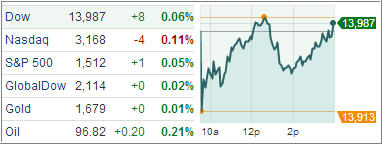
US indexes finished slightly higher Wednesday, recouping early losses as better-than-forecast earnings eclipsed concerns over Europe’s debt crisis ahead of tomorrow’s European Central Bank meeting in Frankfurt.

Equities had slumped earlier amid concerns Europe’s debt crisis may get worse. An opinion poll in Italy showed former Premier Silvio Berlusconi’s anti-austerity campaign has boosted his popularity before this month’s general elections. Berlusconi’s proposals go completely against the policies implemented by the current technocrat Prime Minister Mario Monti, who has accused Berlusconi of trying to buy votes.

Meanwhile, European Central Bank officials are set to meet Thursday while euro-area leaders will gather for a summit in Brussels amid widespread concerns over a rising currency. Greek finance minister Yannis Stournaras today expressed concern over the recent gain in strength of the euro. French President Francois Hollande had voiced concern about the currency’s rapid appreciation yesterday.

Read More

7 ETF Model Portfolios You Can Use – Updated through 2/5/2013

Ulli Model ETF Portfolios Contact

Sitting above and trying to hold on to the 1,500 S&P level was the theme of the past week, as the benchmark index managed to add 3 points since last week’s ETF Model Portfolio was published.

Although that’s not the entire story as the S&P dropped 17 points on Monday only to regain 15 of them back on Tuesday. Maybe some volatility is creeping in at these lofty levels.

With equities having been all the rage this year due to the continued Fed pump fest, it’s not surprising that our bond portfolio is lagging. However, this has only been one month and as equities inch higher, the case for a serious correction becomes much more likely, which should help our bond positions.

Again, some analysts see the old S&P high of some 1,575 taken out before the indexes head down sharply. Since no one really knows, we’ll let our sell stops be our guide as to when to exit any of the current holdings.

Here’s the latest update for our Model ETF Portfolios:

Read More

Equities Rally On Buyout Hopes; Europe Bounces Back On Data

Ulli Market Commentary Contact

Tue pic

[Chart courtesy of MarketWatch.com]

US stocks rebounded Tuesday to recoup much of the previous day’s biggest loss of the year for benchmark indexes as investors found confidence in robust corporate earnings and PC-maker Dell Inc’s decision to go private in the biggest leveraged buyout deal since the financial crisis.

Shares found some support in today’s economic data. The Institute for Supply Management’s index of US non-manufacturing businesses, which covers about 90 percent of the economy, dropped to 55.2 in January from 55.7 in the prior month. Any reading above 50 indicates expansion and, when considered in combination with last week’s better-than-expected manufacturing report, it becomes evident that the private-sector is holding up OK despite the turbulence in the public sector.

Separately, a CoreLogic report showed US home prices rose 0.4 percent in December, bringing the yearly gain to 8.3 percent and marking its biggest rise since May 2006.

Read More

02-05-2013

Ulli Newsletter Archives Contact

Buy-Sell Cycles

The ETF/No Load Fund Tracker—Monthly Review—January 31, 2013

Equities End January With A Bang; Europe Rise On US Economic Data

US equity averages saw broad gains as December’s last-minute budget deal, to avoid the so-called fiscal cliff, and a wave of economic numbers in January ensured more money flowed into equity funds than bond funds for the first time since 2007.

The benchmark S&P 500 jumped 5 percent for the month, hitting its highest level since December 2007 and marking its best January since 1997 when it added 6.1 percent. The benchmark index finished with a gain in 13 out of 21 sessions for the month.

Of course, let’s not forget that the main driver for this parabolic rise was not the underlying economy but merely the reckless money creation by the Fed at the tune of $85 billion a month. At that rate, it‘s only logical that some of that money finds its way into the stock market.

As we saw, much of the economic data released during the month came up short. Five out of seven January reports fell short of expectations.

Employment, the most crucial indicator on the economy’s health, remained a sticky issue. The economy added a modest 157,000 jobs in January, falling short of the 170,000 forecast by analysts, while the unemployment rate ticked up 0.1 percent to 7.9 percent. The hiring pace in January showed businesses are somewhat cautious about taking on new employees amid a weak growth outlook, a hike in US taxes and the continued budget wrangling in Washington over the crucial debt-ceiling issue.

But more importantly, the rise in the unemployment rate means the Federal Reserve is unlikely to curb its bond buying program any time soon. Also interest rates are likely to be held at ultra-low levels until the jobless rate falls to the Fed’s stated target of 6.5 percent. Consumer spending accounts for 70 percent of the US economy, and the Fed wants to make it easier for people to buy homes, cars and other big-ticket items.

In other words, while more fuel to continue the rally is being generated, it’s questionable in my mind, how long this disconnect between stock market levels and economic fundamentals can continue. Sooner or later, this difference will matter and either the economy picks up steam enough to justify the recent rally or the market indexes come back down to align with reality.

Our main directional gauge, the Domestic Trend Tracking Index (TTI), headed higher and is now positioned as follows:
TTI

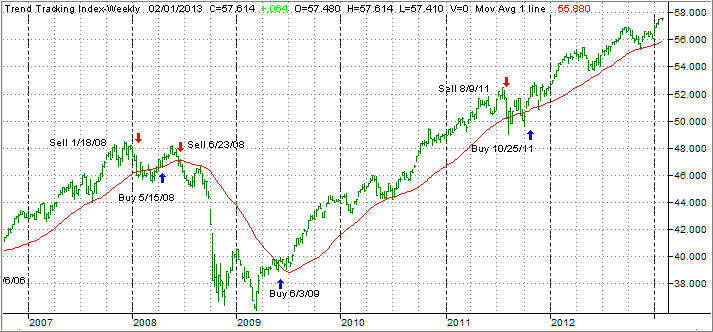
As of last Friday, the TTI (green line) had rallied above its long term trend line (red) by +3.10% indicating a strong bullish position.

With the market indexes and our TTI being at multiyear highs, my preference remains to be balanced in our approach and not be recklessly exposed to equities only. While equity only exposure can have its rewards, it is a risky proposition given the fact that the only reason we are in nosebleed territory is due to monetary stimulation by the Fed.

I have mentioned it before, but it’s worthwhile repeating. None other than the NY Fed itself stated last December that the S&P 500 should be trading at a level of 700 (current level is 1,500) were it not for the variety of stimulus programs enacted over the past few years.

During this past month, I increased our holdings in Real Estate Trusts (VNQ) and Consumer Staples (XLP), both of which have performed well in the past but have also held up fairly well during market pullbacks.

The same applies to the Dow Jones Dividend Index (DVY), which was also added again to our current menu. Rounding out our exposure were additional bond purchases in BOND and PONDX.

We are now having primarily balanced portfolios with bonds providing a temporary buffer against equity declines; of course, our trailing sell stops will be our ultimate risk protection as I believe that continued market manipulation by the Fed will have unintended consequences with the big one being a sharp hit to equities and eventually to bonds.

However, as long as the rally goes on, we will participate, but I am well aware that there is a limit to this euphoria, and I am prepared to exit should the need arise.