Nothing To Slow It Down; Bulls Push Dow Above 15,000

Ulli Market Commentary Contact

Tue pic

[Chart courtesy of MarketWatch.com]

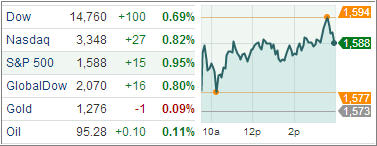
Stocks continued their winning streak Tuesday as the Nasdaq and the Standard & Poor’s 500 Index logged their 11th up day in the past 13 sessions. The blue chip Dow Jones industrial average rose 0.6% (87 points) to 15,056, closing above the 15,000 mark for the first time ever, the S&P 500 Index increased 8 points (0.5%) to 1,626, notching its own record close, and the Nasdaq Composite gained 4 points (0.1%) to 3,397.

Among the seven industry groups within the transportation sector, air freight and shipping did best. The Dow Jones transportation average led with a 1.6% gain. Volume grew on both major exchanges vs. Monday’s trade. 630 million shares were traded on the NYSE, and 1.7 billion shares changed hands on the Nasdaq.

Similar to yesterday, with the absence of notable economic data, earnings shaped the early price action followed by a surprising rate cut from the Reserve Bank of Australia (RBA). The central bank cut its benchmark interest rate by 25 bps to a record low of 2.75%, noting that it has decided to use some of the scope that the inflation outlook has afforded to ease further. The Bank of England will probably leave its stimulus program on hold this week amid signs the economy has found a firmer footing. Moreover, an unexpected jump in March German factory orders gave global stocks a boost to set the tone for trading today.

Read More

SPY Closes At Record Again On Lack Of Positive News

Ulli Market Commentary Contact

Mon pic

[Chart courtesy of MarketWatch.com]

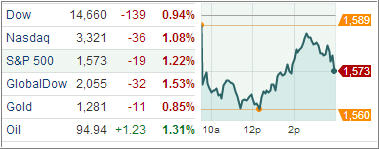
The Standard & Poor’s 500 Index extended its record level on Monday to kick-off the week. Stocks traded in a tight range and ended mixed but the Nasdaq outperformed again, thanks to another strong showing from Apple.

During the session, the S&P 500 also reached an all-time intraday high of 1,619.77. In moderate volume which came in about 13% lower than Friday’s levels, 612 million shares were traded on the NYSE, and 1.5 billion shares changed hands on the Nasdaq.

Financial stocks rallied the most out of 10 S&P 500 groups, as Bank of America Corp. climbed 5.2 percent. Cliffs Natural Resources Inc. added 5.5 percent after being raised to outperform from market perform by FBR Capital Markets. Humana Inc. (HUM) added 2.1 percent as its rating was boosted by JPMorgan Chase. Bank of America announced it would settle claims with MBIA for $1.6 billion, lifting shares of both companies.

Read More

ETFs/Mutual Funds On The Cutline – Updated Through 5/3/2013

Ulli ETFs on the Cutline Contact

Below are the latest ETF Cutline reports, which show how far above or below their respective long-term trend lines (39 week SMA) my currently tracked ETFs/MFs are positioned.

The first report covers the ETF Master List from Thursday’s StatSheet and includes 398 ETFs, of which currently 354 (last week 343) of them are hovering in bullish territory.

The second report includes only High Volume ETFs. To clarify, High Volume (HV) ETFs are defined as those with an average daily volume of $10 million or higher.

These ETFs are generated from my selected list of some 93 that I use in my advisor practice. It cuts out the “noise,” which simply means it eliminates those ETFs that I would never buy because of their volume limitations. 73 ETFs (last week 67) have managed to remain in bullish territory after the recent market volatility.

The third report covers Mutual Funds on the Cutline. There are currently 824 (last week 809) above the line and 35 below it out of the 859 that I follow.

Take a look:

1. ETF Master Cutline Report

2. ETF High Volume Cutline Report

3. MF Cutline Report

In case you are not familiar with some of the terminology used in the reports, please read the Glossary of Terms.

05-05-2013

Ulli Newsletter Archives Contact

Buy-Sell Cycles          The ETF/No Load Fund Tracker

Monthly Review—April 30, 2013

US Equities Extend Gains In April; Europe Hums Along

US stocks finished April higher with the S&P 500 index posting its longest monthly winning streak since September 2009, as markets cheered corporate earnings and the Fed’s continuing monetary stimulus.

Analysts believe the bull market, which entered a fifth year in March, has mostly been driven by strong corporate earnings and three rounds of quantitative easing by the Federal Reserve. I, however, remain skeptical and wonder what will be the catalyst for the bull’s next leg up if all the quantitative easing could get only 2 percent annualized GDP growth at best with major companies falling short of revenue targets?

The S&P 500 added 3.96 points on the last trading day of the month, tallying its April gains to 1.8 percent and marking its longest winning run since a seven-month stretch that ended in September 2009. The benchmark index is up more than 13 percent for the year. The Dow Jones Industrial Average also added 1.8 percent for the month while the tech-laden NASDAQ Composite Index climbed 1.9 percent in April.

Economic data for April continued to be mixed. The Chicago-area manufacturing PMI slumped to 49.0 in April from 52.4 in March, its worst level in more than three years. On the upside, the S&P Case-Shiller home-price index climbed 0.3 percent in February, capping annual gains at 9.3 percent. The consumer confidence index surged to 68.1 in April from an upwardly revised 61.9 in March. Consumer confidence had nosedived in March in part because of the so-called sequester that requires billions of dollars in government spending cuts.

An advance report showed first-quarter GDP rose at an annualized 2.5 percent pace, up from the 0.4 percent gain in the final quarter of last year. However, things may change significantly during the second quarter, and the economy may experience a pullback as consumption and inventory growth slows down. Government spending, which slipped 4.1 percent in the first quarter, is set to fall by a larger amount in the second quarter as the effects of sequestration become more pronounced.

The all-important jobs market continues to vacillate though unemployment rate is showing signs of improvement. Non-farm payrolls increased unexpectedly by 165,000 last month, after an upwardly revised 138,000 gain in March. The unemployment rate fell to 7.5 percent in April from 7.6 percent the prior month, the lowest level since December 2008.

However, a deeper look reveals some not-so-encouraging facts. Total hours worked failed sharply in April while US workers actually earned less than the month before. Employers cut everyone’s hours by 12 minutes on an average. Spread over a 135-million strong workforce, that is equivalent to firing more than 500,000 workers while keeping hours steady.

European exchanges tracked US equities in April though economic data from the region showed further deterioration, though political uncertainty receded somewhat. Eurozone unemployment rate climbed to a record 12.1 percent in March while economic confidence in the currency bloc fell more than expected in April. The European Commission said a gauge of consumer and business sentiment slipped to 88.6 from a revised 90.1 in March.

With all that uncertainty, our increased exposure in low volatility ETFs turned out to be the right move. Our investments in consumer staples (XLP), the S&P low volatility index (SPLV), Vanguard REIT index (VNQ) and health care (XLV), just to name a few, provided us with some nice gains during the month of April.

Trend wise, the bull is still alive and well, as our main tracking indicator clearly shows:

TTI

The index (green line) remains firmly above its trend line (red), which means the major market trend is up, so we will remain fully invested for the time being. Of course, should a reversal materialize our trailing sell stops are identified for each holding and will be executed as it becomes necessary.

Last Week In Review: ETF News And Blog Posts To 5/5/2013

Ulli Market Review Contact

In case you missed it, here’s a summary of the ETF topics and market reviews I posted to my blog during the week ending on 5/5/2013.

Wednesday’s modest sell off turned out to be only a brief interruption in the life of the bulls, as momentum shifted into high gear, supported on Friday by a better than expected jobs report, with all major indexes gaining for the week.

The S&P 500 managed to add some 2% and not only broke its widely watched 1,600 milestone marker but also closed solidly above it. It now remains to be seen what, if anything, can drive the indexes higher or, if investors will follow the battle cry to ‘sell in May and go away.’

Over past week, we covered the following:

Read More

One Man’s Opinion: Do The Latest Jobs Numbers Reflect The Employment Scenario Accurately?

Ulli Market Commentary Contact

92835431Markets have cheered the latest jobs report as payrolls came in better than expected at 165,000 in April and unemployment rate fell to 7.5 percent. The stock market rallied while the bond market witnessed a sellout Friday.

Bond markets were pricing in a slowdown due to the federal spending cuts in the US and investors were mostly long bonds due to a recent spate of weak economic numbers. Friday’s jobs number came as a pleasant surprise for the markets, feels Priya Misra, head of US rates strategy at the Bank of America.

The employment to population ratio went up while labor force participation rose in April, indicating people are not leaving the labor force. Markets, however, chose to ignore the decline in work hours. The so-called sequester has not led to layoffs but furloughs, resulting in a drop in total hours worked. Also, consumer sentiment is not very strong and hence rates are unlikely to move higher from current levels. Friday’s jobs numbers, in essence, took care of the spate of recent weak data points, she observed.

Read More