Weekly StatSheet For The ETF/No Load Fund Tracker Newsletter – Updated Through 01/09/2014

Ulli ETF StatSheet Contact

ETF/Mutual Fund Data updated through Thursday, January 9, 2014

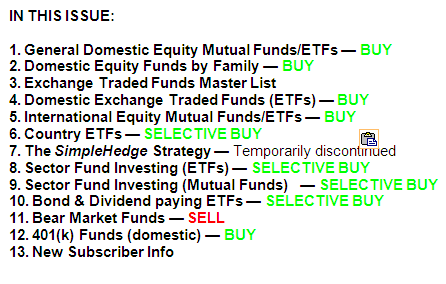
Table of Content082312

If you are not familiar with some of the terminology used, please see the Glossary of Terms.


1. DOMESTIC EQUITY MUTUAL FUNDS/ETFs: BUY — since 10/25/2011

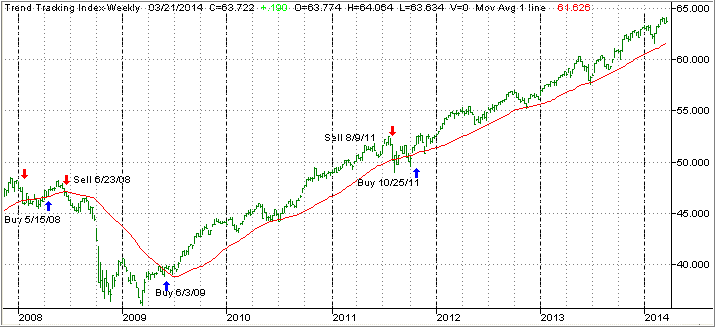
TTI

Our main directional indicator, the Domestic Trend Tracking Index (TTI), broke through its long-term trend line generating a Sell for this area effective 8/9/2011. Over the recent past, we’ve seen the TTI hovering slightly below and above this dividing line between bullish and bearish territory. The clear break to the upside occurred on 10/24/11 and, effective 10/25/11, a new Buy signal for domestic equities went into effect.

As of today, our Trend Tracking Index (TTI—green line in above chart) has bounced off its long term trend line (red) by +4.10%.

To avoid a potential whip-saw, a Sell signal to move out of all domestic equity positions will be generated once we have clearly pierced the line to the downside. Be sure to tune in for the latest updates.

Read More

Market Still Yet To Break Out Of 2014 Slump

Ulli Market Commentary Contact

Thur pic

[Chart courtesy of MarketWatch.com]

1. Moving The Markets

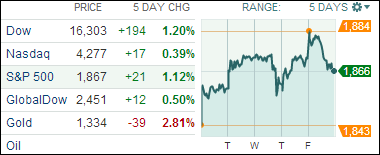
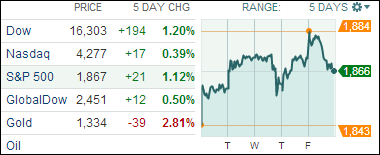
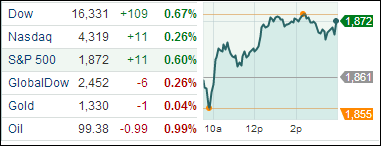
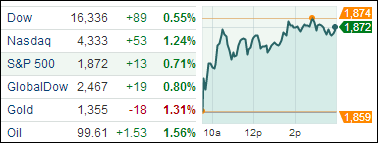
The S&P 500 index eked out a marginal gain today, while the Dow Jones Industrial Average dropped, weighed down by losses for Verizon Communications Inc. (VZ) and AT&T Inc. (T). Bed Bath & Beyond Inc. (BBBY) shares fell 12.5% after the retailer reported fiscal third-quarter earnings and trimmed its outlook late Wednesday. Macy’s Inc. (M) jumped 7.6% after the retailer said it would lay off 2,500 workers and close five underperforming stores. Family Dollar Stores Inc. (FDO) shares recouped sharp losses but still closed 2% lower after the discount retailer’s quarterly results missed expectations. Apple Inc. (AAPL) shares fell 1.3% after saying it will try to reach a settlement with Samsung on their long-running patent fight ahead of a new trial that is scheduled to begin in March in California.

While the overall market has yet to break out in 2014, there are a number of sector ETFs that have already hit new highs and appear to be ready to lead the first 2014 market rally. There are several health care-related ETFs (XLV) that are hitting new highs, led by a big surge in the biotech and pharmaceutical stocks. The financials, which often outperform during market rallies, have a couple of ETFs breaking out, and then there is the group of miscellaneous sectors attracting buyers.

In economic news, the number of Americans who applied to receive unemployment benefits in the first week of the New Year fell to the lowest level since the end of November. In the week ended Jan. 4, initial jobless claims fell by 15,000 to a seasonally adjusted 330,000, the U.S. Department of Labor said Thursday.

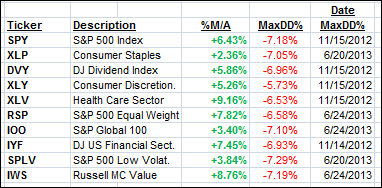
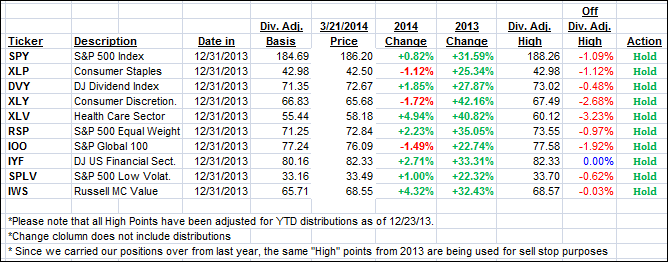
With the the sideways pattern continuing, only 2 out of our 10 ETFs in the Spotlight made new highs.

Read More

Sloppy And Choppy

Ulli Market Commentary Contact

Wed pic

[Chart courtesy of MarketWatch.com]

1. Moving The Markets

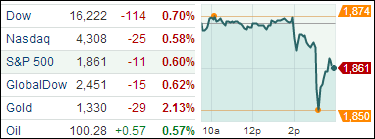
Market behavior can only be described as sloppy today after the minutes from the FOMC meeting showed, what only few analysts had assumed, that the effects of the Fed’s asset purchases have a diminishing effect over time. The general consensus had been that the recent tapering effort was supported by an improving economy.

ADP reported that 238,000 jobs were created in December, which exceeded estimates. It now remains to be seen if Friday’s US Labor Department’s employment report supports these numbers.

If they are better than expected, further tapering by the Fed could be a possibility. Combining the positive ADP numbers along with the upward revision of November numbers and recent greatly improved trade deficit data, some analysts are already making the case for a higher 2014 GDP estimate.

With the major indexes moving predominantly sideways, our 10 ETFs in the Spotlight followed suit.

Read More

Bounce Back Tuesday

Ulli Market Commentary Contact

Tue pic

[Chart courtesy of MarketWatch.com]

1. Moving The Markets

U.S. stocks rallied today, helped by data showing a smaller-than-expected trade gap and gains by health-care stocks following an upgrade for UnitedHealth Group Inc. UnitedHealth Group Inc. (UNH) +3.06%  performed best among Dow components and provided a boost to the blue-chip index after Deutsche Bank upgraded the company on Tuesday to buy from hold. Firmer overseas markets data also provided a lift, and traders absorbed largely encouraging comments from Federal Reserve officials. The U.S. trade deficit fell to $34.3 billion in November, the Commerce Department said on Tuesday. That was a steeper-than-expected drop and could signal a stronger economy.

European stocks pushed higher Tuesday after the annual rate of euro-zone inflation fell further below the European Central Bank’s target in December. That triggered some deflation concerns, but analysts also said it could put pressure on the ECB to respond with stimulus measures. Asian stocks closed mostly higher, while gold fell, but the dollar rose and oil futures snapped a five-session losing streak.

With record cold temperatures gripping a large portion of the country, the demand for natural gas has increased exponentially. Over the last month there have been some nasty cold spells that have hit everywhere from the Northeast to the South and in between. The price of natural gas is often driven by extreme weather and the current situation is no different. Considering this trend, United States Natural Gas ETF (UNG) rallied to end 2013 with a gain of 9.5 percent and has recently pulled back from a multi-month high. This is an ETF to keep an eye on as freezing temps continue.

With the major indexes heading to the upside, our 10 ETFs in the Spotlight showed some life again.

Read More

A Mixed Monday Upon Service Sector News

Ulli Market Commentary Contact

Mon pic

[Chart courtesy of MarketWatch.com]

1. Moving The Markets

U.S. equities slipped on Monday after a mixed batch of economic reports, which showed a slowdown in growth in the U.S. services sector and a rebound in new orders for factory goods. The pace of growth in the U.S. services sector slowed for a second straight month in December with business activity expanding at a lower rate and new orders contracting, according to the Institute for Supply Management. This data serves as a reminder that the U.S. economy is still battling headwinds on its road to recovery. European indices, meanwhile, finished largely lower on the day.

Leading Dow Jones Industrial Average (DJIA) performers included Goldman Sachs, up 0.70%, Verizon, up 0.63%, and JPMorgan Chase, up 0.58%. The Dow Jones Industrial Average’s (DJIA) worst performers included Microsoft, down 2.13%, Caterpillar, down 1.32%, and DuPont, down 1.24%.

Top movers in the ETF sector were (LBND) PowerShares DB 3x Long 25+ Year Treasury Bond ETN (+5.92%), (YANG) Direxion Daily China Bear 3X Shares  (+5.03%), and (DYY) PowerShares DB Commodity Double Long ETN (+4.95%). It seems as though changes in the Fed’s policy are resulting in increased activity throughout the bond ETF market.

As a political side note, the U.S. Senate is set to vote today to confirm Janet Yellen as the next chair of the Federal Reserve. Yellen, who has been the Fed’s vice chair since 2010, is poised to become the first woman to head the U.S. central bank. She is widely seen as continuing the policies set in place by Ben Bernanke, who will step down as Fed chairman at month’s end.

With the major indexes continuing their pullback, our 10 ETFs in the Spotlight followed suit. Take a look at the YTD table below.

Read More

01-06-2014

Ulli Newsletter Archives Contact

The ETF/No Load Fund Tracker

Monthly Review—December 31, 2013

US Equities End 2013 On A High; Dow Logs Biggest Gain In 18 Years

US stocks finished 2013 with a bang with the Dow Industrial Average and the S&P 500 ending the year on a record high, making sure blue chips logged their biggest annual gains since 1995.

The financial markets have been trying to front-run the US Fed around the timing and scale of tapering since the central bank first announced its intention in May and that has been the dominant theme for the markets for the rest of 2013. Equities witnessed fleeting anxious moments and bond yields surged on expectations of an imminent interest rate hike.

By the time the Fed set the ball rolling and announced in December a $10 billion reduction in asset purchases starting January 2014, markets had reconciled to the fact that a rate hike is nowhere on the horizon as the central bank pledged to keep the target Fed Funds Rate near its current levels well after the unemployment rate had fallen below 6.5 percent.

The Fed’s dovish forward guidance boosted the bond market with Treasuries nearly retracing all of their post-announcement losses. Although many market participants remain worried about a pullback they say is long overdue, equities may play out flat in January.

However, markets generally perform well in the January-May period, partly due to additional flows into retirement accounts. Also, fourth-quarter earnings are likely to exceed expectations, ensuring equities hold ground at current levels.

On the macro-economic front, data continued to be mixed in December with job creation and GDP growth continuing with their positive momentum, paving the way for higher capital spending as we go along. Data released by the Conference Board revealed the consumer confidence index advanced to 78.2 in December from a revised 72 in November.

While consumers seem to feel more optimistic after politicians made truce in Washington and the Senate passed a two-year budget agreement, eventually, an elevated confidence level will have to be supported by sustainable income growth and a robust labor market once the current euphoria has died.

The housing sector continued to mend in 2013, maintaining its overall growth momentum. The Case-Shiller home-price index for October rose 0.2 percent, indicating sustained demand.

Initial jobless benefit claims declined by 2,000 to 339,000 in the week ending December 28, the Labor Department said. Continuing claims, which shows the number of people already receiving unemployment benefits, fell by 98,000 to a seasonally adjusted 2.83 million.

The US labor market continues to heal as hiring by companies appears to pick up. The private sector added 191,000 jobs on an average through the first 11 months of 2013, the most since the economic contraction ended in mid-2009.

On the flip side, the Chicago Business Barometer, a regional gauge of business activity, dropped to 59.1 percent in December from 63 percent in the prior month. Though the decline was steeper than economists’ forecast of 61 percent, it remained above the 50 percent mark that suggests expansion.

Inflation continued to remain benign with PPI falling 0.1 percent in November. Core producer prices, which exclude volatile items, rose 0.1 for the month. Both readings matched forecasts.

The strong growth in third-quarter GDP also failed to cheer as latest data showed change in inventories accounted for 1.68% growth in economic output. The bigger-than-estimated inventory build-up is likely to be a big drag on the economy. The consensus estimate puts fourth-quarter GDP growth at less than 1 percent.

European stocks closely followed US equities in 2013. The pan-European Stoxx Europe 600 index finished the year up 17.3 percent. Among the regional indices, Germany’s DAX 30 index zoomed more than 25 percent in 2013, making it the best-performing European regional index among the major economies.

The French CAC 40 index added nearly 18 percent in 2013 while the British FTSE 100 index picked up 14 percent.

Smart money seems to agree European equities will outperform the US in 2014. A poll by Bank of America Merrill Lynch showed 43 percent of fund managers were overweight on Europe compared to just seven percent for the US.

Looking at the big picture, the major trend direction, as measured by my Domestic Trend Tracking Index (TTI) remains up, as the chart below shows:

TTI123113

The index itself (green line) still hovers above the trend line (red) by a solid +4.34% indicating strong upward momentum.

Our core holdings showed good results during 2013, although, with the benefit of hindsight, it became clear that the early leaders finished the year on the weak side. Here’s the annual comparison of our major ETF holdings:

YTDETFs

As you can see, consumer staples (XLP), green line in chart, came out like gangbusters and made its returns during the first 5 months, while the discretionary consumer section (XLY) had a slow start but a breathtaking second half of the year. All others were somewhere in between.

With XLP showing a disappointing finish, I have started to reduce our exposure to it and added some of the better performers. Most important, however, continues to be my theme that, despite the current positive economic numbers, this rally can be unraveled by a number of global events, which means that the use of our exit strategy becomes even more important as the market’s rise was predominantly caused by an accommodating Fed policy.

I’ll be on the lookout for any trend changes but, for right now, we will enjoy the ride as long as it lasts.