06-05-2014

Ulli Newsletter Archives Contact

The ETF/No Load Fund Tracker

Monthly Review—May 31, 2014

US Equities Mostly Higher In May; Europe Continues To Report Robust Gains

US equities broadly gained in May with all three leading indexes finishing higher for the month with the Dow Jones Industrial Average (DJIA) and the S&P 500 (SPX) hitting new highs.

The blue-chip Dow ended May up 2.1 percent for the month. The benchmark S&P added 2.1 percent to finish at 1,923.57.

The NASDAQ composite index picked up 3.1 percent in May to end at 4,242.62. That was the tech-heavy index’s first monthly gain since February.

Both the DJIA and the NASDAQ turned positive for the year in May.

The US economy continued to heal after logging in disappointing GDP numbers in the first quarter. The Federal Reserve’s favorite gauge for inflation – the Personal Consumption Expenditure Price – surged 1.6 percent in the 12 months through April from 1.1 percent in March, posting the biggest gain since November 2012. Higher PCEP indicates firming up of consumer demand and bodes well for the economy as consumption makes up for about 70 percent of GDP.

The Chicago-area Institute for Supply Management’s business barometer unexpectedly jumped to 65.5 from 63 in April. The May reading was a seven-month high and well above economists forecast for a monthly print of 61. Readings above 50 indicate expansion from the previous month.

Separately, the National Association for Realtors said a gauge for pending home sales rose 0.4 percent in April, marking the second consecutive gain since the slump that started last summer.

Data released by the Commerce Department showed US single-family home sales jumped 6.4 percent to an annual rate of 433,000 in April. That was higher than the 429,000 units most economists had projected and compared with the upwardly revised 407,000 reading reported for March.

Minutes from the Fed’s April meeting showed officials discussed several approaches about tightening of monetary policy going forward while acknowledging the need to improve guidance on interest rates.

The Institute for Supply Management’s manufacturing index rose to 55.4 in May from 54.9 in April. The factory output gauge rose at the fastest pace this year and was well above the initial “flash” print of 53.2.

On the downside, consumer spending fell in April as Americans spent less on utilities and cut back on car purchases. The decline was led by a 3 percent drop in spending on natural gas as the weather warmed up and nullified March’s upwardly revised 1 percent gain.

Across the Atlantic, European stocks continued to advance in May despite inflation in the 18-member euro area deteriorating during the month. The Stoxx Europe 600 index finished at 344.24, capping its monthly gain at 1.9 percent. The benchmark index has added about 5 percent since January and hit a six-year high during the month.

Annual inflation rate in Spain fell to 0.2 percent in May from 0.3 percent in April, while Italy’s inflation rate dropped to 0.4 percent from 0.5 percent. Inflation in Germany fell sharply last month, stoking speculation the European Central Bank will ease policies further when they meet on June 5. EU-harmonized annual inflation rate slumped to 0.6 percent last month from 1.1 percent in April in Europe’s largest economy.

Data released by Eurostat showed unemployment rate in the euro area fell to 11.7 percent in April from 11.8 percent in March. April’s jobless level beat forecasts of an 11.8 percent reading.

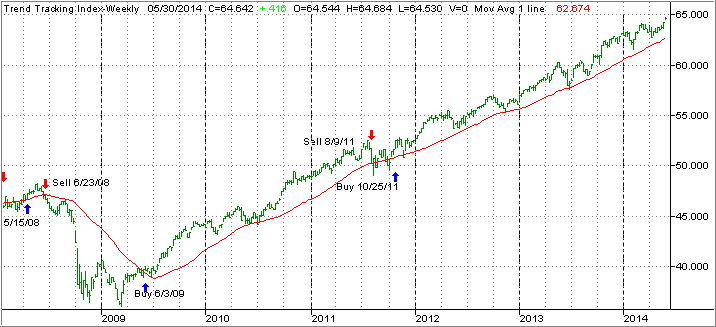
Technically speaking, our Domestic Trend Tracking Index (TTI) remains firmly entrenched in its long-term bullish pattern and actually made new highs during May as the chart below shows:
TTI0530

Market pullbacks were well contained and of short duration before the major trend reestablished itself pushing the benchmark indexes along with our TTI higher and into unchartered territory. Despite the daily onslaught of wild and opposing market predictions in the financial media, it’s best to continue the path of staying with our positions until a trend change advises us otherwise.

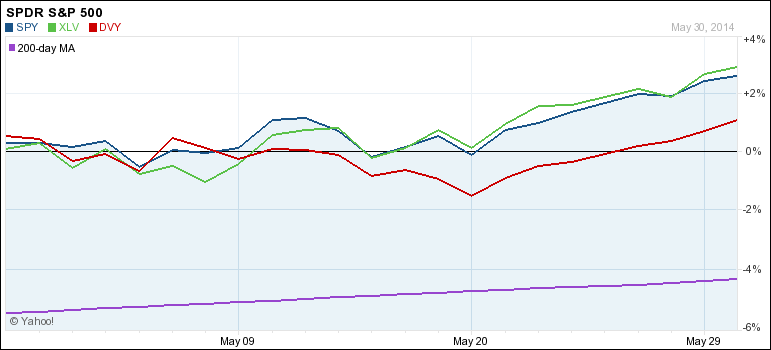
Our main holdings showed far less volatility as in the month before as you can see in the 30-day chart:
MonthlyChart

The past 30 days gave us a pretty smooth ride in that the trading ranges of the various indexes were less broad, which means we never came close to having any sell stops triggered.

The S&P 500 successfully not only conquered its 1,900 milestone marker on May 23rd  but has also managed to stay above it ever since. With earnings season being over, I think a new driver is needed to propel these markets higher; otherwise we might get stuck in a trading range again.

Of course, a pullback with unknown magnitude from these lofty levels is always a possibility, so I will be watching our sell stops closely and head for the exit doors, should the need arise.
You Can’t Keep A Good Stock Index Down

Ulli Market Commentary Contact

Wed pic

[Chart courtesy of MarketWatch.com]

1. Moving The Markets

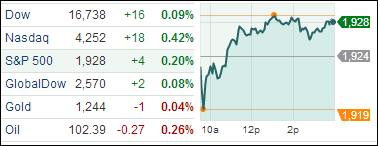
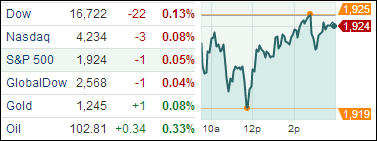
Well, stocks came roaring back today after a solemn Tuesday. The S&P 500 once again closed in record territoryas the chart above shows. The service sector was a leading gainer, as we received a report that showed U.S. service firms grew more quickly as production, hiring and new orders increased. All are interpreted as signs that the economy is accelerating after dipping at the start of the year.

Among the day’s biggest gainers were U.S. solar companies after the United States slapped new import duties on solar panels and other related products from China in a preliminary determination. First Solar (FSLR) rose 3.9% to $65.39.

While markets keep trending up, looking at some other economic numbers might keep our heads a bit more in check. The U.S. trade deficit ($47.2 bil) widened to its highest in almost two years in April as imported goods set a record; U.S. productivity declined even more rapidly than believed in the first quarter as extreme winter weather made businesses far less efficient. The path to forge ahead shall continue to be an uphill battle, needless to say, with the hope being that the GDP growth number hovers around that 2.2% mark.

Our 10 ETFs in the Spotlight improved with 5 of them making new highs today while 9 of them remain on the plus side YTD.

Read More

Equities End Winning Streak; Gold Closes Higher

Ulli Market Commentary Contact

Tue pic

[Chart courtesy of MarketWatch.com]

1. Moving The Markets

Stocks pulled back a tad, snapping a record breaking streak since last Friday. All major indexes gave back some of their recent gains. Although we saw a drop today, markets have been trending up over the past two weeks.

M&A activity regained their share of headlines, especially the recent Hillshire-Jimmy Dean-Tyson Foods-Pilgrim’s Pride bidding war. Today, Pilgrim’s Pride upped their bid for Hillshire by topping Tyson’s bid of $50/share by $10 to $60/share. Hillshire’s stock reacted positively gaining 9.5% to $58.65, while Pilgrim’s shares fell 2.2% to $25.34.

Well, I was bashing gold yesterday and, of course, as irony would have it the precious metal rose for the first time in six days today. Gold is a common safe haven that often moves in the opposite direction of general stock market trends and that was the case today it seemed as markets dropped. One good day doesn’t cover up the long term trend, which analysts still predict to be an uphill battle, especially given the uncertainties of Thursday’s ECB policy meeting and a big decline in interest rates in the futures market.

Our 10 ETFs in the Spotlight stayed pretty much even; however, 1 of them made a new high today while 9 of them remain on the plus side YTD.

Read More

Apple Fails To Impress; S&P And Dow Continue Marching Forward

Ulli Market Commentary Contact

Mon pic

[Chart courtesy of MarketWatch.com]

1. Moving The Markets

The S&P 500 and Dow both kept moving forward to new record highs today, while the Nasdaq limped to the finish line to close in the red. The S&P 500 realized its 15th record close of 2014, and the Dow posted its 6th record close of the year.

There was a folly in the Manufacturing Index released by the Institute for Supply Management that caused a slight shock in the Dow. The index reported an unexpected drop to 53.2 in May, but actually had improved to 55.4, up from 54.9. The correction shortly thereafter eased sudden concerns about the economy and the Dow climbed back up accordingly.

While the S&P and Dow kept trending upwards, things were not so fruitful for the Nasdaq today. Big names like Amazon (AMZN), Biogen (BIIB), Google (GOOG) and Tesla (TSLA) all were a drag on the index. Even Apple (AAPL), after unveiling new operating systems for their computers, phones and tablets, couldn’t impress investors enough to post gains on the day. The stock fell $4.35 to $628.65.

Meanwhile, gold prices still continues to trend downwards, dropping 0.2% to $1,243/oz. The metal has been slowly moving away from its 2014 high of almost $1,400/oz. and has not shown any apparent signs of regaining momentum.

Our 10 ETFs in the Spotlight went predominantly sideways; however, 4 of them made new highs today while 9 of them remain on the plus side YTD.

Read More

ETFs/Mutual Funds On The Cutline – Updated Through 05/30/2014

Ulli ETFs on the Cutline Contact

Below are the latest ETF Cutline reports, which show how far above or below their respective long-term trend lines (39 week SMA) my currently tracked ETFs/MFs are positioned.

The first report covers the ETF Master List from Thursday’s StatSheet and includes 398 ETFs, of which currently 362 (last week 359) are hovering in bullish territory.

The second report includes only High Volume ETFs. To clarify, High Volume (HV) ETFs are defined as those with an average daily volume of $10 million or higher.

These ETFs are generated from my selected list of some 97 that I use in my advisor practice. It cuts out the “noise,” which simply means it eliminates those ETFs that I would never buy because of their volume limitations. 82 ETFs (last week 81) have managed to remain in bullish territory after the recent market volatility.

The third report covers Mutual Funds on the Cutline. There are currently 625 (last week 591) above the line and 224 below it out of the 859 that I follow.

Take a look:

1. ETF Master Cutline Report     

2. ETF High Volume Cutline Report

3. MF Cutline Report

In case you are not familiar with some of the terminology used in the reports, please read the Glossary of Terms.

If you missed the original post about the Cutline approach, you can read it here.

One Man’s Opinion: Will The European Central Bank Be Extraordinarily Aggressive?

Ulli Market Review Contact

92835431There are a series of factors that are driving the current rally in the US bond markets though the main one that has been apparent for a long time and driving the market is the incredible amount of liquidity, said Rick Reider, co-head of America’s fixed income at BlackRock Inc.

Some of the reasons include a rush to safety due to geopolitical tensions in Russia and the Fed advancing gradually with tightening, because America’s economic data points are going to improve slowly. However, the most significant reason is, and investors often tend to miss it, the yield difference between US Treasuries and German and Japanese 10-year govt. bonds. US Treasuries at about 2.5 percent look attractive compared with Germany’s 1.4 percent or Japan’s 1.6 percent. Given the amount of liquidity in the market, owning some duration is actually good, he explained.

Asked how long the relative value could persist, Rick said the dynamic currently at play is not only extraordinary, but truly historic. There is a situation where European Central Bank President Mario Draghi is going to be extraordinarily aggressive, which is going to drive into bond yield spreads; and then there is an aggressive Bank of Japan which could potentially be more aggressive going forward. As long as those stimuli are in place, Treasuries could drift higher and the yield volatility could be profound, he said.

Read More