Equities Bounce Aimlessly; European Central Bank May Cut Interest Rates

Ulli Market Commentary Contact

Thur pic

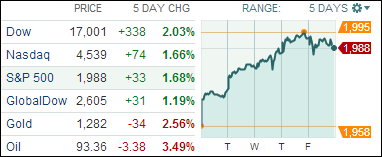
[Chart courtesy of MarketWatch.com]

1. Moving The Markets

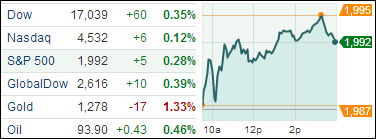
There was not much movement up or down in the U.S. equity markets today. Both the S&P 500 and the Nasdaq closed slightly in the red zone, while the Dow managed to squeeze out some positive gains. Utilities and technology companies led sector losses. The trend continues to be investors selling out of big growth and momentum stocks and moving into less risky value stocks.

Keurig Green Mountain and Twenty-First Century Fox were among the winners after reporting earnings, while electric carmaker Tesla slumped. Tesla Motors (TSLA) fell $19.72, or 9.8%, to $181.67, after the company reported a $49.8 million first-quarter loss late Wednesday and said that reinvestment in the company would weigh on earnings later this year.

In Europe, European Central Bank President Mario Draghi said today that the ECB is ready to cut interest rates next month if needed and expressed concern about the euro’s exchange rate. There seems to be a growing assumption amongst international investors that the ECB is going to start a quantitative easing program. Thus, we have seen more and more investors pouring cash into the euro-area bond markets amid optimism the ECB will step in to support the debt.

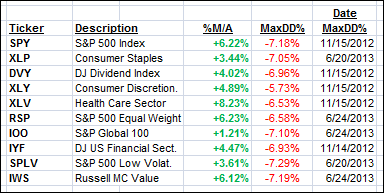
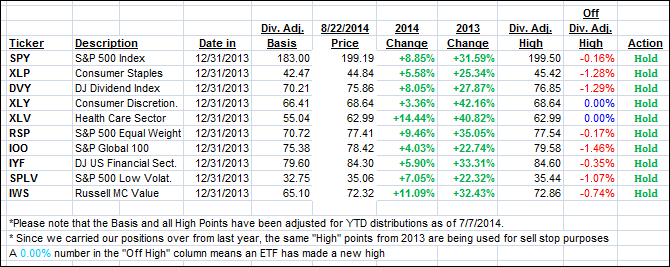
Our 10 ETFs in the Spotlight went sideways with one of them making a new high; 9 of them remain on the plus side YTD.

Read More

Markets Bounce Higher; Responding Well To Yellen’s Speech

Ulli Market Commentary Contact

Wed pic

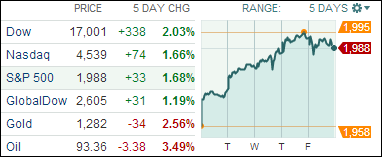
[Chart courtesy of MarketWatch.com]

1. Moving The Markets

Wednesday was a rather uneventful day across the board with the S&P 500 and Dow climbing and the Nasdaq stumbling. Tech stocks continued to fall out of favor as worries of overvaluation continue to be the culprit. A number of Nasdaq listed stocks have taken quite a beating over the past two weeks, thus it comes as no surprise that Twitter (TWTR), AOL (AOL), GroupOn (GRPN), Zullily (ZU) and FireEye (FEYE) are all down more than 20% in the last two days.

On the positive, investors were receptive to Janet Yellen’s speech today, wherein she told the Joint Economic Committee of Congress that a tough job market and weak inflation meant that the Fed will likely keep borrowing rates low for a “considerable time.” Thus, the economy will still need the Fed’s help.

In tech news, Yahoo’s (YHOO) stock dropped 6.6% today, which came as a surprise in that Yahoo is one of the largest shareholders of Chinese e-commerce giant Alibaba, which filed Tuesday its much-anticipated plans to sell shares in what could be one of the biggest initial public offerings ever.

And finally, Ford Motors (F) announced today that it will buy back about 116 million shares of company stock worth about $1.8 billion. The Michigan-based automaker says the buybacks will help offset potential dilution from convertible debt and stock-based compensation for employees. The stocked closed the day up 1%.

Our 10 ETFs in the Spotlight recovered nicely with one of them making a new high; 9 of them remain on the plus side YTD.

Read More

A Pullback Tuesday For The Markets

Ulli Market Commentary Contact

Tue pic

[Chart courtesy of MarketWatch.com]

1. Moving The Markets

Markets took a hit today, a day after the Dow and S&P 500 closed near record highs. The Nasdaq took the largest hit, while the S&P and Dow dropped dropped by lesser percentages. Again, we see the Nasdaq, which is filled with those big momentum social media and tech stocks, showing the highest sensitivity to market volatilities.

Twitter (TWTR) shares led the plunge, officially hitting a new low as company insiders became eligible to sell their stock today as their “lock-up” period ended. Under federal securities law, company founders and executives must wait six months before selling any shares following an initial public offering. Netflix (NFLX), TripAdvisor (TRIP) and Amazon (AMZN) all took a beating as well today, while Target (TGT) shares continued to tumble following the exit of their CEO yesterday. In short, it was not a good day for the big momentum stocks that have captured so many headlines so far this year.

In more positive news, I saw a report today that the U.S. trade deficit narrowed in March as exports rose to the second highest level on record. Sales of aircraft, autos and farm goods were the big leaders. The deficit declined to $40.4 billion, down 3.6 percent from a revised February imbalance of $41.9 billion.

Our 10 ETFs in the Spotlight slipped with 8 of them remaining on the plus side YTD.

Read More

A Shaky Morning, But Markets Recover In Afternoon Trading

Ulli Market Commentary Contact

Mon pic

[Chart courtesy of MarketWatch.com]

1. Moving The Markets

Stocks rebounded today after a shaky start this morning. All three major indexes finished in positive territory, with the Nasdaq leading the way up as the chart above shows. Earnings season is winding down, but Target (TGT) announced today that their CEO, Gregg Steinhafel, has resigned from the position effective immediately and turned over the reins to CFO John Mulligan. Shares dropped 3% today on the news. Many across the U.S. were calling for Steinhafel’s resignation shortly after the data breach that occurred during the holiday season. It shall be interesting to see who will be willing to step into the “hot seat” as CEO.

Apple (AAPL) regained ground today as its shares closed above the $600 mark for the first time since October of 2012. The stock has been performing relatively well since the company recently announced that a 7-for-1 stock split will take effect in early June.

European markets finished lower amidst continued worries over tensions in Ukraine, and Asian markets ended the day in mixed fashion as China reported contracting monthly manufacturing numbers.

Our 10 ETFs in the Spotlight inched higher, although no new highs were made new highs and 9 of them remain on the plus side YTD.

Read More

04-30-2014

Ulli Newsletter Archives Contact

The ETF/No Load Fund Tracker

Monthly Review—April 30, 2014

US Stocks Show Mixed Gains In April; Europe Fares Better

US equity indexes showed a mixed picture in April with the blue-chip Dow Jones Industrial Average and the benchmark S&P 500 heading higher.

The DJIA hit a record high for the first time this year while the S&P 500 staged only a modest advance. The Dow finished the month up 0.75 percent while the S&P 500 added 0.6%. The Nasdaq bucked the trend and lost 2%.

The US jobs market made a strong comeback in April after losing steam in the first-quarter due to unusually cold weather conditions. Data released by the Labor Department showed the economy added 288,000 jobs in April, marking the best monthly gain since January 2012. The unemployment rate dropped to 6.3 percent, the lowest since September 2008.

The labor participation rate slumped to 62.8 percent in April from 63.2 percent the prior month, matching a 35-year low. The government attributed the decline in participation rate to fewer people entering the workforce, rather than more people leaving the labor force.

The US Fed cut its monthly assets purchase program by another $10 billion to $45 billion, as was widely expected.

The consumer sentiment index rose to a final reading of 84.1 in April from 80.0 the prior month. That was the most since July and well above the 82.8 reading economists had predicted.

The Chicago business barometer revealed the Chicago purchasing managers’ index rose to 63.0 in April from 55.9 in March, marking the fastest gain in six months. Production and new orders rose sharply, indicating the economy is getting its momentum back.

Separately, a gauge for pending-home sales rose 3.4 percent in March, the most in three months, the National Association of Realtors said. That was also the first gain in nine months, indicating the decline in sales of existing homes may have found a bottom.

On the downside, growth in the first quarter nearly ground to a halt, brought about by one of the worst winters in years. GDP grew at a dismal 0.1 percent annual pace from January through March, marking the weakest performance in three years. Most economists had called for a seasonally-adjusted 1 percent increase from a 2.6 percent rise in the final three months of 2013.

Separately, data showed single-family home sales dropped by a steep 14.5 percent to a 384,000 annual pace in March, missing forecasts of an annualized gain of 450,000. That was the worst number since July last year.

Across the Atlantic, European stocks broadly tracked US equities though tensions between Russia and Ukraine continue to cloud sentiment. The pan-European Stoxx Europe 600 added 1.1 percent for April.

The constant threat of a deflationary spiral across the 18-member currency region eased somewhat as April inflation edged higher to 0.7 percent from a near four-year low of 0.5 percent in March. Inflation remained below 1 percent for the seventh month in a row.

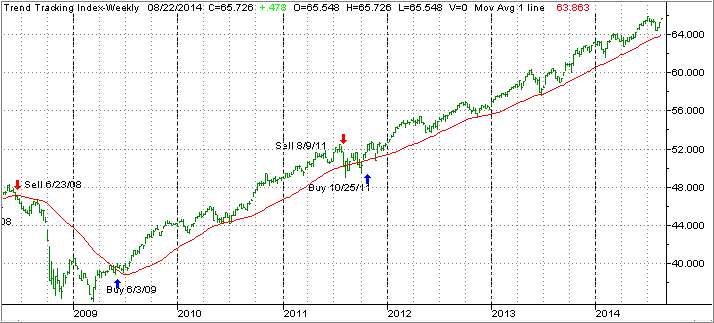
Now to the technicals: Our main directional indicator, the Domestic Trend Tracking Index (TTI), remains off its February highs but is still positioned above its long term trend line:

TTI0430

The index itself (green line) now hovers above the trend line (red) by +2.41% (last month +2.91%).

Despite the volatility in April, with the S&P 500 swinging wildly between a low of 1,816 and a high of 1,889, a spread of 73 points, none of our trailing sell stops were affected during the race to the low side. That means we will continue to hold all positions subject to their respective sell stops.

Let’s now hone into the actual volatility that out current main holdings experienced during April, which is shown in the 30-day chart below:

Monthly Chart

XLV (Healthcare) took the biggest hit but recovered nicely before its sell stop was triggered. In the end, XLV now shows a YTD gain of +5.19%, which puts in second place. Leading the pack is the DJ Divided Index (DVY), which was the most stable of this trio and leads YTD with +5.77%. The S&P 500 (SPY) hovered in the middle in regards to volatility and sports a gain of +2.41% YTD.

With the S&P 500 nibbling at its historical 1,900 level, pullbacks and rallies will continue to be part of the investing landscape. You’ll never know what might push the index above and how long that kind of a breakout might last.

Yet, at the same time, the danger of a serious pullback is ever present, and we need to be prepared to deal with either scenario. To my way of thinking, the only true measure is the long-term trend which, when combined with our trailing sell stop discipline, should limit our downside risk in the event the bears gain the upper hand again.

Right now, the major trend remains bullish, and we will stay onboard and ride it as long as it lasts.

ETFs/Mutual Funds On The Cutline – Updated Through 05/02/2014

Ulli ETFs on the Cutline Contact

Below are the latest ETF Cutline reports, which show how far above or below their respective long-term trend lines (39 week SMA) my currently tracked ETFs/MFs are positioned.

The first report covers the ETF Master List from Thursday’s StatSheet and includes 398 ETFs, of which currently 360 (last week 351) are hovering in bullish territory.

The second report includes only High Volume ETFs. To clarify, High Volume (HV) ETFs are defined as those with an average daily volume of $10 million or higher.

These ETFs are generated from my selected list of some 97 that I use in my advisor practice. It cuts out the “noise,” which simply means it eliminates those ETFs that I would never buy because of their volume limitations. 81 ETFs (last week 77) have managed to remain in bullish territory after the recent market volatility.

The third report covers Mutual Funds on the Cutline. There are currently 658 (last week 601) above the line and 191 below it out of the 859 that I follow.

Take a look:

1. ETF Master Cutline Report     

2. ETF High Volume Cutline Report

3. MF Cutline Report

In case you are not familiar with some of the terminology used in the reports, please read the Glossary of Terms.

If you missed the original post about the Cutline approach, you can read it here.