Equities Get Spanked In Worldwide Rout—Trend Tracking Indexes (TTIs) Slip Into Bear Market Territory

Ulli Market Commentary Contact

Thur pic

[Chart courtesy of MarketWatch.com]

1. Moving the Markets

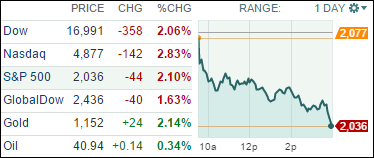
It was a sea of red numbers crashing on world equities as Wall Street notched a third straight day of losses with the Dow plunging 358 points.  When the markets closed today, the Dow sat below 17,000 for the first time since Oct. 29 last year.

Fear is still percolating throughout the marketplace due to the losses and negative feel about markets globally. The closely watched Wall Street “fear gauge,” dubbed the VIX, is up nearly 20% today to 18.19, its highest level since July 9, but still well below its 52-week peak of 31.06 back on Oct. 15.

Crude did not perform well today either. A barrel of U.S. based crude flirted with falling below the $40 per barrel mark today for the first time since early 2009, which marks a fresh 6-1/2 year low. Crude is being pressured by data showing a bigger weekly inventory build in the U.S., continued oversupply and concerns about slowing growth in China.

None of our 10 ETFs in the Spotlight were able to overcome the worldwide bearishness, so all closed in the red. Leading to the downside was Healthcare (XLV) with -2.32% with Consumer Staples (XLP) showing the most resistance with a modest loss of -0.91%.

Our Trend Tracking Indexes (TTIs) broke their trend lines to the downside confirming the “Sell” signal for the International one. The Domestic one is in alert mode. Please see section 3 below for details.
Read More

Fed Fed Fed Was All The News Today

Ulli Market Commentary Contact

Wed pic

[Chart courtesy of MarketWatch.com]

1. Moving the Markets

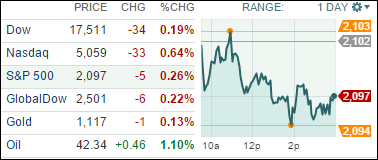
The ticking sounds of the countdown clock to the Fed’s interest rate hike are getting louder it seems. The stock market closed lower today after minutes from the Fed’s last policy meeting showed the central bank was “approaching” its first rate hike in nearly a decade. Rates near 0% and cheap borrowing costs have helped the real estate sector and greater economy heal over the past decade.

However, much of the policy speculation has depended on improvement in the labor markets and inflation moving back to its 2% mandate. The labor market has improved, but inflation remains tame. Consumer price level in July, for example, grew only 0.01%, which was below its forecast. Then there are stumbling oil prices and the devaluation of the Renminbi…

Oil prices have continued to slide, which is deflationary for the USD and China devaluing its currency sent yellow flags up about the state of the world’s second largest economy.

Let’s keep one eye on the domestic housing market indexes as we move towards the end of the week, as well as what the reactions will be on the Fed and China policy over the next couple of trading days. If it any more slippage occurs, we may very well enter bear market territory and exit our equity positions. Please see section 3 below for the current status.

All of our 10 ETFs in the Spotlight headed south today as bearish forces were too strong to overcome. Still, Consumer Discretionaries (XLY) held up the best by surrendering only -0.18%, while the Mid-Cap Value (IWS) fared the worst by giving back -0.93%.

Read More

Markets Still Moving Sideways; Housing Continues To Perform

Ulli Market Commentary Contact

Tue pic

[Chart courtesy of MarketWatch.com]

1. Moving the Markets

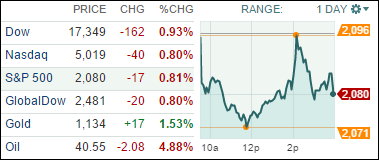
Equities closed lower today after a big earnings miss from Walmart (WMT) and continued concerns over China’s capital markets. All three major indexes here in the U.S. lost and gave back some of Monday’s gains.

Investors were cautious in their trading all day after Walmart reported adjusted quarterly earnings of $1.08, which was four cents short of analyst estimates. The company reduced its outlook for the remainder of the year and shares dropped about 3.4% on the day, which was the biggest loser for the Dow.

Weighing heavily on investors’ minds today was the 6.2% drop in China’s Shanghai Composite index. The index has been extremely volatile as of late, dropping more than 8.5% in a single day just a few weeks ago. The government injected USD $19 billion into the markets to prop up stocks, but investors are weary that this type of intervention may be less supportive of the equity markets moving forward.

The bright spot here at home were home builder stocks. As the real estate rebound continues, investors have remained bullish on housing-related stocks and those have continued to perform. Also, Home Depot (HD) gained 3% after reporting a 5.7% increase in same-store sales.

8 of our 10 ETFs in the Spotlight joined the bears and headed south led by Consumer Staples (XLP) with -0.50%, while Consumer Discretionaries (XLY) bucked the trend and gained +0.09%.

Read More

Equities Rebound From Early Drop

Ulli Market Commentary Contact

Mon pic

[Chart courtesy of MarketWatch.com]

1. Moving the Markets

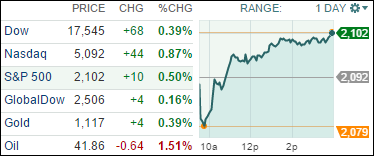
The major indexes overcame an early drop, with the S&P 500 visiting the 2,079 level, at which point the bulls took over and managed to push the index back above the 2,100 mark.

Homebuilders were the leaders, although volume was extremely light with anxiety being present about the intentions of the Fed as to their stance on interest rates. We continue to be stuck in a tight trading range and need some sort of driver to provide new upside momentum.

Concerns about China have eased somewhat so the focus has been on the economy and what the Fed might or might not do. If they decide to become more transparent in their intentions, we most likely will see an immediate market reaction. Should the Fed indicate that a rate hike for September is unlikely, whatever obscure language they might use to come to that conclusion, we could see the top of the trading range (around 2,130 for the S&P 500) being taken out with the next target being the 2,050 level.

All of our 10 ETFs in the Spotlight managed to close up with Healthcare (XLV) taking the lead by gaining +1.01%. Lagging today was Consumer Staples (XLP), which eked out a meager +0.10%.

Read More

ETFs/Mutual Funds On The Cutline – Updated Through 08/14/2015

Ulli ETFs on the Cutline Contact

Below are the latest ETF Cutline reports, which show how far above or below their respective long-term trend lines (39 week SMA) my currently tracked ETFs/MFs are positioned.

The first report covers the ETF Master List from Thursday’s StatSheet and includes 410 ETFs, of which currently 152 (last week 143) are hovering in bullish territory.

The second report includes only High Volume ETFs. To clarify, High Volume (HV) ETFs are defined as those with an average daily volume of $10 million or higher.

These ETFs are generated from my selected list of some 97 that I use in my advisor practice. It cuts out the “noise,” which simply means it eliminates those ETFs that I would never buy because of their volume limitations. 24 ETFs (last week 24) have managed to remain in bullish territory after the recent market volatility.

The third report covers Mutual Funds on the Cutline. There are currently 367 (last week 314) above the line and 453 below it out of the 820 that I follow.

Take a look:

  1. ETF Master Cutline Report
  2. ETF High Volume Cutline Report
  3. MF Cutline Report

In case you are not familiar with some of the terminology used in the reports, please read the Glossary of Terms.

If you missed the original post about the Cutline approach, you can read it here.

One Man’s Opionion: Will The Fed Delay The Rate Hike To Avoid Importing Deflation From China?

Ulli Market Review Contact

ManThe recent devaluation of the Chinese Yuan is a reason for worry because it’s a huge event, said Joachim Fels, global economic advisor at PIMCO. Two major economies, the US and China were willing to let their currencies appreciate, which allowed the rest of the world to export their deflation. Since China just decided to jump ship, Beijing’s own deflationary pressure will now start to weigh on the rest of the world, which is a reason for worry, he noted.

Asked how far the People’s Bank of China will let the Yuan fly, Joe said till now the PBOC has allowed the currency to depreciate 4.5 percent, but the buck doesn’t stop there. The PBOC is likely to allow about 10 percent depreciation for the Yuan, he observed.

Asked if 10 percent depreciation is realistic, despite the PBOC publicly dismissing such steep cut as overblown, Joe answered in affirmative. Markets are pushing the Chinese currency lower although the PBOC, for obvious reasons, doesn’t want to be seen to be encouraging that move. They are trying to stem against it and making efforts to make it smoother. However, China would require a weaker currency eventually, because its exports and the overall economy have been sagging, which explain the latest currency slide, he argued.

Read More