When Bad News Is Good News And Good News Is Great News

Ulli Market Commentary Contact

Tue pic

[Chart courtesy of MarketWatch.com]

1. Moving the Markets

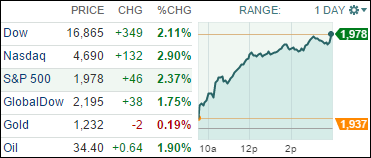
As I was scanning the early news on MarketWatch, I cam across the headline “Wall Street gains as weak data spurs stimulus,” which was later removed and replaced with “Wall Street surges as data points to economic recovery” confirming that according to MSM bad news is good news and good news can be great news—all at the same time.

However, nothing mattered, despite the worst global macro data in some 4 years as timely verbal assists about possible interventions from ECBs Draghi and NY Fed President Dudley lit some fire under the major indexes.

That was enough and March came in like a bull in a China shop for with U.S. stocks up sharply adding fuel to an early rally on China’s latest stimulus move. All major indexes gained more than 2.1%.

The initial boost came after China freed more money for lending by lowering the amount commercial lenders must hold in reserve in a move to shore up slowing economic growth. I can’t see how this would be a good thing given the massive amounts of non-performing loans in the system other than to lift the stock markets temporarily.

Domestically, bank and tech stocks led the charge. Bank of America (BAC) rose 5% to $13.15 and JPMorgan Chase (JPM) gained 4.3% percent, to $58.72, pacing the gains among financial stocks.

Shares of Valeant (VRX) took a hit today. The company is under investigation from the SEC, but they are denying suggestions from a short-seller that they used Philidor and other specialty pharmacies to commit accounting fraud.

Read More

Dow Is Only Index To Stay Above Water In February

Ulli Market Commentary Contact

Mon pic

[Chart courtesy of MarketWatch.com]

1. Moving the Markets

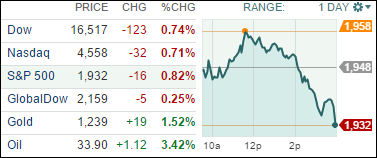
U.S. stocks ended February on a sour note as oil prices rose and “the” meeting of G20 finance officials ended without pledges for joint action to stimulate sagging global economic growth. As I mentioned on Friday, chances are great that useless jawboning without concrete results or resolutions is as good as it gets.

The weak end to February resulted in a mixed bag in terms of the performance of the three big U.S. stock indexes. The Dow did the best for the month, rising 0.3%. The S&P was next, down 0.4%. The Nasdaq brought up the rear, falling 1.2% for February.

Finance ministers and central bankers from the Group of 20 of the world’s biggest economies said they would use “all tools” at their disposal to bolster weak global growth at a meeting in Shanghai on Saturday. They also vowed not devalue their currencies to boost exports. Sure, I won’t hold my breath for that one.

Again, most of February’s rally was short covering, which turned out to be longest uninterrupted cover streak in some 2 years. We’ll now have to wait and see if this rebound off the February lows actually has legs or if we’re close to heading back south. The latter would be my best guess for the day.

Read More

ETFs/Mutual Funds On The Cutline – Updated Through 02/26/2016

Ulli ETFs on the Cutline Contact

Below are the latest ETF Cutline reports, which show how far above or below their respective long-term trend lines (39 week SMA) my currently tracked ETFs/MFs are positioned.

The first report covers the ETF Master List from Thursday’s StatSheet and includes 381 ETFs, of which currently 55 (last week 48) are hovering in bullish territory.

The second report includes only High Volume ETFs. To clarify, High Volume (HV) ETFs are defined as those with an average daily volume of $10 million or higher. Volume figures can change in a hurry, so be sure to check first before investing.

These ETFs are generated from my selected list of 98 that I use in my advisor practice. It cuts out the “noise,” which simply means it eliminates those ETFs that I would never buy because of their volume limitations. 13 ETFs (last week 12) have managed to remain in bullish territory after the recent market volatility.

The third report covers Mutual Funds on the Cutline. There are currently 32 (last week 29) above the line and 748 below it out of the 780 that I follow.

Take a look:

  1. ETF Master Cutline Report
  2. ETF High Volume Cutline Report
  3. MF Cutline Report

In case you are not familiar with some of the terminology used in the reports, please read the Glossary of Terms.

If you missed the original post about the Cutline approach, you can read it here.

One Man’s Opinion: Does A Strong Labor Market In The US Mitigate Recession Risks?

Ulli Market Review Contact

Man

Recessionary fears in the US are a little overworked, said Doug Gordon, Senior Portfolio Manager for Tactical Asset Allocation Strategies at Russell Investments. Recessionary fears were justified may be two months ago, but the strength of the US labor market including the strong payroll gains in the past three months and comparatively lower weekly unemployment claims numbers indicate resilience.

To the extent the unemployment problem is solved, the labor market supports a more resilient consumer in the United States, which can backstop and mitigate some of the recessionary risks.

Russell Investments thinks that paints a relatively low recessionary probability in the US, which was also echoed by Federal Reserve officials James Bullard recently. While the Fed pushes its data driven argument for rate rises, the Fed officials admitted they didn’t see high risks of a recession in the US, he added.

Read More

New ETFs On The Block: Market Vectors Generic Drugs ETF (GNRX)

Ulli Pharmaceutical ETFs Contact

91551519Breakthrough drugs generally attract investors’ attention in the pharmaceutical industry although generics make up bulk of the sales in most geographics. Average life expectancy is rising, thanks to the wonders of modern pharmacology, and pushing consumers toward generic versions of expensive brands for cost reasons.
While exchange traded funds tracking the broader healthcare sector have become increasingly refined, nobody really put their focus strictly on the generics industry.

Market Vectors, the ETF arm of fund manager Van Eck Global, recently put the records straight by rolling out the first ETF targeting global manufacturers of generics and biosimilars.

The newly launched Market Vectors Generic Drugs ETF (GNRX) may appeal to investors that believe rising healthcare costs will increase public support for cheaper options to brand name drugs.

Read More

ETF/No Load Fund Tracker Newsletter For February 26, 2016

Ulli ETF Tracker Contact

ETF/No Load Fund Tracker StatSheet

————————————————————-

https://theetfbully.com/2016/02/weekly-statsheet-for-the-etfno-load-fund-tracker-newsletter-updated-through-02252016/

————————————————————

Market Commentary

SECOND STRAIGHT WEEK OF GAINS UPON CALM FRIDAY

Fri pic

[Chart courtesy of MarketWatch.com]

1. Moving the Markets

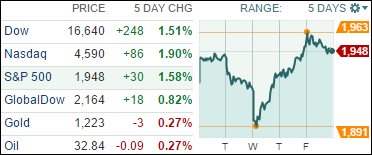
U.S. stocks ended mixed but posted a second straight week of gains Friday as oil prices basically held steady, China’s top central banker eased market fears and a report on U.S. economic growth showed the economy wasn’t quite as weak in the fourth quarter as previously thought (GDP revised from 0.7% vs. 1.0%).

Shares of Herbalife (HLF) rose sharply Friday after the embattled multi-level marketer of nutritional supplements disclosed it is in talks with the Federal Trade Commission to resolve an investigation of its marketing practices. The Los Angeles-based company’s stock closed 20.52% higher at $55.15.

Shares in Weight Watchers (WTW) went on a “diet” Friday, falling $4.54, or 29%, to close at $11.01 after the diet company said it expects a quarterly loss. Of course, Oprah was one of the biggest losers. Winfrey, the entertainment superstar, saw her massive, nearly 6.4 million-share stake in Weight Watchers shrink by almost $29 million.

Investors will be closely watching the G20 meeting of the world’s 20 major economies in Shanghai, where global leaders will discuss ways to jump-start weak economic growth around the world. As we’ve seen in the past, much jawboning will be going on very likely without any tangible results. Will this time be different?

Read More